
The city of Athens can boast of the multitude of saints it has raised over the centuries. In particular, he should be proud of the holy Hieromartyr Dionysius the Areopagite, who is counted among the great Fathers and Hierarchs of our Church.
He was born in Athens around 10 BC and came from an illustrious Athenian family, which took care to educate him in the great philosophical schools of the kleinos asteos, which, like the whole of Greece, was at that time subject to the Romans, but maintained even its glory, having some privileges, with the most important being the function of the Supreme Court. Dionysios studied philosophy and became an elite member of Athenian society. In fact, he was given the position of one of the nine members of the Supreme Court.
Although he lived in an "idolatrous" city, where idolatry had corrupted the morals of the inhabitants in his time, he lived wisely and cultivated his innate virtues. He lived like a Christian before he became a Christian. Everyone admired and respected him, because in the performance of his duties he did justice.
Around 33 AD he went to Heliopolis, Egypt for higher studies. One spring noon he suddenly saw the sun go out, a thick veil of darkness covering the whole earth and a powerful earthquake shook it. Our God-Man Redeemer was suffering in Palestine, and for that reason the entire creation was shaken. The pious Dionysios was surprised by the supernatural event and exclaimed: "Either God suffers them, or everything is lost"! In fact, he noted the date, the day and the time when the shocking event took place, which was deeply engraved in his soul and demanded an explanation.
After completing his studies he returned to Athens again, in the position of Areopagite, administering justice. About AD 49 there came to Athens a strange fiery preacher of a new religion. It was the apostle Paul, who was invited by the Athenians to develop his "spermologies" from the platform of the Supreme Court. There the great apostle announced to the Athenians the "Unknown God" whom they adored, although they ignored him. Among his listeners was the Areopagite Dionysius. Certainly, the immediate effect of that wonderful sermon was meager. Only Dionysius, a woman Damaris and a few others believed, as the book of the Acts of the Apostles tells us.
The preaching of the Apostle of the Gentiles made a strong impression on the pious Dionysius, the word of God was accepted and began to bear fruit in his good soul. So he invited Paul to his home where he asked to learn more about the new faith. When Paul told him the shocking events of the Passion, he remembered the supernatural events he experienced in Egypt. So it was confirmed that the God who suffered was Christ, the only true God. He immediately asked Paul to be baptized, together with his family. This decision of his led many other Athenians to deny the pagan religion and to be baptized, thus forming the first church of Athens, with its first bishop being Saint Ierotheos, a pious Athenian.
Dionysios dedicated himself soul and body to the Church of Christ. Now the virtues he experienced were not theoretical schemes, but the evangelical law. In fact, after the death of Saint Hierotheos, the Athenian Christians demanded that Dionysios be ordained as their bishop. As bishop of the brilliant Athens
he worked zealously for the development of the local church. Within a few years he converted multitudes of pagans to the new faith.
According to tradition, he went to Jerusalem to meet and adore the Mother of the Lord. He then preached in many countries and then returned to Athens again. During the Ascension of the Virgin, he too caught in the clouds, like the holy apostles and attended her funeral.
After shepherding the episcopal throne of Athens for many years, he felt that he should continue the rest of his life as a missionary. He went to the West and settled in Paris, built a small church, where he made it the center of his mission. He preached with fervor and zeal to the pagans of the region, where many were abandoning idols and embracing faith in Christ, establishing and consolidating a strong church in the heart of Europe.
But in those years the terrible persecutions against Christians by the pagan Romans were in full swing. Thousands of believers were arrested, tortured and killed in the most horrific and painful ways. The action of the holy bishop of Paris became known to the Roman authorities, he was denounced by the wretched unscrupulous pagan druid priests, who, among other things, performed thousands of human sacrifices per year to their bloodthirsty demonic "gods". He was denounced to the emperor Dometian (82-96), that he refuses to respect the emperor and worship the "gods" of the empire, inciting the citizens to do the same. He was arrested and dragged as a prisoner to the local commander, who tried at first by flattery and then by threats to deny his faith. Dionysius, with unprecedented heroism and recklessness, civilized his pagan faith, which worships "gods" who are beastly, criminal and immoral.
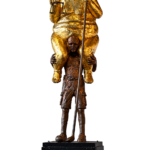
After his brave confession, his death sentence was decided. Be beheaded along with his heroic followers Rustikos and Eleftherios. But after they cut off his honest head, the unexpected happened: The headless saint bent down, took his head in his hands and walked two miles, filling his captors with admiration. He met a pious woman named Catoula, to whom he gave his head. She took care of the burial of Dionysios, as well as the other two Martyrs, near Paris. His honorable chariot is today in the Holy Monastery of Dochiari on Mount Athos.
The Memory of Saint Dionysios, together with the other two Martyrs, is celebrated on October 3rd.
In the name of Saint Dionysios, they appeared on the 5thο X century AD well-studied writings of the highest theological value, which many attribute to another author. These are the famous "Areopagite Writings", which formed the basis of the mystical Theology of our Church.
photo https://www.imchiou.gr/