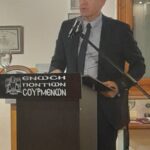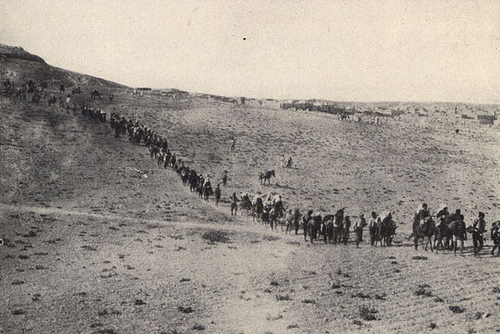
From the speech at the event on the Genocide, an event organized by the Panpontian Federation of the USA-Canada in Agios Nikolaos in Grounds Zero. New York May 19, 2026.
I feel moved for many reasons because I am here in this charged space, where violence and death momentarily defeated politics and life, but ultimately the struggle, the Resurrection, prevailed over silence, denial, and the Crucifixion.
The struggle we have waged and are waging for the recognition of the Genocide of our ancestors has had, is having, and will have results. Exactly twenty-five years ago, the internationalization struggle began when we received the first recognition from the governor of New York, and since then, despite the obstacles and difficulties, we have achieved a great deal. For the recognition of the crime of Genocide, for the exiles, persecutions, massacres, the barbarity that Hellenism suffered from the coasts of Ionia to Cappadocia and from Thrace to Pontus, for the planned, planned attempt to eliminate the Greek nation. For the organized plan that constitutes Genocide both in form and in substance (without limitation no matter how many years pass) in the terms of the relevant UN convention and international law. Convention and law that provide for sanctions for those responsible and for those who refuse, without limitation, that provide for reparation, compensation, and rehabilitation of the victims and their descendants.
For the murder, for the mass crime, for the Genocide of one million Greek men and women, justice has not been served to this day and as an unpunished act it was repeated from Imbros, Tenedos, Constantinople and Cyprus, to Distomo and Kalavryta.
The causes of silence
The reasons for the non-implementation of justice, the perennial impunity, the escape of criminals and Turkey's denial, which cause and repeat the Genocide, were and remain many:
First (and perhaps for many the most important):
Greece remained silent for decades, refusing to promote the recognition of the Genocide, undermining every relevant effort, adopting “the doctrine of the integrity of Turkey”, “of the cohesion of NATO”, “of retreating to the pirate from the east”, which the state represents. Unfortunately, no institution of the Hellenic Republic followed the example of other states, such as Armenia, which suffered the same Holocaust and imposed oblivion and denial through policies of silence. Policies that evolved in Yvres with the proposal for a Nobel Peace Prize for Mustafa Kemal, the ethnic nihilism of the "crowdedness in Smyrna", the denial of the Genocide by Ministers and Members of Parliament, the laying of wreaths at the mausoleum of Hitler's teacher Mustafa Kemal and much more...
The second reason was Turkey's stance:
The Turkish state, operating as a mechanism of disappearance, violence, and death, finances and strengthens every effort to erase the Genocide, distorting the truth, denying responsibility for it, threatening and unfortunately murdering every voice that highlights the mass crime (imprisonment of activists, murders of journalist Hrant Dink, pastor of Santa Maria in Trabzon Andrea Santoro, etc.).
And third reason, but not last, It was the hypocritical attitude and the attitude of silence of the so-called "international community".
A stance which, starting from the massacres by the Young Turks, to the climax of the Genocide by the Kemalists in Pontus in 1919 and on the waterfront of Smyrna in 1922 and continuing to this day, is unable to follow examples of admission of the crime (e.g. Willy Brandt's act of Germany's responsibility, the shocking evidence of the Genocide (e.g. Horton and Morgenthau). Thus, in this way, it chooses to legitimize, to "whitewash" Turkey.
To the above choice, action, and tactic of the indifferent and absent Athens, the guilty Ankara, and the international community of cruel interests, came the reaction, the duty, the obligation, the duty of memory and restoration of truth and history, the necessity of recognition.
From the first meetings in the refugee communities in Macedonia and Athens, from the first publications on the Genocide, to the passing by the Greek Parliament of the law on the Genocide Remembrance Day, the struggle had many obstacles, sorrows, trials, losses and painful moments. The same difficulties appeared and continue to exist, but now the issue of the Genocide has taken the path of historical restoration, justice, recognition. And especially here in the USA, the fight is having results and will have more!
Last but not least: The above text is dedicated to the refugees and survivors of the Genocide, it is dedicated to the Greeks and Philhellenes who are fighting for the recognition of the unpunished crime and we met from Evros to Crete and from Kastellorizo to the Diapontian Islands, from Nicosia, Paphos, Limassol, Larnaca and the occupation line, to Korçë, Himara, Saranda, Vouliarates, Vodrista, Gjirokastra and in the Diaspora: in the USA, Canada, Germany, Switzerland, Sweden, France, Italy, Armenia, Russia, Georgia, Australia, and even Turkey!
However, the speech is dedicated specifically to the memory of Michalis Charalambides, the pioneer of highlighting the Genocide.
As he wrote in his book "The Pontic Question, "the reference to our dead is an expression of respect for Europe itself and the values that constitute the foundations of its construction. The Young Turks and the Kemalists were not only murdering people, they were murdering a European and universal civilization… Our own intellectual, moral and militant commitment was judged, determined by our love for life, for people. By the worship of the ideology of life and our opposition to the ideologies of death represented by Kemalism and Nazism. It is a lot of blood that we, as well as the other indigenous peoples of Asia Minor, have lost. But we, despite all this loss of blood of our loved ones, do not want, do not ask for our blood back. We do not seek revenge, a draw. We have lost so much blood, we want so much blood from you. We are the descendants of those who created the region of Asia Minor, Greece, as the Zone of Humanity as Cicero called it. We are inspired by the ideologies of Life and not of Death. We love the peoples and people who are inspired by the same ideals as us. We are with life. This is our own humanitarian horizon. In this we will not be alone. The Muses will be with us from Olympus to Ararat…”.
Michalis Charalambides was the pioneering intellectual, the distinguished politician, the special person who opened and showed the way of advocacy, memory and justice. The fight for truth is now happening for him too!
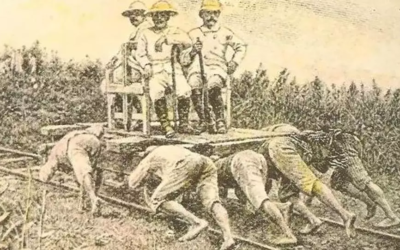
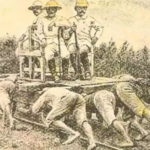
Photo By Photographer: CD Morrisflickr uploader: narek781 – Chater, Melville (November 1925). “History's Greatest Trek”. National Geographic 48 (5): 533-590. ISSN 1044-6613. // Cited: Page 537Also published in: Barton, James L. (1930) Story of Near East Relief, Macmillan . On an illustration page immediately after p. 152 (document viewer page 207/574). Available online here, with specific page available here. Digitized by Google, original held by University of California.Re-published in: Kastopoulos, Tasos (2007) War and Ethnic Cleansing: The Forgotten Side of a Ten-Year National Expedition (1912-1922), Vivliorama, p. 32 (photos). Immediate source: https://www.flickr.com/photos/56767781@N00/896449249 (this post identifies them as Armenians; the original National Geographic caption calls them Christians without specifying their ethnicity), CC BY-SA 2.0, https://commons.wikimedia.org/w/index.php?curid=25017859, https://el.wikipedia.org/wiki/