It was dawning on Tuesday, June 3, 1941. A summer, sunny day, which, apparently, would allow the suffering residents of the poor village to gather whatever strength they had left and throw themselves back into work, in order to manage to survive.
Besides, everything else was lost: The homeland first, which was enslaved once again, the soil, which was watered abundantly with honest, but also barbaric blood and polluted by the dirty boot of the conqueror, the smile, which abruptly faded from their lips.
All they had left was their stubbornness and the decision to remain firmly attached to the land of their ancestors. To bend over the barren land, to tell it their pain, and to coax it to bear fruit and nourish the few living things and their families.
With what courage, you ask? With the same courage with which they had bid farewell, a few months ago, to the Flower of the village, when he departed for the Albanian Front. To face the insidious invader with self-denial, heroism and incredible courage and to fight the Good Fight, for Freedom and Independence.
Their campaign did not have a good ending, despite the overwhelming victories of our Army in Northern Epirus, because Hitler decided to get Mussolini out of his difficult position, to save the honor of the Axis and to subjugate, at all costs, shameless Greece, which dared to defy him. And with it Crete, which seemed easy prey, unarmed and defenseless as it was.
There were no young and capable, beautiful, courageous men.
and Crete remained lonely, poor and devastated.
But he was calculating differently and found out differently. Because, while:
Everything seemed right to him, practice and theory,
but the momentum of Crete and the bravery eluded him,
of a people who breathed free air
and he wouldn't let an enemy get away with it.
Men, minors, women and old women,
Look how they fight tooth and nail!
With only the jugs, knives and shovels,
They quickly made weapons and gadgets,
destructive tools and death machines,
They were lost and passed into his hands.
Paratroopers fell, but they all turned to dust
and those who remained left with their souls in their mouths.
The dominance of the few, unarmed and untrained inhabitants over the powerful and well-trained army of the Third Reich was universal. To the point that the “Operation Hermes”, which had begun on May 20, seemed to be headed for an ignominious end. Because, despite the deprivations and hardships, Crete Fought and Endured. Especially Heraklion, as well as Rethymno, after the complete victory in the Battle of the Crucified, due to the assistance of Australian and New Zealand warriors.
Some wrong decisions, however, led to the fall of Maleme Airport, through which reinforcements were constantly arriving. The battle was now decided.
The enemy's iron-clad columns advanced slowly and methodically, spreading havoc and destruction around them. And on June 2, Lieutenant General Kurt Student sent the signal to the German Supreme Headquarters for the occupation of Crete.
At the same time, he installed a battalion of Paratroopers in Stavromenos, allowing them to act uncontrollably for a week, killing civilians and burning villages, for revenge and terrorizing the rest.
Already in the previous days, German planes had been dropping leaflets with propaganda material and calling on the locals - who had taken refuge in the deserts, olive groves and caves of the area - to return to their homes, assuring them that they had nothing to fear.
The war was over, they said, order had been restored, so there was no danger.
Many believed them, came out of their hiding places and returned to the village. But the Germans had other plans.
And the reprisals began in our own places, too,
with first on the list Asteri – Hamalevri.
Pangalochori later…
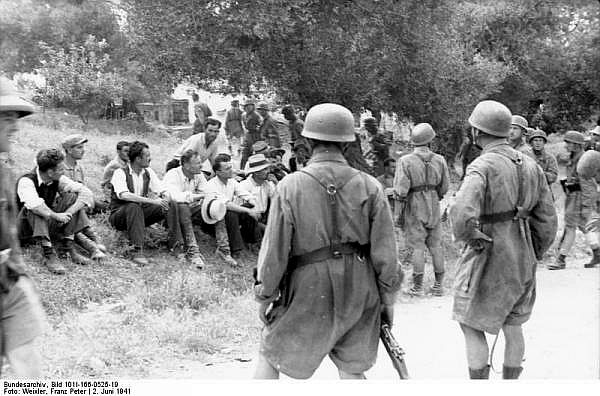
It was dawn on Tuesday, June 3, 1941, when the column set off towards Pangalochori. It passed Arsani and at the entrance to the village it met the seventy-eight-year-old elder Damianos Kallergis, a hieromonk at the Arsani Monastery, with a waterskin full of water on his shoulder. They grabbed him, threw the waterskin overboard and took him to Mesochori. They also caught Charidimos Dragasis, brother of another hieromonk, Hierotheos.
The rest raided the houses in the village and rounded up the men. In the house of my grandfather, Nikos Dakakis, next to the church, they found no one and out of spite they gathered their belongings in the middle of the house, doused them with gasoline and set them on fire. As expected, the house burst into flames and collapsed into ruins, which smoked for days.
They also set fire to other houses, until a hand grenade hit a wall and its fragments injured the person who threw it.
They had gathered the rest in front of City Hall:
Manolis Perakakis,
Manolis Drygiannakis, together with his son Lefteris,
Antonis Dakakis.
Kostis Koumiotakis,
Stylianos Dakakis,
Manolis Raptakis and
An Unknown Soldier, who was dug up from a field, in a clearing, to the west of the village.
They lined them up and when they reached "Tsagari", they stood them in front of the anchor. A burst of machine gun fire, scattered shots and then Silence.
Only the painful cry of a dog, running as if hunted, could be heard, and the cawing of a flock of crows, which got up in fright and flew south. Towards Loutra. Where the army of death arrived after a while, to continue its destructive work.
Everyone fell into the clutches of the "Tsagaris". Only Stylianos Dakakis escaped them, but he did not escape either. They found him dead the next day, lying in the ditch, near the Tsihlis mill.
And the above are not the only fallen heroes, in a supreme sacrifice on the altar of the homeland. The list, unfortunately, is long and includes:
Manolis Kissandrakis, who fell to “Tsichlikas”, along with fighters from Asteri and Chamalevri.
Manolis Koumiotakis, who was executed in “Kriniotissa”,
Georgios Kallergis, who was executed in Meronas, in Amari,
Stylianos Kallergis, who fell in “Rousa”, in Sfakaki,
Manolis Dakakis, who was executed in the “Reds”,
Irene Koumiotakis, who lost her life from a stray bullet, inside her home, in the village, and finally, at the last moment, on the day when the Germans were ignominiously withdrawing and were blowing up sacks and forts, Nikos Dakakis was also fatally shot.
It was dawn on Tuesday, June 3, 1941, when a squad of German executioners ravaged Pangalochori, plunging it into mourning and despair and leaving behind widows and dozens of unprotected orphans.
But that sacrifice was not in vain and the souls of the fallen flew to the heavens and remained there, in the neighborhoods of the heroes.
Eternal is their memory.