Friends,
Using art as a distraction from what's going on, I present to you a famous painting.
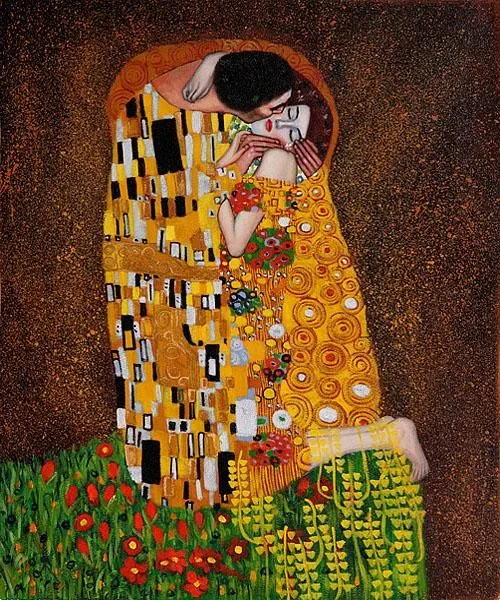
It is a masterpiece, a depiction of lust and love, a masterful creation with the glitter of gold leaf to lift it off, and, of course, Klimt's most well-known and famous work, created in the first decade of the 20th century, in 1908. The notable its dimensions (1.80 x 1.80 m.) make the presence of the embracing couple even more intense, whose figures are of human height.
In 1903 Klimt traveled twice to Ravenna to see the San Vitale mosaics. It was these Byzantine-influenced works that inspired him to create a series of works known as the Golden Age.
The use of gold dates back to Klimt's childhood, as his father and younger brother worked with the metal. The painter's interest in the Byzantine period symbolizes a step towards stability and follows the previous one which was inspired by Greek antiquity.
Both figures are acutely aware that they are symbolically entangled as they face the golden abyss of perfection through the manifestation of their love. The male predominance is accentuated by the black and gray pieces and softened by the organic rotating female shapes, reminiscent of another work of the painter, the "Tree of Life". Feminine energy takes the form of spiraling circles, bright floral patterns and wavy ascending lines. Through these artistic garments, golden rain blesses the fruitful land.
Although the couple in love are dressed, their image evokes intense eroticism, in a dreamy setting. Something unusual for Klimt, who had no limits (see his other works), just as the man's presence - even if dim - is unusual.
Some art critics have written that the couple represents Klimt himself and his partner Emily Flege, others believe that the woman is Adele Block-Bauer (there is, however, a full-length portrait of her, famous and expensive!) and finally, there are those who think the woman is the model Red Hilda, who posed for "Danae" and "Goldfish".
The use of gold leaf, known for its use in sacred images, was regarded by post-Victorian conservatives as blasphemy of the painter…
Klimt is quoted as saying: "Whoever wishes to know something about me should look carefully at my works and search in them to find what I am and what I want."