From the perspective of the Greek Diaspora
For those of us who live far from home, Greece is not just a place on the map. It is a memory, a language, an identity and a history that we carry with us every day. It is our children who learn Greek in afternoon schools, the parades, the festivals, the churches, the books we read and the values we try to keep alive.
That is why every time someone attempts to cut modern Hellenism off from its roots, the Greek diaspora cannot remain indifferent.
Edi Rama's recent statement that "Plato and Aristotle are not the ancestors of the Greeks" is not just an unfortunate phrase. It is part of a long-standing effort to relativize and weaken Greek historical continuity.
When History Disturbs, Some Try to "Correct" It
This is not the first time such opinions have been heard.
A few years ago, we heard that Alexander the Great "was something else" besides being Greek.
In the past, we read theories that the ancient Greeks "disappeared" and were replaced by other peoples.
At times, various circles even question the Greekness of Byzantium, as if the emperors spoke... some unknown language.
The pattern is always the same:
Everything that is Greek must be disconnected from the Greeks.
But history does not change with statements.
Plato lived and taught in Athens.
Aristotle founded the Lyceum in Athens and taught Alexander the Great in Greek.
Herodotus, Thucydides, Sophocles, Euripides, Hippocrates – they all created within a distinctly Greek world.
Their works were written in Greek.
Their cities were Greek.
Their thinking was shaped by Greek culture.
This is not nationalism. It is a historical fact.
Similar attempts in the past
The attempt to alter Greek heritage is not new.
In the 30s, German historian Jakob Philipp Fallmerayer attempted to argue that “modern Greeks have no relation to the ancients.” His theory was scientifically rejected, but is still propagated by politically motivated circles.
At the beginning of the 21st century, theories of "multiethnic Macedonia" emerged, attempting to separate Alexander the Great from the Greek world, despite irrefutable historical sources.
Today, we hear that Plato and Aristotle have nothing to do with the Greeks.
The same work, in different eras.
Science answers, not slogans
The international academic community has spoken clearly.
The great historian Will Durant, in his work "The Life of Greece", recognizes the unbroken continuity of Greek culture.
Steven Runciman and George Ostrogorsky document the continuity from antiquity to Byzantium and from there to modern Hellenism.
Modern genetic studies, such as those by Stanford University (2017), confirm population continuity in the Greek area.
No serious university in the world teaches that "the ancient Greeks had no descendants."
So what is the purpose of such statements?
Greece as an Idea
Greece is disturbing not as a state, but as an idea.
It's annoying that Democracy was born here.
It's annoying that philosophy first spoke Greek.
It's annoying that medicine, mathematics, theater, science, have Greek names.
And because they cannot erase this, they try to cut it off from today's Greeks.
But Greek identity is not an invention. It is a living continuity.
As Isocrates wrote:
"Those who participate in Greek education are called Greeks."
And this education was not born in any “neutral space.” It was born in Greece.
Message from the Diaspora
We, the Greeks of the Diaspora, know well that Greece does not need to prove anything to anyone.
Our children learn its history in schools around the world.
The books of its philosophers are taught in all universities.
Its words are in every scientific vocabulary.
No interview, no political statement, no attempt at revision can erase a 7.000-year-old legacy.
Greece has endured empires, conquests, wars, and refugees.
It will withstand a few unfortunate statements.
Bibliographical references
- Will Durant – The Life of Greece
- Steven Runciman – The Byzantine Theocracy
- George Ostrogorsky – History of the Byzantine State
- Anthony Kaldellis – Hellenism in Byzantium
- Stanford University – Genetic study “Genetic Origins of the Greeks”, 2017
- Isocrates – "Panegyric"
- Thucydides – "Histories"
Epilogue
Greece is not in danger from such statements.
But he must answer.
Not with shouts.
With knowledge, history and dignity.
Just like he always did.
Postscript:
Even if only one Greek were left, whether in Greece or abroad, no matter how many genocides were attempted, no matter how many disasters our nation went through, Greece will live eternally in the hearts of everyone. It will live in the millions of people who visit us every year to get to know our cultural heritage, monuments, history and spirit firsthand. Neither Edi Rama, a random politician of the moment, nor anyone else can alter the indisputable fact that Greece gave the lights of Democracy, Philosophy and Culture to the entire world.
And let everyone remember:
"Those who participate in Greek education are called Greeks."
– Isocrates
Ioanna Lazarou
a Greek woman
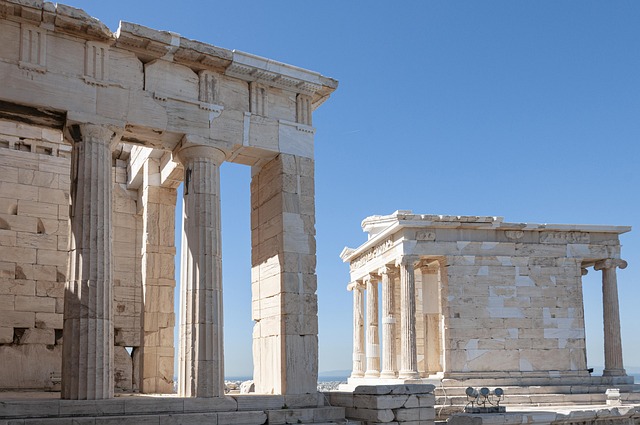
photo Nick115, https://pixabay.com