Ukraine did not rewrite naval history by building a bigger navy. It rewrote it by changing the facts.
The Black Sea has become a veritable testing ground for modern sea denial. A country with a limited traditional fleet has managed to force a superior naval power to move, hide, disperse its forces, and rethink the way it operates. The lesson is harsh but simple: in contested waters, the number of ships and their displacement no longer guarantee freedom of action.
The first phase involved missiles and unmanned surface vessels (USVs). The second phase is now being carried below the sea surface. With systems such as the Sea Baby, Magura, Marichka and the newly introduced heavy unmanned underwater vehicle (UUV) Sea Trident, Ukraine is expanding the “Sea of Drones” into a new operational domain. Surface drones made ports dangerous. Heavy underwater drones now make distance, depth and patience part of the kill chain.
This is where naval planners should start to worry. A long-range UUV with a heavy payload doesn’t just threaten ships at sea. It threatens the places where ships feel safe: naval bases, anchorages, bridges, sea lanes, undersea infrastructure, and submarines moored at docks.
The “Sea of Drones” is no longer a coastal nuisance. It is becoming a strategic undersea problem.
Denial of Sea Access Is Now the Main Issue
For decades, navies have loved big numbers: number of ships, displacement, number of vertical launch cells (VLS), aircraft carrier air wings. The bigger the data table, the greater the self-confidence.
Ukraine made this painting look outdated.
The sinking of Moscow and repeated attacks on Russian naval assets have demonstrated that a smaller naval force can deny access to a much stronger one without having to compete ship-to-ship. And this distinction is crucial.
Sea Control means being able to use a sea area while preventing the adversary from doing the same. It is an extremely expensive, personnel-intensive, and difficult-to-maintain situation, especially under conditions of constant surveillance.
Sea Denial is different. Its message is simple:
"You may have a larger navy, but you cannot operate here unhindered."
This is exactly what Ukraine has achieved in the western Black Sea. The Russian fleet is still there, but its freedom of movement has been significantly restricted. Ships have been moved away from exposed areas, operations are conducted with greater caution, and ports are no longer safe havens.
This is Sea Denial in practice.
The USV Evolved into an Modular Fleet
The first naval drones were essentially single-use floating munitions: fast, explosive, and expendable. Useful, but not particularly sophisticated.
But this changed very quickly.
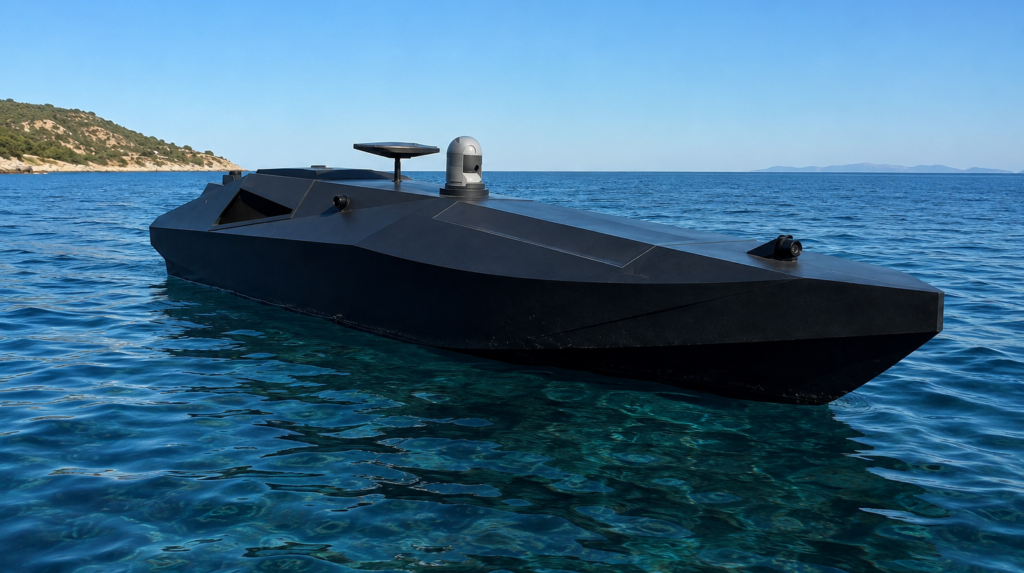
Ukrainian USVs have evolved from suicide boats to modular naval platforms. The Sea Baby, Magura V5 and other systems are now elements of a broader unmanned fleet concept. They can carry explosives, sensors, electronic warfare systems, mine warfare payloads, communications equipment and even launch aerial drones.
Here lies perhaps the most important conclusion:
The USV is not the operational capability. The real operational capability lies in the payload it carries.
A USV with explosives is an impact weapon.
A USV with antennas is an information, surveillance and reconnaissance (ISR) node.
A USV with jammers is converted into an electronic warfare tool.
A USV carrying mines becomes an expendable minelayer.
A USV that launches aerial drones comes as an unpleasant surprise to those who still consider sea and air to be distinct domains of operations.
This is not a Navy's traditional procurement process.
It's real-time combat mechanics.
The experience of the front returns to the engineers. The engineers modify the system. The new version returns to the battlefield. This short adaptation cycle is worth more than any impressive but slow procurement program.
If the process of acquiring new weapons systems takes seven years, while the adversary adapts within seven weeks, then this process is not mature.
She is petrified.
Sea Trident Changes the Undersea Equation
The narrative now moves below the surface of the sea.
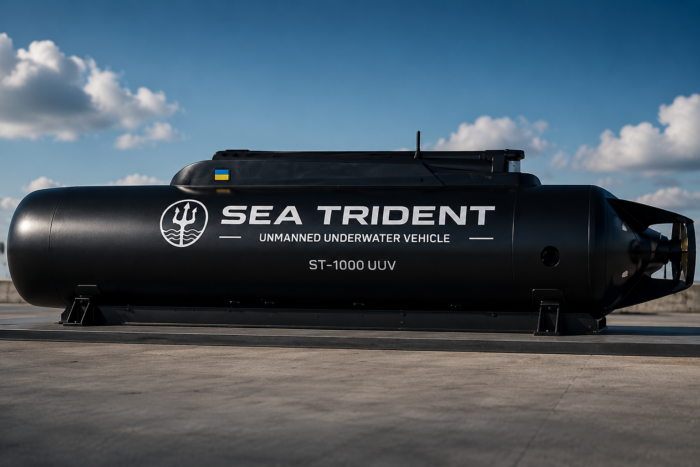
The heavy unmanned underwater vehicle (UUV) Sea Trident ST1000, according to available information, is not just another drone. It indicates the emergence of a new class of long-range systems for subsurface maritime access denial operations. Public reports indicate a payload of up to 1.000 kg and an operational range that could reach 2.000 nautical miles. If these performances are confirmed operationally, the implications for naval planning will be particularly significant.
The tactical consequences are serious.
First, naval bases become even more vulnerable. A long-range UUV doesn't need to attack during a rapid naval engagement. It can approach slowly, lie in wait, and strike when and where defenses are weakest.
Secondly, ports and anchorages must now be protected in three dimensions. Surface barriers and cameras are not enough. The defense of a naval base must cover the seabed, the submarine approaches, acoustic surveillance and continuous underwater monitoring.
Third, bridges and critical maritime infrastructure are now among the potential targets. A heavy payload doesn’t just threaten a patrol vessel; it can threaten fixed infrastructure that supports the military supply chain and national resilience.
Fourth, even submarines are losing some of their traditional security. A submarine tied up at the naval base or moving in predictable areas of operations can be targeted by a system that does not operate like a conventional torpedo. The UUV can wait. And patience is now an operational advantage.
Fifth, the boundaries between mine warfare and strike operations are beginning to blur. A heavy UUV with long range and a significant payload resembles a mobile mine, a slow torpedo, and a stealth strike platform all at once.
This combination creates a particularly difficult operational challenge.
The New Problem of Port Defense
Protecting a port or naval base has always been a particularly demanding mission. Divers, mines, small speedboats, sabotage groups and underwater infiltrations have been perennial threats.
Today, long-range unmanned underwater vehicles are also being added.
The question is no longer just whether a speedboat can be intercepted before it reaches the port gate. It is whether a silent underwater vehicle can be detected before it approaches a pier, a bridge pier, a submarine cable landing site, or a submarine docking basin.
This requires extensive sonar coverage, bottom sensors, underwater obstacles, rapid target classification capabilities, and immediate response systems.
However, detection alone is not enough.
The really difficult and costly stage is the correct identification of the target.
It must be distinguished whether the contact is a marine organism, environmental noise, a drifting object, a friendly vehicle, or a hostile UUV with a warhead. This requires advanced acoustic processing, artificial intelligence for pattern recognition, and new operational doctrines.
A false alarm every hour can paralyze the operation of a port.
However, one contact that is ignored can lead to its closure.
Drones as a Means of Maritime Policing
But there is another interesting dimension.
Ukraine has mentioned the possibility of using naval drones not only to destroy targets but also to immobilize or control ships.
This is a significant change.
A drone performing maritime policing missions needs much more than a warhead. It needs identification capabilities, communication, escalating use of force, legal authorization, non-lethal means, and possibly air support.
The mission is shifted from kill chain At compliance chain.
Often the goal is not to sink a ship but to disrupt illegal activities, impose sanctions, collect evidence, and enforce compliance without escalating into a generalized conflict.
The VLS Trap Is Real
Russia is adapting.
Every new weapon also gives rise to a countermeasure.
The biggest lesson, however, goes far beyond the Black Sea.
Western navies are called upon to address the problem of cost-effectiveness.
A warship can shoot down cheap drones using expensive interceptor missiles. It can win the tactical engagement, but lose the economic war.
This is Vertical Launcher Trap (VLS Trap).
Vertical Launch Systems (VLS) are extremely powerful, but have a finite number of cells. When these are exhausted, the ship must leave the area of operations to reload.
The opponent doesn't always have to sink the ship.
It only needs to exhaust its stock of missiles.
That is why high-power lasers, electronic warfare means, decoys, guns and low-cost, multi-layered defense systems are becoming increasingly important.
In the era of drones, cost per shot is not just a technical parameter.
It's survival mathematics.
Strategic Conclusion
Ukraine did not only damage ships.
It caused damage to decades of assumptions.
The Black Sea demonstrated that future naval power will be evaluated based on speed of adaptation, modular payload design, sensor fusion, autonomy, and the ability to simultaneously act above, on, and below the sea surface as a single interconnected system.
Sea Trident makes the lesson even clearer.
The “Sea of Drones” is no longer just about speedboats laden with explosives attacking at night.
It now concerns long-range underwater systems, capable of threatening critical infrastructure, naval bases, submarines and supply lines from unpredictable directions.
The traditional fleet was designed around platforms.
The fleet of the future will be designed around the results that payloads and interconnected autonomous systems can produce.
The question now posed to the international maritime community is simple:
Do we continue to build 20th century targets to counter 21st century swarms, or will we finally start designing fleets that can actually survive in the new “Sea of Drones”?