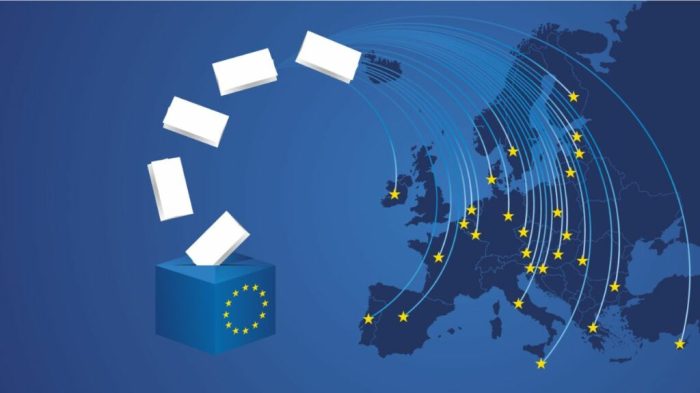
The sweeping increase in power of the so-called, from the traditional political parties, "extreme right", "nationalist", "populist", "dangerous for democracy", "fascist" or even "non-progressive", constitutes the major upheaval of the June 9 European elections.
It should be noted that these characteristics were attributed arbitrarily and without being asked, to these new political parties, from the traditional ones. And it is clear that they are intended to stigmatize, degrade and ridicule them. It goes without saying that these characterizations are not accepted by these new political parties and I mention as an example that Marine Le Pen herself, who is likely to be the president of France in the upcoming parliamentary elections, clarifies her party's characteristics: it is "economically right, socially left and nationally French". Let me also remind you that the important role, which is undoubtedly now recognized in the Prime Minister of Italy and already MEP Giorgia Meloni, in the bosom of the EU, nevertheless inherits earlier characterizations of her priesthood about her, such as, among others, that "she will be the disaster for Europe" and that she is "fascist ». Already, however, Mrs Ursula von der Leyen is begging for support for her second term as Commission president. Needless to remind that this panic, against the new, non-systemic parties, has also occupied Greece, so that parties that threaten the traditional ones are called, indiscriminately, extreme right, while (with minimal exceptions) they have nothing to do with them.
But how did these new non-systemic political parties come about and what do they do, and what risks do they entail for the EU and the euro.
A. WHAT ARE THE NON-SYSTEMIC PARTIES OF EUROPE
The risks to the survival of the EU from the rise in power of these new political parties are currently limited by the fact that they show significant differences between them, which make their reconciliation difficult. However, despite their differences, certain common tendencies are also distinct, which are considered important, because they could possibly form the basis of a common European policy. Let me emphasize at this point that in the event that Marine Le Pen prevails in France, tectonic changes are expected changes throughout Europe and the accession of many political formations to its views. But, beyond the geographical boundaries of Europe, the possible election of Donald Trump, in the USA, is predicted to significantly influence EU policy in general.
*The common bases for the creation of non-systemic political parties
After the financial crisis of 2008 they appeared in politics around Europe and beyond, new political forms. It was about the reaction against globalization and distributional inequalities, which favored the elite and decimated the middle class. These populist parties are both right-wing and left-wing, although this classic distinction has faded. In any case, the main difference between them refers to the field of immigration policy. Along the way, the right-wing parties seem to have prevailed, probably because the left-leaning ones proved effective during the globalization period. The dominant position of almost all of these non-systemic parties is its opposition to the elite and their stance in favor of the people (although, as is well known, the precise identification of both runs into difficulties). And more specifically, these new political parties promise a fairer distribution of wealth and undertake to implement everything that the traditional political parties, which were in power, did not accomplish during the period of globalization. To implement their plans, and in particular to achieve a fairer distribution of income, they turn to state intervention, oppose extreme austerity and pro-liberalism, and declare themselves in favor of the nation-state and the basic values of life. Regarding the ways of dealing with illegal immigration, which was the central difference between the right and left direction of these non-systemic parties, to underline the recent convergence of their views, specifically in France.
*The EU's reaction against them
Frightened, the EU, and not having effective measures to deal with this political upheaval against it, resorted to the broad and unauthorized use of the above designations, against non-systemic political parties. At the same time and on a case-by-case basis, the attack against them, by the EU, also includes the imposition of sanctions (see Hungary and earlier and Poland). These categories, although not precisely defined, revolve, however, with veiled methods, around religion, patriotism, the family, the nation-state, democracy and, in short, against the whole of traditional European values. Summarizing, but without being able to specify the relevant conclusions, much less the process of proving them, it is taken for granted that the traditional political andgroups belong to the progressive category, while the non-systemic ones are classified caught in that of maintenance and delay. With this obfuscation, around the EU's new choices, the basic values of life are faced, with a veiled, but clearly hostile treatment from it. And more specifically, patriotism takes on the connotation of conservatism because it opposes globalization. So is the return of the nation-state, which is tarnished and rejected, in spite of the multiple sufferings suffered by the middle class, during the long period of globalization. Around religion, which constitutes dominant element of separation between the populations of Europe and among the hordes of immigrants, reflection and deepening of debate is discouraged, by the traditional political parties, in contrast to the position of the new political parties, which sound the alarm, about the developments. In addition, the concern of the non-systemic political parties regarding the alteration of the European population, which developments verify Gudenhof Kalergi's vision, is perceived by the traditional parties as racism. Regarding liberal democracy, which the EU proudly claims as its exclusive treasure, it is nevertheless necessary to remind that, with the progressing decline of the West, only 13% of the earth's population still enjoys it, while the remaining 87 % lives under conditions of illiberal or hybrid democracy and authoritarianism.
*The retreat of traditional political partiesThe gradual expulsion of the traditional parties, from the non-systemic ones, is the reality in Europe. Apart from Italy, which already has a non-systemic government, the June 9 European elections reveal the existence of serious preparations to overthrow the systemic governments in Spain, Austria, the Netherlands, Sweden, Finland, and also in Germany. And in the meantime, the "populist coalitions" significantly influence political, economic and social developments throughout Europe. At this point I consider it necessary to point out that this populist news and non-systemic political parties, except in rare cases, have nothing to do with the content of the extreme right. They are, however, given the term abusively, by the panicked EU, which reacts in this way, to the now visible danger of a generalized substitution of its traditional governmental forms by them. On the contrary, it could be argued that the dominant feature of these new political formations, which is their position against the elite and in favor of the people, also gives them elements of a left direction. However, the case of the attack against these new political parties proves for the umpteenth time how easy it is for white to prevail over black, as a result of a well-designed and continuous propaganda.
B. THE RISKS FOR THE EU
It is a fact that the traditional political parties of Europe (and not only) face a serious threat of their disappearance, from the so-called "extreme right" or "populist". However, this threat is currently manageable, by the traditional parties, thanks to the strong differentiation of the goals pursued by the non-traditional ones and which, for the time being, make it impossible to agree between them to implement a common policy. However, it should be taken for granted that the rising power of these non-systemic parties, will exert multifaceted pressure on the EU and force it to change certain axes of its policy. Such a development is considered important, given the disappointing course followed by the EU in its entire policy, and which the war in Ukraine makes more and more evident. First of all, and as it is sadly known, the EU has kept absolutely none of its original promises to the peoples of Europe (rapid growth for all, fairer distribution of income, monetary stability and peace). Its founder/visionary Jacques Delors expressed his deep disappointment with its course, with the following statement: "from a Europe of the people it ended up in a Europe of industrialists". But, moreover, as the war in Ukraine painfully showed, the EU did not even respect the dominant reason for its creation, which was to acquire its own voice (against the US monopoly) and its own political choices in the international arena.
These bad choices of the EU, on many levels they ended up, during the last decade, in a weak growth of around 4% per year, in contrast to America, which grew at twice the rate and equal to 8% during the same period. In addition, the EU, with its unsuccessful choices, widened the development gap between the European North and South to a dangerous extent and accelerated deindustrialization in Europe, with Germany collapsing economically. Besides, we Greeks, it would be unforgivable to forget the unacceptable methods adopted by the EU together with the IMF, for dealing with our debt, in order to bail out the German and French banks, and ignoring our ruin. Its related choices, some of which were criminal in nature, such as those included in the Memoranda, impoverished Greece for many, many generations. With regard to Europe as a whole, recent surveys reveal that 42% of citizens consider it preferable to be inside the EU rather than outside it. But, at the same time, they say they would prefer a "different Europe".
*Conclusion
As a general finding, able to identify future developments, it is the admission that, with exceptions, these new parties are not friendly, or even some are clearly hostile, towards the EU and the euro. In particular for the two leaders of non-systemic/European parties, the Marin Lepen and Georgia Meloni, who is also prime minister, although they have renounced their previous positions against the EU and the euro, it is assumed that they have not changed them and that they will return to their original preferences when they consider the conditions favorable. As an important point of convergence, moreover, between most populist European political parties, I will mention their fatigue, because of the war in Ukraine, which is not ending, which is extremely expensive and extremely dangerous to provoke World War III. In general, Europeans may oppose Putin's expansionist tendencies. At the same time, however, they are concerned about the mortal danger that Europe is facing, due to the advance of Islamists on its lands. These hordes confirm Samuel Huntington's prediction of a clash of civilizations, as well as Gudenhof Kalergi's analysis of the extinction of the European population. And right-wing and left-wing populist parties in Europe seem to agree with all of this, that is, EU policy is dangerous and incomprehensible. In addition, the parties do not seem to agree with the decision taken by the EU headquarters, e.g.on militarization of the EU, which will require more than 3% of its GDP, thus ignoring how much the quality of life of large socio-economic categories within it has deteriorated. These parties, moreover, do not agree with the EU's austerity policy, without an end date, which is nevertheless necessary to ensure the relative stability of the euro, as it is an imperfect currency, which cannot survive without it. But, exactly, the The Stability Pact, which is the crutch of the euro, is what is dooming the EU economy in conditions of near stagnation. Additional complaints, presented by the European populist parties, concern the now uncontrollable bureaucracy, which has been concentrated in the bosom of the EU and whose offer is not at all clear, even though it is becoming more and more expensive. In particular, the huge expenses with which each MEP is associated do not seem to be justified by the quality of the services they offer.
As a general conclusion it is worth holding that the populist parties in Europe maintain and respect the values that, for centuries, belonged to the traditional political parties of Europe, but which Europe is already fighting and trying to eliminate. Shall we speak of progress or decline?
photo https://dramini.gr