This article is for informational purposes only and does not constitute legal advice. Every immigration case is different. Please consult a licensed immigration attorney before making any decisions.
For thousands of families, the change announced today is not just a technical detail in a government document. It touches on life decisions: whether to stay, whether to leave, whether to risk separation from their family, and whether to continue a process that until yesterday they considered relatively predictable.
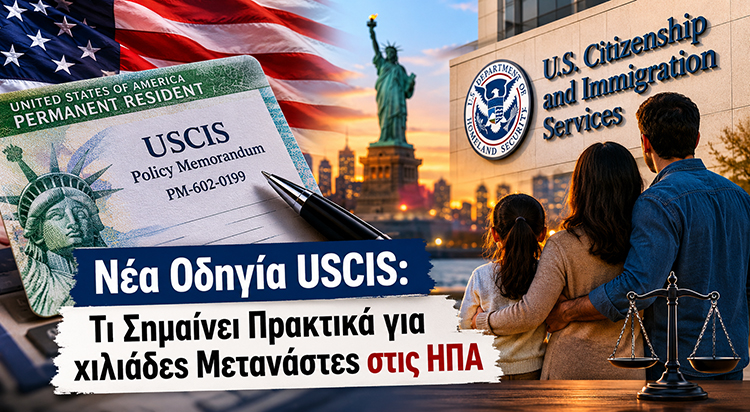
The United States Citizenship and Immigration Services (USCIS) issued Policy Memorandum PM-602-0199 on May 21, 2026, which fundamentally changes the way Green Card applications from within the country are evaluated.
Before we get into the details, one thing should be clear: this memo is not a law passed by Congress nor a regulation that has gone through the full rulemaking process. However, it is an official administrative directive to USCIS employees and has immediate practical impact. Legal challenges are expected, and the courts will have the final say. The picture remains fluid and evolving.
What was Adjustment of Status and what changed?
For decades, a foreign national who was in the United States on a legal visa, whether tourist, student, or work, could apply for a Green Card without leaving the country. This process was called Adjustment of Status. As long as the applicant met the requirements and there were no serious obstacles, it was a well-established and relatively predictable process.
The new memo doesn’t prohibit these applications. What it does do is instruct USCIS officials to treat them as a discretionary administrative action, not a right. The official reviewing your case now has broader authority to determine whether your stay in the U.S. during the application is justified or whether you should have returned to your home country to follow the regular consular process.
The new directive is aimed primarily at those who came on a temporary visa, such as a tourist or student visa, and applied for permanent residency without leaving. H-1B and L-1 work visa holders appear to be less affected, as the memo explicitly acknowledges that these categories remain compatible with filing an application within the United States.
Those who are without papers
Here the situation has its own peculiarity and two clear distinctions need to be made.
Those who entered legally on a visa but let it expire were, in many cases, able to apply for Adjustment of Status as spouses of U.S. citizens. The new guidance does not explicitly prohibit this, but it significantly increases scrutiny and uncertainty. For those who entered without ever having had a visa, the situation was already complicated before this guidance, as USCIS normally does not allow Adjustment of Status in these cases, even if the applicant is married to a U.S. citizen.
One thing that many people know but often misunderstand: as long as an I-485 application remains pending, the applicant does not accumulate unlawful presence, meaning the 3-year or 10-year reentry bar is not triggered. However, this is not a “pardon.” A pending I-485 application does not provide lawful residence status. And most importantly: while it used to be rare for ICE to initiate deportation proceedings against individuals with a pending I-485, that has changed. Arrests have even been recorded at USCIS offices during interviews.
The second critical point concerns leaving the country. If someone leaves the United States after living without legal residence for more than six months, they risk being banned from re-entering for three to ten years. The decision to leave to appear at a U.S. consulate is never a simple one and should not be made without legal advice.
There is, however, a legal route: the I-601A petition, known as a Provisional Unlawful Presence Waiver. It is filed before departure from the U.S. and asks the government to “forgive” the time spent illegally present, by demonstrating that the absence will cause serious hardship to the American spouse. If approved, the applicant can travel to the consulate with significantly less risk. The process requires time, documentation, and an experienced attorney by your side.
If you already have a pending application
There is no reason to withdraw an application that has already been filed based on this memo alone. Be prepared for possible delays. If you receive a Request for Evidence, i.e. a request for additional documents, respond fully and promptly with legal assistance.
What has not yet been clarified?
What remains open is how the new policy will be implemented in practice, which cases will be considered “exceptional circumstances,” and how pending applications will be handled. Legal challenges are expected in federal courts that could block the new policy. It’s worth following developments from official sources, such as the USCIS Newsroom at uscis.gov/newsroom.
For immigrants and their families, the most important thing right now is not to make hasty decisions out of fear or rumors. Every case has a different history, different risks, and different legal possibilities. Do not withdraw an application without a lawyer. Do not travel outside the United States if you have a pending case without first consulting with a specialist.
Reminder: This article is for informational purposes only and does not constitute legal advice. Please consult a licensed immigration attorney for your specific case.