In ancient Greece, procreation was the main purpose of marriage and the basis for the survival of the "household." When a couple faced childlessness, they turned to a wide network of religious, magical and medical rituals to induce fertility.
The main practices and rituals included:
Initiation at the Asclepia
The Asclepius of Epidaurus and other healing centers of antiquity were the destinations par excellence for childless couples:
The process: The women underwent purification (baths, fasting) and then slept in the abattoir (the sacred space of the temple).
The vision: They believed that during sleep the god Asclepius or his sacred snakes would appear in their dreams to heal them or show them the solution.
Testimonials: Ancient inscriptions (healings) mention dozens of cases of women who were "cured of sterilization" after a night of sleep.
- Women's Holidays and Mysteries
Certain religious festivals were exclusively dedicated to female fertility, most notably the Thesmophoria in honor of Demeter:
The Thesmophoria: Only married women participated in this multi-day festival. They sacrificed young pigs and buried them in special pits (megara). The following year, they dug up the rotten remains and mixed them with the seed in the fields, an act that symbolized the fertility of the land and of the woman herself.
Phallic Symbols: During these ceremonies, women made buns or effigies in the shape of a phallus and female genitalia, exchanging obscenities (obscenities) to ward off the evil eye and attract reproductive power.]
Offering of Offerings (Votives)
When a woman wished to become pregnant or had just given birth safely, she visited temples of childbirth deities, such as Artemis (e.g. at the Sanctuary of Bravrona), of Hera or her Illithyias (the goddess of childbirth par excellence). There they offered:
Clay models of the uterus or female breasts.
Their own children's toys or clothes (if it was their first marriage).
Special belts, which women untied and dedicated to the goddess as a symbol of "liberating" their belly for childbirth.
Amulets and Magical Practices
In popular tradition, childlessness was often attributed to witchcraft, witchcraft, or the displeasure of spirits. To treat it, they used:
Periapta (Amulets): They wore semi-precious stones, such as the "aetite stone", tied to their bodies to protect the reproductive process. [1]
Herbs and Potions: They drank concoctions from plants that were considered fertile (such as the mandrake or the pomegranate, which due to its many seeds was the ultimate symbol of abundance).
The "Holy Marriage"
In some areas, the fertility of people and nature was ensured through the ritual of Holy Marriage. It was the symbolic (or even real) union of a priestess and a priest, who represented the divine couple (e.g. Zeus and Hera), transferring divine fertility to the entire community.
The claim that childless women had intercourse with young men to become pregnant is an urban myth and is not confirmed by any historical, archaeological or philological source from antiquity.
The idea that in the Cabeirian Mysteries young men or priests had sexual intercourse with childless women during the time of conception, then presenting it as "divine intervention", is historically inaccurate for the following reasons:
There was no "initiation" in the Kabeirian Mysteries
The practice of sleep (i.e. the believer sleeping inside the sanctuary in order to have a healing dream) was done almost exclusively in Asclepius (such as that of Epidaurus) and in certain oracles (such as that of Amphiaraus). The Kabirian Mysteries (held on Samothrace, Lemnos and Thebes) were initiation ceremonies. They included group nightly rituals with torches, purifications, theatrical representations of cosmogonic myths and confessions of sins, but not confinement in individual rooms.
Strict purity rules in the sanctuaries
In all ancient Greek sanctuaries where engoimesis was practiced (such as the Asclepia), the rules of ritual purity (purity) were extremely strict.
Believers were required to abstain from any sexual activity before entering the abattoir (the sacred space of sleep).
Sexual intercourse inside the temple was considered sacrilege and great miasma which would anger the gods and nullify the cure.
The character of the Kabirs
Although the Caberites were associated with the fertility of nature (they were often depicted as Ithyphallic deities, such as Cadmilus), the main purpose of initiation into their mysteries was not the cure of childlessness, but the protection of seafarers from maritime dangers and the assurance of the moral and spiritual salvation of the initiate. Men, women, and even children or slaves could be initiated into these mysteries.
To understand the contemporary myths that connect the mysteries with orgiastic practices, the literature is divided into:
Early Christian Warfare: Works by ecclesiastical writers such as Epiphanius of Salamis and Augustine of Hippo, who, in the context of defending Christianity, often presented pagan cults in a negative light, contributing to the creation of misconceptions. Their definitive cessation in 392 AD by decree of Theodosius I sealed this image.
Contemporary Paranormal Fiction and Scandalousness: These are texts that often recycle older categories or invent impressive “revelations,” without being based on archaeological and literary data. The lack of sources and the secrecy surrounding the mysteries make them an easy target for such theories.
How did they deal with childlessness back then?
The ancient Greeks dealt with childlessness with a network of practices that were distinct from the Caberian Mysteries and did not include sexual acts in the sanctuaries:
Asclepius: The main place for treating infertility was the Asclepia (e.g. in Epidaurus). There, the practice of encomiesis (sleeping in the sacred space) was performed after strict purifications (fasting, baths) and with the aim of the believer seeing a healing dream from the god Asclepius, not to have sexual intercourse.
Fertility Celebrations: Festivals such as the Thesmophoria had symbolic practices (sacrifices, burial and the gathering of seeds), but they were exclusively female, were held under strict chastity and their purpose was the euphoria of the earth and fertility.
Votives and Magic: Believers offered clay models of wombs or breasts to temples of childbirth deities, while also using amulets and herbs to treat infertility, practices that were based on the magical and symbolic power of the objects, not on ritual sex.
Ancient Sources
The Herodotus Excerpt
Ancient Text (Herodotus, Stories 2.51.1-4):
These things now and others to this end, I will say,
2.51.2
Greeks from Egyptians, they are called by their names; but Hermes is the
Statues have the vaginas right, makers not from Egypt-
Whose language did they learn, but from Pelasgians first with Greeks
2.51.5
All the Athenians received it, but others besides them.
For Athenian citizens already perform acts of worship to Greeks.
They became neighbors in the country, from where Greeks also came.
<They> began to think. But those who saw the orgies of Cabeir
initiated, they perform the Samothræan rites, receiving from
2.51.10
Pelasgians, this one I heard the word for; for Samothrace
These Pelasgians, who were formerly residents of Athens,
It happened, and despite this, the Samothræans took over the orgies.
They are standing upright, the statues of the
Hermes, the first Athenians to learn Greek,
2.51.15
They were made by Pelasgians. And the Pelasgians say some reason
They chose about him, those in the Samothræan mystery
is declared.
Translation
[2.51.1] These customs, then, and others, which I will mention, the Greeks took from the Egyptians, but the statues of Hermes with their heads erect the Greeks did not learn to make from the Egyptians, but from the Pelasgians, and the Athenians were the first of all Greeks to take them, and from them the rest took them. [2.51.2] For the Athenians were already considered Greeks when the Pelasgians came to live in their land, and then they also began to be considered Greeks. And whoever has been initiated into the orgies of the Cabeirians, which the Samothracians perform, who have taken them from the Pelasgians, understands what I mean. [2.51.3] For Samothrace was formerly inhabited by those very Pelasgians who came and lived with the Athenians, and from them the Samothracians took up the orgies. [2.51.4] Thus the statues of Hermes with the erect penis were first made by the Athenians among the Greeks, having learned them from the Pelasgians. And the Pelasgians have some sacred explanation for this, which is set forth in the mysteries of Samothrace.
What the Excerpt Says
Herodotus gives us three basic pieces of information about the Cabeir Mysteries:
Pelasgian Origin: The worship of the Cabeiras in Samothrace was a legacy from the ancient population of PelasgiansThese Pelasgians originally inhabited Samothrace and brought with them these rituals, which were later adopted by the Samothracians who succeeded them.
Hermetic Knowledge (Mystery): Herodotus hints that there is a deeper interpretation of the cult of Hermes with the Ithyphallic statues, which is known only to those initiated into the Caberian Mysteries. He uses the phrase “But he who is reminded of the orgies of the Cabirs… this man understands what I am saying” to declare that the true meaning of the custom is secret and known only to the initiated.
Connection with the Pelasgians of Athens: Herodotus directly connects these Pelasgians of Samothrace with those who later inhabited Attica and lived together with the Athenians. The Athenians, according to him, received from them the custom of the Ithyphallic statues of Hermes, while the Pelasgians themselves transmitted the knowledge and origin of the custom from Samothrace.
Conclusion
This passage confirms that the Cabeirian Mysteries were an ancient cult with deep roots in a pre-Hellenic population, the Pelasgians, and that their secret character was already recognized in the time of Herodotus (5th century BC). His information, therefore, is indeed the oldest scriptural evidence we have of this cult.
The Sanctuary of the Cabeir in Thebes
The most important monuments of Kavireio are:
The Temple, dedicated to the gods Kabir. It is a rectangular building, the oldest remains of which date back to the 6th century BC. The current surviving foundations belong to a later phase of the late 4th century BC. Later renovations, including additions to the west of the temple, took place in the 2nd and 1st centuries BC. The temple had a pronaos and a cella, as well as an outdoor courtyard with two rectangular pits for sacrifices. It had a perimeter around it.
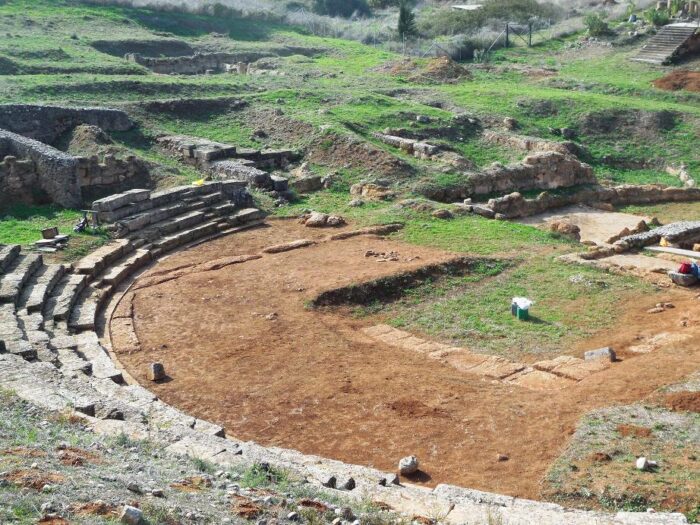
The Theater, which was built during the Hellenistic period (3rd-1st century BC) on the same axis as the temple on its eastern side. It had no stage, had ten stands in the cavea and an altar in the center of the orchestra. It served to observe the “acts” related to the initiation of the faithful.
The stoa, a long, narrow building 40 m long, to the SE of the theatre. It served the cult needs of the sanctuary. It was built around the middle of the 1st century BC.
The circular and elliptical buildings, of which several were found throughout the sanctuary. They had cesspools for bloody sacrifices and ritual purifications as well as a built bench inside for the initiates. The largest, from the end of the 5th century BC, is located between the portico and the temple and was perhaps a simple enclosure without a roof. It fell into disuse at the beginning of the 1st century BC.
The precinct, once built, surrounded the entire sacred area with the temple and the outdoor courtyard until before 300 BC. In the 2nd century BC it was extended further east to include its cavea.
The sanctuary of the Cabeiros is located 8 km. west of Thebes. It was dedicated to two deities of unknown origin, Cabeiros and Paedas, to whom Demeter revealed some secret rituals aimed at enhancing all-round fertility (fruits, animals, humans). The Cabeiros were worshipped as protectors of the vine and the fertility of animals, which is why over 1400 animal depictions of bulls were found there. Worship at the sanctuary begins at least from the archaic period (700-500 BC) and continues uninterrupted until the Roman post-Christian years (4th century AD). Even the pottery of the sanctuary is typical, mainly kantharos, which are decorated with grotesque figures. However, the discovery of a few Neolithic shells (6000-3000 BC) under the temple proves an even earlier habitation in the area, before it was transformed into a religious center.
The sanctuary was discovered by chance in 1887, when lead figurines of bulls originating from the area were found being sold in the Athens market. The excavation of Kavireion was carried out in 1888-9 by the German Archaeological Institute under P. Wolters, W. Doerpfeld, W. Judeich, H. Winnefeld, F. Winter while G. Bruns continued in 1956, 1959, 1962 and 1964-6. A small supplementary excavation was carried out in 1971.
In the period 1993-94, reinforcement work was carried out on the built enclosure of the theater hollow, which was in danger of landslides from rainwater.
Bibliography
Herodotus, “Histories”: It provides the oldest secretarial testimonies about the mysteries of Samothrace and the people who performed them.
Modern archaeological studies: Excavations in Samothrace and other centers of the Cabeir cult have brought to light inscriptions and architectural remains that help in understanding the ritual practice
“Asclepius and Asclepius” by P. Aravantinos (1907)
“Ancient Greek Mysteries” by Georgios Sietos:
KEDE.GR