The Saints were people like us. Many of them were born to pagan parents in the early Christian centuries, and many of them were mutilated by their parents. The Holy men and women chose the path of Christ. The narrow one and not the wide one of pleasure. Laymen or clergymen offered themselves to Christ. The path of marriage and the path of monasticism can lead the believer to holiness.
Saint Nicodemus of Mount Athos writes the following: “And let no one of the secularists say that these things were written for the monks, and not for the laity… What the monk is obligated to keep in order to be saved, the layman is also obligated to keep… The monk has a duty to keep all the commandments of Christ, the secular man has the same duty…” (Preface to the book “SYMEON THE NEW THEOLOGIAN THE FOUNDINGS” in Fr. Georgios Marnellos. The holy…life of the sanctified Elder Ephraim of the Lakes of Mirabello… Saint Nicholas of Crete 2024, pp. 48-49).
Saints are included in the calendar of our Holy Church by the official Orthodox Church, in this case by our venerable Ecumenical Patriarchate, those of the baptized faithful who lived a godly life with fasting, prayer, unceasing praise of the Holy Triune God and with a pure heart without deceit and ulterior motives. Those who radiate the grace of the Holy Spirit and are full of virtues. If God grants them the gift of miracles, foresight, prophecy or any other, the reason for canonization is strengthened. Other reasons that contribute to canonization are the myrrh-bearing of relics, the miraculous end, etc. It is wrong to use the term canonization, because we do not proclaim Saints. The Church simply confirms that someone is a Saint in the consciousness of its members and in fact, by including him in the canons of the Orthodox Church.
Our Holy Church has raised up many saints and will continue to raise them up until the end of time. Many are unknown to the fullness of the Church; their words are known only to God. Sometimes GOD REVEALS UNKNOWN SAINTS TO US at the right time to support the faith of his people and to reveal the power, grace and glory of God.
“God is wonderful in His saints” (Ps. 67:36). “The Lord is wonderful in His saints in His land” (Ps. 15:15)! God works miracles through His saints!
The work of the Saints after their repose is to intercede before the throne of God for our salvation and protection from all evil.
“The Supreme Judge” grants to the righteous after death “from the beginning some of their glory in Heaven… He grants them a glory also in the Church that is at war on earth at the same time. This glory is manifested in the fact that the earthly Church respects the righteous as saints and friends of God. It invokes them in prayers… It also honors their relics and everything that belonged to them, as well as their icons. The Church honors the saints… as faithful servants, as saints and friends of God. This praises the struggle and the works accomplished by them for the glory of God, the power of his grace, in such a way that all the honor given to them by the Church is referred to the Highest Majesty, whom they oversaw with thanksgiving during their life on earth” (Saint Nektarios, On the Saints of God, Athens 1986, p. 5).
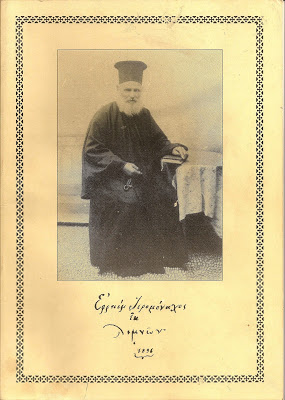
The present text is inspired by the books of the former Scholar and Professor of the PAEAI of Crete, Protopresbyter George Emm. Marnellos, about the blessed, visionary and miraculous Elder Hieromonk Ephraim Hatzipateras, who lived in the Holy Land for three or four years, as a hierodeacon around 1860-1862; and later as a Hieromonk and vicar of the Holy Church of the Annunciation of the Lakes (during the years 1871,1896). The Holy Land, writes Fr. George Marnellos, “marked his benevolent heart deeply within him, crafted the secret steps of his soul and rekindled his faith. Based on interviews with relatives of the blessed Hadjis Dimitris Mastorakis of Limnos, “from then on, the miraculous Elder Ephraim showed signs of foresight, holiness and miracles” (The Miraculous Elder of Limnos, Hieromonk Ephraim…, Agios Nikolaos Crete 2023, p. 68).
I will try to outline his holy form and his saintly or ascetic life. The discreet and enlightened Elder Ephraim hails from the Lakes of Mirabello, Crete. He was born in the Lakes in 1828 and died in 1909. His secular name was Efthymios Dimitrakopoulos or Dimitropoulos. The nickname Father Hatzis (Hatzi = pilgrim) is due to his pilgrimage visit and long stay in Jerusalem and specifically to his "baptism" in the Jordan, in 1860. As the "Holy" Hieromonk Ephraim himself testifies in his own writing that was discovered by Fr. George, Marnellos during his research in the library of a relative of the Saint in the city of Agios Nikolaos in August 2022, it is due to the fact that Ephraim was baptized in the waters of the Jordan, in 1860, being a hierodeacon and becoming a "Hatzis", that is, a pilgrim to the Holy Land.
The entire Church of Crete firmly believes that Hieromonk Ephraim Hatzis Father is a saint. “Father” instead of the familiar address of the priest and spiritual father in our villages, “Good morning, Father…”, expresses the manifest presence of the Holy Spirit in the depths of the priestly soul of the Sainted Elder Ephraim, which radiated in his face and in the power of his words. God, as Fr. George Marnellos writes in the booklet he published in 1999, “WORD IN SILENCE FOR MY CHURCH”, speaks from the incarnation of His Son and Word, and through the servants of the word who are in the Church, and the servants of the word are guided and strengthened in the sacrament of preaching by the Holy Spirit who dwells in the Church. Saint Ephraim, CHATZIPATERAS had the inner information that his popular and convincing theological preaching, imbued with the tears of repentance and the holy experiences of the desert ascetics, is not his personal affair but a natural consequence of the sacrifice of Christ on the cross. Also, that in order for someone to acquire the frankness of preaching, the clergyman, especially the Spiritual Father, must be in such a mental state that the light of the Holy Spirit is visible on his face and in his every movement, in his every "reading" for the recovery of those suffering in various ways, in front of the image of Christ and the Virgin Mary, that he is certain of his participation in the uncreated energies of God and sees Jesus Christ "eternal being", always present in the sacramental and liturgical life of the Church (Father Georgios Marnellos, ibid., pp. 7-8).
The address and request for blessing, on behalf of the faithful, "BLESS, FATHER HADZHI" also expresses the great respect of his fellow villagers, the people of Merampelli and all those Cretans who knew him and accepted his advice and teachings, his fatherly blessings or his miraculous power and the gifts he had as a spiritual Father of the Church and Healer of the variously afflicted.
Information indicates that the miraculous Elder Ephraim was a true patriot and fought against the Turks during the Cretan revolutions alongside the chieftain, Father George Giamalakis (1820-1889) from Kato Chorio of Ierapetra, residing in his hideout with other revolutionaries from eastern Crete, at the location "THRYPTI" in the province of Ierapetra during the years 1867-1869, for the freedom of Crete and its union with Greece.
As Father George Marnellos states in the subtitle of his historical work, “The miraculous Elder Ephraim of Mirabello…” is the “Holy Monk who supported the liberation struggle with heroism and self-sacrifice.” The life of the much-respected Elder Ephraim was blameless, Christian, and pleasing to God.
In 1867, in the battle with the Turks in the village of Zenia, in Pano Merambello, "Efthymios (Efraim) Dimitrakopoulos also risked being taken prisoner. A cloud, (by the grace of the Virgin Mary), covered the land in the place where he was passing... The Turks lost them," writes the writer Giorgis Kyriakou Kokolakis (O Hatzi Pateras, Athens 1986).
The Hieromonk Ephraim built, renovated and rebuilt many churches during the difficult years of the Turkish occupation. I specifically mention, in addition to the Church of the Annunciation, which was built by his pious parents Michael and Maria, the historic church of Saint Panteleimon in the village of Choumeriakos Merambellos. In the city of Agios Nikolaos Lasithi, the church of All Saints on the islet of the same name and the church of the Holy Forerunner (1st Cemetery of the city) and of Saint John the Theologian in Mesa Laconia, Schisma settlement, where a two-room cave is also preserved, in which he practiced asceticism around the years 1899-1903.
Some of the miracles of Elder Ephraim
1 treatment of Taxiarchis Kandylakis…a paralyzed child from Psychro.
In Psychro, Lassithi Plateau, a boy was born to a poor family, who was given the name Taxiarchis at his baptism. The child grew, but when he reached the age of walking, this did not happen, neither at two years old nor at four. The mother ran everywhere without finding a solution to the problem. She was informed by a nearby villager about the treatment of a sick member of his family by Hatzi Patera, and decided to go with her child to find the famous Saint Elder Ephraim. When she asked her husband for a donkey for the journey, he refused because of the agricultural work. The winter was not suitable for the journey. The following summer, the husband refused again and cursed. The mother did not waste time. With the child on her shoulders, she began the long journey on foot. They would stop for a little rest and to eat some bread. With the six-year-old child on their shoulders, they arrived at sunset and were looking for shelter. They met a priest, greeted him, kissed his hand, and the priest said to them, "You are welcome, but they have sent you elsewhere." The mother replied, "Forgive us, Elder, we are poor and from all the work in the fields, we do not know what to say."
The Wonderful Elder Ephraim immediately took them to his house to eat and rest. The next day, early in the morning, they went to the church of the Annunciation. Elder Ephraim placed the child under the icon of the Annunciation, performed the liturgy, prayed, and told the child to get up and go to his mother. To sit down when he got tired and to get up on his own without asking for his mother's help. This child grew up in his village, became a shoemaker, started a family, and had no health problems. This is what Nikos Karavalakis, a civil engineer, fellow villager, neighbor, and a witness to this from Taxiarchis himself, testified to in the newspaper ANATOLI.
- Treatment of a possessed girl.
The Miracle Worker and Holy Elder Ephraim went to the Church of the Annunciation of the Lakes, where he served as a vicar, along with the parents and the demonized girl from the village of Ierapetra. He celebrated the service and then read the relevant prayers. The girl was healed and, leaving the church, donated to the Virgin Mary a large chain that she was wearing.
All the people of Limni are familiar with the chain from the story of an aspiring thief, who, before reaching the exit of the Church, remained motionless in the middle of the temple. In the morning, after prayers to the Virgin Mary, he was freed. This man became a model of morality and did not harm anyone.
The monk Damaskinos of Mount Athos writes about the Ascetic Elder Ephraim of Limnai, among others in 1984. From the desert of St. Basil, the following, important for the virtuous life and holiness of Saint Ephraim, Hadjipater: “…in the times of Joseph Gerontogiannis…” (+1884) “Father Hadji, renowned for his virtue and holiness of life, shone in the village of Limnai…about whom many have told me miraculous and unheard-of things, which I omit for the sake of brevity and I only mention the remembrance of one, which happened to a woman who went to the Saint with her husband. It is as follows: One day, Father Hadji, having built a cell, said to them, "Today at night a woman comes with her mouth open, which, while gaping, remained open and cannot be closed, and she comes with her husband." And they marveled and asked in sorrow if she would be healed. And he said to them, "Do you doubt that she will not be healed as long as she comes to the Virgin Mary with faith?" He said this because he had the holy icon of the Virgin Mary in his cell with an unlit lamp and he took oil with cotton and anointed the sick and healed them. About sunset the woman came with her mouth open, a sight of horror and terror to those who heard, let alone to those who saw it? Then the father Hadji, gazing at the woman's husband, utters a most bitter rebuke and says to him: "Wretched and wretched one, you have committed a crime and what evil you have done to your wife. You are the cause of this misfortune because you insulted your wife and her mouth remained open and now she cannot close it." Hearing this, the man falls at the feet of the Saint and tears flow like a river, begs forgiveness and promises to correct his life from now on. But the Saint, accepting his repentance, raises him up and comforts and admonishes him. Then, taking oil with cotton, he seals the woman's mouth and it is restored to its place and he dismisses them in peace. This miracle was told to me about 60 years ago by a fellow villager of the couple where he met the man and his wife" ( ).
- The healing of the eyes of Helen, the Stavrakakis family, wife of the godson of Saint Ephraim, Hadjipater, the blessed George Dim. Marnellos (1877-1970), and many others.
As for the proactive charism, among other things, the cases are recorded in which the Hieromonk Ephraim refused to eat nicely cooked greens because they were from someone else's field or had been collected on Sunday morning without the housewife going to church. In my humble opinion, the Elder wants to tell us that even greens of insignificant value cannot be collected from someone else's garden without the owner's permission. It is considered theft, taking someone else's property. From the small and insignificant we slowly but surely arrive, many times, at the important ones, at the removal of things of significant value. We should also not skip regular church attendance every Sunday and engage in other work.
The Metropolitan of Petra and Cheronissos, Mr. Gerasimos, speaking at the historic Church of the Annunciation of Limnos, (23-2-2022) linked the memory of the celebrating Saint John the Baptist and the multi-athletic hieromonk and ascetic Ephraim who fell asleep on the same date. During the transfer of the relics of the Holy Elder, in the summer months of 1915, to the Cemetery of the Holy Forerunner in Limnos, an indescribable fragrance (myroblysia) flooded the place and more broadly the plains of Limnos and Exo Laconia. One could say it was a divine sign, revealing the purity of life and the heights of holiness of the Miraculous Elder Ephraim.
These are not the only signs after his holy repose. The Hieromonk Ephraim appears many times and makes his presence felt to pious and God-fearing laity and virtuous priests during the Divine Liturgy. He also appears with Saint Nektarios, with whom they have the following in common: Both were slandered and persecuted because of envious and scheming people.
All Orthodox Christians, we are in the hands of the living God, the "risen from the dead" and "resurrected Lord". Let us therefore be vigilant and prayerful. Let us pray to the Triune God to enlighten us in the difficult times we live in, of unbelief and indifference even of so-called Christians. May He grant us His grace and mercy and may we have unshakable faith, trust in God and humbly obey His Holy will. Times are difficult and wicked. Humanity is faltering. A heavenly message is needed. God, we believe and in the case of our canonized Holy Father Ephraim of the Lakes of Mirabello, is already sending us from above, this special message of hope. To all of us. Let us keep the eyes and ears of our souls open.
Institute of Greek Language, Orthodox Theology and Culture