By Pantelis Savvidis
Τ2025 was the year that international politics returned to the logic of spheres of influence and corridors. Geopolitics prevailed over International Law. International rules did not disappear, of course. They were simply stripped bare. The King is, unfortunately, naked.
It has been proven, on all fronts, that international law does not work alone: it needs power, alliances, technology, an industrial base, and above all the will to impose costs on the revisionist forces. Globalization is not “over.” It has changed form. In the era of new technologies, humanity cannot return to nation-states. These will be the core of the international structure but within broader wholes. Either in the form of a Union or in the form of other partnerships.
On this already flammable material, Trump’s return to power acted as an accelerator. 2025 was not just another year of American hegemony, but the year in which Washington openly declared that it no longer intended to act as the international policeman. In the new National Security Strategy, the principle that states fairly share the costs and responsibilities of a common policy is bluntly formulated, along with the requirement that allies assume “primary responsibility” for their regions and be rewarded only if they align themselves commercially, technologically, and defensively with the United States.
US President Donald Trump arrives to deliver remarks on the US economy and affordability at the Mount Airy Casino Resort in Mount Pocono, Pennsylvania, US December 9, 2025. REUTERS/Jonathan Ernst
"Transaction" instead of "class"
The US National Security Strategy It is not reminiscent of the classic, extensive texts of American “world order.” It is short, politically charged, and almost ideological, with “America First” functioning as the core of not only foreign policy but also domestic security (borders, social cohesion, culture war).
The US is withdrawing because it prioritizes differently than in the past. It retains the ability to act unilaterally, but turns the alliance into a contract: whoever wants American coverage pays and falls into line.
Herein lies the great European embarrassment of 2025. Europe did not clash with a hostile superpower, but with its traditional protector. The National Security Strategy contains rhetoric about Europe that escapes geostrategic priorities and verges on culture war, speaking of “undemocratic constraints” and implying that the US will support “resistance” to the European trajectory, proposing a return to the sovereign power of nation states.
European policy in 2025 was harshly criticized in Ukraine. It hovered between moral rhetoric and strategic ambivalence: support without a clear political goal, defense without sufficient industrial acceleration, and fatigue management without a victory narrative or honest compromise. Leaks and negotiation frictions towards the end of the year showed that Europe does not control the flow of developments, but follows them—often behind American initiative and under Russian pressure.
In this structural weakness, Germany emerged as a problem againNot because it is "anti-European", but because its power acts as gravity.
The US-China confrontation
In 2025, the world was organized not only around Ukraine, but around the US-China “great game”. The US seeks to redesign trade flows with China, avoiding an open rupture. China has both the capabilities and the means to resist. It is the American nightmare. The projections into the future favor China, not the US.
The US-China conflict is systemic: technology, supply chains, shipping lines, development banks, influence in the Global South.
Israel–Iran–Eastern Mediterranean
Within this global context, the Eastern Mediterranean is not a “regional detail.” 2025 confirmed that every serious Israeli-Iranian tension, every escalation through networks of influence, and every American attempt to control the conflagration sends ripples throughout the wider region: in energy, in maritime security, in flows.
In 2025, "corridors" became politics. IMEC (India–Middle East–Europe Economic Corridor) It emerged as a promise of connecting India–Middle East–Europe with infrastructure and trade acceleration, in response to the new geo-economy.
But corridors are not technocratic schemes: they are alliances, exclusions, choices of nodes. Whoever stays out pays for decades. Greece is in a remarkable geopolitical position, it has ports, shipping, and the Eastern Mediterranean as a natural "crossroads", but in 2025 it did not appear as a country claiming a position in global plans, but as a country that hopes to be included.
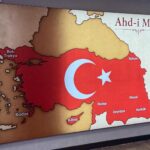
A comforting phenomenon is its convergence with Cyprus and Israel. It is the only cooperation that places it in the Eastern Mediterranean game. IMEC appears as a reason for this convergence, but the cooperation is broader and deeper. All three countries are concerned about Turkish revisionism and are trying to stop it. Benjamin Netanyahu stated at the last meeting of the three in Israel that those who dream of reviving their empires should forget it. Alluding, of course, to Turkey.
The tension between Turkey and Israel was not ideological; it was a clash of regional ambitions. Ankara instrumentalized Gaza to reposition itself as a leading pole in the Muslim world, directly challenging Israel. This conflict reshaped the Eastern Mediterranean and increased its fluidity.
The Israeli campaign in Gaza was the central event of 2025The scale of the destruction, the systematic displacement of populations and the dismantling of any concept of civilian protection constitute ethnic cleansing. Greece cannot accept this policy.
Sudan
Africa
In Africa, 2025 clearly showed what it means "West in retreat". China invests selectively and systematically. Turkey moves flexibly with defense, agreements, commercial penetration. Russia is not limited to hard power: it also utilizes religious/ecclesiastical networks of influence, with the establishment of a parallel ecclesiastical presence in Africa causing open conflicts of jurisdiction with the Patriarchate of Alexandria.
In Sudan, the war has become a self-sustaining system of violence. There is no international initiative for peace in sight. In Congo, violence over minerals has exposed the dark side of the global green transition. The West has accepted exploitation when it serves supply chains.
The Sahel entered a phase of disengagement from the Western security architecture, with Russia filling the gap and China watching closely. The West has paid for its failure to combine security with political legitimacy. The Horn of Africa remains a hub of competition.
For Greece, Suez is not just an international waterway; is the strategic lung of the Mediterranean. Any disruption translates into economic costs, energy uncertainty and geopolitical pressure. 2026 will be judged by whether the region returns to relative normality or whether it remains a zone of permanent tension.
In America
And in the Americas, 2025 marked a qualitative shift in American foreign policy from the rhetoric of “international order” to the logic of overt power. The US-Venezuela conflict reemerged not as an ideological confrontation but as a matter of energy realism. Sanctions were selectively eased, pressure was reinstated on a case-by-case basis, and Washington confirmed that “democracy” now functions as a bargaining tool, not a fixed principle.
At the same time, Donald Trump has unabashedly reinstated the logic of territorial power, publicly demanding the acquisition of Greenland and, on a rhetorical level, even placing Canada within the framework of the American sphere of influence. These statements had no immediate practical follow-up, but they made it clear that the Washington of 2025 does not feel bound by post-war taboos about borders between allies.
The overall message in 2025 was clear: the United States returned to a perception of power where sovereignty, resources, and geography trump rules. 2025 was not just a year of American toughness; it was the year when hegemony stopped hiding behind institutions.
2026 is shaping up to be the year when Trump will attempt to impose the new American architecture: more pressure on allies, more transactionalism, and a Europe of “aligned sovereign states” rather than a single political entity. Even the former is doubtful to succeed. The last Summit showed a deep division on the continent.
Europe will be forced to choose: either accelerate power and cohesion, or accept the role of a market and a region. Germany will continue to be the regulator. It will find itself facing the pole formed by Hungary, the Czech Republic, and Slovakia.
And Greece?
Greece is being dragged by developments. It has no understanding of its history, its role, or its capabilities. Israel, for its own reasons, has dragged it into a cooperation that, under certain conditions, can be beneficial.
In general, Greece declares submission to the "allies" and expects a reward. Fortunately, the good God remembers her sometimes.
2025 showed that the world is getting more expensive, more harsh, more transactional. 2026 will show who turns this reality into strategy — and who simply suffers through it.
source: newspaper "Thessaloniki"
photo Yomare, https://pixabay.com