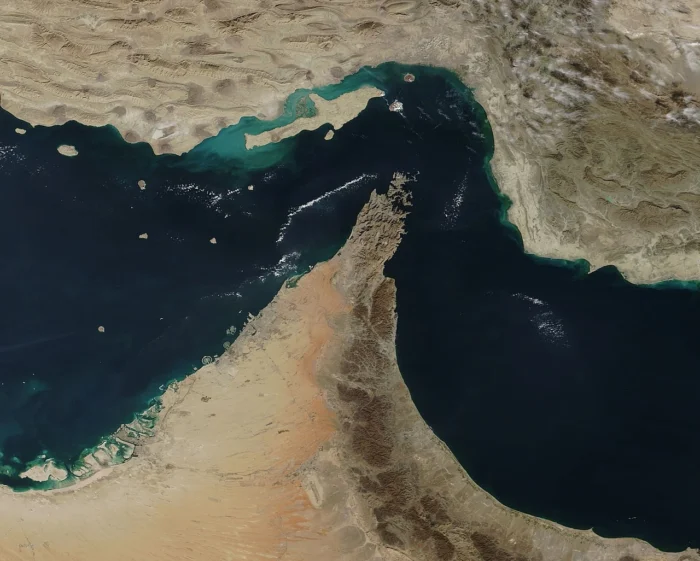
Looking at the economic dimensions of the Middle East can reveal how the conflict will develop, because each country is forced to make specific decisions based on its de facto and geographical location. What is happening in Iran now could shape the global power struggle between the US and China for decades. China has spent years trying to silently and strategically weaken the US and the dollar. Iran became one of its testing grounds. Since Iran was already isolated from Western financial networks, Beijing began buying large quantities of Iranian oil at low prices, paying in Chinese currency instead of dollars. This was not just trade, it was an experiment aimed at reducing the dominance of the dollar. Iranian missiles are now guided by Chinese satellites. China sent chemical rocket fuel, precision guidance systems, and other components. By the time the war broke out, Iran had 2.000 ballistic missiles, the largest arsenal in the entire Middle East, built on Chinese supply lines and guided by Chinese satellites.
The United States already has decisive influence over several of the world's most critical trade routes, such as the Strait of Malacca, the Suez Canal, and the Panama Canal. If it gains similar influence over the Strait of Hormuz, the energy arteries that fuel the Chinese economy will pass through waters protected by virtually a single naval power.
The practical use of mines, drones and missiles in the Persian Gulf maritime area increases the uncertainty of maritime transport and requires costly neutralization operations (e.g. unmanned underwater vehicles, naval clearance teams). If major facilities (e.g. Kharg Island) are damaged, oil supply is dramatically reduced and global prices react, with tangible effects on borrowing costs, asset valuations and market confidence. The following mechanism is already evolving, disrupting the global economy.
- Reduction ofrosphoraς energy increases the price energyA disruption or reduction in exports (e.g. from facility disruptions or closure of the Strait of Hormuz) increases the international price of oil as the Strait of Hormuz carries approximately 20–25% of seaborne oil flows.
- The aincrease in energy costs increases transportation & production costsThis is channeled along the supply chain: insurance premiums, alternative routes, fleet/route adjustments, and related cost reassessments.
- The appearance inflation expectations it affects the monetary policy. Central banks react to rising inflation expectations (or actual price increases) by raising interest rates to reduce liquidity and demand. This in turn changes bond yields and risk valuations.
- Sudden change in yields affects the financial valuationsRising yields lead to falling bond prices and declining stock valuations, hurting pension funds, the banking system and indebted households.
- Risk of socio-political tensionEconomic adversity can create political costs for governments (growth, employment, energy costs), intensifying uncertainty and political reactions.
This chain of transmission, from a local blow in a strait to the global monetary/financial impact, is the key to the Iran war effort.
The US-Israeli coalition seeks to impose its dominance through surprise “decapitation” raids, exploiting information superiority, and targeting the adversary’s command structures. In contrast, Tehran’s strategy is primarily aimed at avoiding total destruction by turning the conflict into a protracted, regional confrontation. The Iranian leadership does not necessarily seek a quick, conventional victory on the battlefield. It prefers to create conditions in which the US and Israel will not be able to achieve clear and definitive results without unbearable costs.
Over the past decade, Iran has built a multi-layered defense framework that balances the technological advantages of its adversaries, creating underground facilities and covert bases, decentralized command that allows for autonomous action, extensive use of missiles and unmanned vehicles, and a network of regional allies and proxies. The goal of this set of measures is to maintain the ability to counterattack even under constant pressure while, at the same time, imposing economic, military, and political costs on the adversary. The end result is to make any conflict protracted, costly, and geopolitically turbulent with consequences for all.
Iran is disrupting the firepower of its adversaries, forcing the US and Israel to protect bases, pipelines, terminals and shipping lanes, reducing their ability to apply rapid, concentrated pressure and preventing any invasion against it.
Iran calculates that by closing the Strait of Hormuz, it could bring high volatility in energy prices and global economic turmoil. The sense that the crisis is costing consumers and countries' political stability is shaping political constraints on escalation. ΑIt aims to undermine the economic resilience of regional rivals and to provoke a global economic crisis by disrupting the flow of energy through a critical strait.
Through targeted information and diplomatic activity, Iran seeks to push neighboring countries into neutrality in order to create cracks in the West and prevent future alliances against it.
If the US invades Kharg Island, where over 90% of Iran’s energy is exported, then the US will control the flow of money into Iran. If the Iranian regime collapses or oil exports are permanently weakened, China loses one of the central pillars of this strategy, and the dollar remains the backbone of global energy trade. China’s economy is heavily dependent on imported energy and on maritime arteries. There is one reality that every strategist in Beijing understands: the world’s oceans remain free for all to sail, as they are dominated by the US Navy. In any global crisis, control of sea lanes can determine whether entire economies grow or shrink.
What is at stake in Iran is not just immediate geopolitical victories or defeats but how global structures of energy, financial dependence, and maritime dominance will be shaped for a generation. So the airstrikes, the sanctions, the disruptions to oil markets are also parts of a much larger strategic game, one that could determine the global balance of power for years to come.
On the other hand, China has armed Iran. Iran is draining US resources, and China has not lost a single soldier. While the US is burning through interceptors in the Middle East, China is watching with interest because every rocket the US launches there is one less rocket available for the defense of Taiwan. This was Beijing’s plan from the beginning. Iran makes 100 missiles a month, while the US only makes 6 interceptors. Each Iranian missile costs about $500.000, but each American interceptor costs several million dollars. In just 15 days, the US had used up interceptors that will take years to replace.
What we are seeing now is not chaos but the beginning stages of a much larger strategic shift. A shift that could define the global balance of power for the next fifty years.
The greatest threat to a state does not necessarily come from the enemy on the battlefield, but from the fiscal burden that will follow. Victory loses all value if it leads to the collapse of public finances. War is risky and corrosive; it can tear apart the society it is supposed to defend. Every tactical choice on the battlefield is, in essence, a choice about the fiscal sustainability of the nation. A miscalculation not only costs lives, but also endangers the very functioning of the state. States that have understood war as an economic tool, something to be used rarely and strategically, have succeeded and survived longer. The strength of a state does not come only from its military but also from its economic resilience that is its ability to absorb shocks, recover, and continue to function. States don't fail because they lose battles. They fail because they exhaust the capital that keeps them cohesive, confident, and functional.
The leader who preserves resources is wiser than the leader who conquers cities. The leader who conquers without fighting is wiser than the one who destroys armies. So in the war in Iran, strength is not measured by how hard you hit, but by how much you can afford to hit.
Given the current energy independence of the US, a sharp rise in prices and an oil shock seems easier to deal with by the US (managing domestic inflationary pressure) than by China (which does not have such strong reserves and can be “deprived” of cheap oil from Venezuela and Iran). This makes a prolonged embargo of the Strait of Hormuz not so disastrous for the US. Perhaps the US is in no hurry to reopen Hormuz if the current situation strangles China’s industrial base. Much will depend on the already ongoing discussions and the upcoming meeting of the US and Chinese presidents and how China’s trade surpluses ($1,2 trillion in 2025) that pose a systemic risk to global industry will be reduced.
Photo By MODIS Land Rapid Response Team, NASA GSFC – This image or video was cataloged by Goddard Space Flight Center of the United States National Aeronautics and Space Administration (NASA) under Photo ID: 2018-12-10., Public Domain, https://commons.wikimedia.org/w/index.php?curid=145434088, https://en.wikipedia.org/wiki/