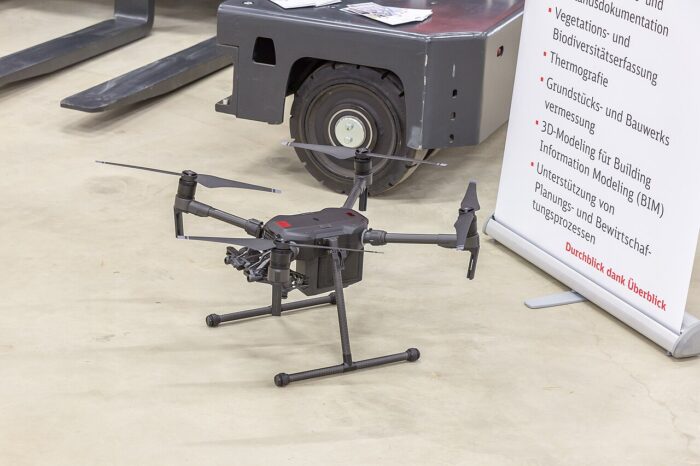
The unmanned aerial vehicle (UAS) threat environment is rapidly changing, with a growing variety of deadly drones requiring different tracking and identification methods to engage and neutralize them.
Countering a swarm of unmanned aerial vehicles (UAVs) is one of the most complex challenges for modern air defense systems. The threat is no longer limited to a single drone, but includes a large number of different types and sizes of unmanned aircraft, which can operate at low altitudes, at different speeds and from different directions.
The problem, therefore, is not simply detecting a drone. In an attack with dozens or even hundreds of drones, the critical issue is the simultaneous tracking, identification, assessment and prioritization of targets, as well as the selection of the appropriate means of countering each threat.
Effective defense relies on a layered and networked sensor architecture. Instead of a large radar being the sole means of surveillance of an area, different systems can be placed at different positions and heights, creating overlapping zones of coverage. This reduces “blind spots,” especially in areas with complex terrain, buildings,
The combination of different sensors
No single sensor is ideal for all conditions. For this reason, the modern approach is based on the cooperation of different technologies. Tactical radars can detect and track objects in the airspace, while electro-optical and infrared systems can provide complementary information for the identification of a target. Acoustic sensors and electronic warfare sensors can also be utilized in an integrated system, depending on the operational requirement.
The value of this approach lies primarily in data fusion. A drone detected by one sensor can be tracked in parallel by others, increasing image reliability and reducing the likelihood of losing track.
The distributed deployment of sensors is also particularly important. If all the assets are concentrated in one location, the loss of this point can create a serious gap in the defense. On the contrary, the dispersion of sensors increases the resilience of the system and allows threats to be observed from different angles.
The real problem with swarms
In the case of a swarm, simply detecting drones is only the first step. The biggest operational problem is managing a large number of simultaneous tracks. If, for example, dozens of drones are heading towards a protected area, the system must be able to determine which of them pose the most immediate threat, which direction they are taking and how the available response resources should be allocated.
Therefore, dealing with a swarm does not simply mean requiring “as many weapons as drones.” It requires a command and control system (C2) which will aggregate data from sensors, create a single operational picture and coordinate the response. The process can be schematically described as:
- Localization
- Tracking
- Recognition
- Threat assessment
- Hierarchy
- Choice of treatment method
- Jam
- Result confirmation
The system also continues to monitor the airspace, as a drone may change course or remain active after the initial engagement.
The importance of time and detection
In a drone attack, time is of the essence. The earlier a threat is detected, the more options the defender has. That's why deploying sensors in different locations and networking them can significantly increase the available reaction time.
A sensor at a higher altitude can provide early warning, while another in a different location can cover areas that are in the “shadow” of the first. This logic creates depth in air defense: Even if one sensor cannot detect a threat due to geographical or operational limitations, another can take over monitoring it.
The last and perhaps most difficult phase is the selection of the appropriate means of counteraction. A modern counter-UAS system can combine different modes of engagement, depending on the threat and the available capabilities. The basic principle is that the sensor does not necessarily need to be located together with the means of engagement.
Information can be transmitted via a networked architecture to a command center and from there directed to the appropriate response system. This allows for greater flexibility, better utilization of available resources, and greater survivability of the overall architecture.
The future of defense against drones
The rapid development of drones, the reduction in their production costs and the possibility of building even small unmanned aircraft with relatively simple means, create a new reality for air defense. The answer does not seem to be a single “super weapon”, but an integrated, multi-layered and networked system. Radar, electro-optical and infrared sensors, electronic warfare systems and jamming means must operate as a single team.
In the case of swarms, success will increasingly depend on a system's ability to see, understand, and manage multiple threats simultaneously, while maintaining sufficient reaction time and alternative options, even when some part of the defense suffers losses or interference.
In other words, the modern approach to dealing with drone swarms is shifting from a simple “spot and shoot down” logic to a much broader “spot, combine data, assess, prioritize and coordinate” logic. This transition is now a key element of modern multi-layered air defense.
source https://slpress.gr/amyna/pos-boroun-na-antimetopistoun-ta-smini-drones/
Photo By © Raimond Spekking / CC BY-SA 4.0 (via Wikimedia Commons), CC BY-SA 4.0, https://commons.wikimedia.org/w/index.php?curid=66772842 , https://en.wikipedia.org/wiki/