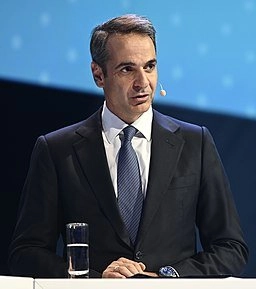
Mr. was remarkably comfortable. Prime Minister, or visit its Press conference of the 12th current, and without even having to think for a second about the content of his answers. He transported us, with a magic carpet, to another Greece. That miraculously, all her thorny problems had disappeared. He no longer faced any threats from outside, since our national interests coincide with the corresponding Turkish ones, nor the risks of alteration of our population, since the invading immigrants will be hosted in new island structures. And, in addition, Mr. Mitsotakis explained thoroughly and without the slightest hesitation, that we now live in a privileged country, which is not plagued by high debt and deadlocked financial problems. That is why the time has come, as our first priority, for our country to embrace young people, as it has the luxury of donating to all students, who study outside their place of permanent residence, and regardless of their financial situation, 1000E for six months. That is why Greece now has the opportunity to offer, as a winning old man, 1200E for six months to every young person under the age of 29, who is hired. That is why our country is now unworthy of the product of high taxes, contributions, ENFIA and co-conspirators, and is in a hurry to make significant reductions. This miraculous homeland, after all, is now able, according to the content of the prime minister's interview, to finance important infrastructure projects from one end of our geographical area to the other. As for the wave of price increases, it goes without saying that our rich Greece would be unthinkable to leave its citizens helpless, but on the contrary it is committed to providing them with compensatory contributions, so that their income does not shrink.
II. RETURN TO REALITY
As unfortunate as it is to fall from the clouds without a parachute, let us return to our real country. The one who bleeds, who is threatened by enemies but also friends and who has to change gears to survive.
And I come to the interview:
It is, indeed, inexplicable how and why, despite the long duration of the interview, which in theory would have allowed the exhaustion of important questions, was absent from it, almost completely, all of our thorny financial problems and more. Indeed, it is a pity, because the reflection on the economy would be of primary importance, the positions of the Prime Minister could be enlightening, and it would certainly be possible to clarify a number of dark points regarding the Prime Minister's announcements. Namely:
* No answers were sought on how to finance all these numerous announced benefits, as well as the implementation of important infrastructure projects throughout the country. Especially since these coincide in time with tax reliefs, ENFIA, etc. Furthermore, it was not clarified whether the product of the accelerated selling rate of public property, and in particular of utilities, will participate in these costs.
* Without objection, the journalists accepted the assurance that, as Greeks, we should celebrate because our GDP increased by 16,2% in the second quarter of 2. However, it is clear that this is not a GDP increase, but a simple substitution of the equivalent reduction of our GDP, in the 2021nd quarter of 2. I should also add that the Prime Minister's report, which presented the deferred substitution of demand as a growth of GDP, is obviously connected with the assumption that the increased deposits of households are considered and these as an increase in income and wealth (2020E billion). It is not, however, a sign of wealth, but of a forced reduction in consumption, due to confinement, and due to uncertainty due to the virus. After all, we should not miss the temptation to consider ourselves "rich", that our average per capita income in the Balkans is now only slightly higher than that of Bulgaria, before the criminal memoranda. , was at the top. But, finally, the question reasonably arises, from where could this supposed increase in wealth be secured, through an economy that has been dead for months?
* Our inflation, which is only 1,9% and which is below the corresponding EU average (over 3%), despite the significant increase in liquidity due to virus, can not be perceived as an encouraging element, as it seems to be believed. And this, because it indicates an inherent inability of our economy to react and mobilize the decisive, for growth, moments, even in periods of such high liquidity. It ultimately indicates the absence of potential growth. On the other hand, however, it is worth noting, in this regard, that the rise in prices for gasoline, gas, electricity, basic foodstuffs, etc. it is not going to be limited to them, but necessarily, it will be generalized. This inflation is both supply, demand and cost, so it is unlikely to develop into productive, which would be welcome. Thus, and unfortunately, the prime ministerial measures that will try to control the situation will be ineffective, as is always the case in free economies.
* According to the prime minister's optimism, "fat cows" are waiting for us, and not just for a year from today, but for more. These positive forecasts seem to be justified by the high growth rate, which for this year exceeds 5%. May it be so! But it is important to know where this panacea will come from. There are, of course, many sources of fuel for growth, but they must be identified, and above all they must be able to increase the productive capacity of the economy. Therefore, the surges in consumption, which are undoubtedly due to the evolution of the virus, and which simply restore the economy to relative normality, are not growth, and will not last. Demand is already falling in the US as the economy returns to normal levels. Therefore, the certainty that this year's high growth rate is not a bubble of the virus should be based on sources of durability. So, apart from the sale of our public property, which certainly does not make us richer but, well, poor and unfortunate, there is also the T.A. in whose benefits high government expectations have been deposited. Although the money we get, apart from the loans that make our debt bigger, is not enough to meet our needs, they could nevertheless be an introduction to the beginning of a development effort. They should, however, ensure completely different specifications for their use, namely:
-We should choose the primary, for the development stage and the peculiarities of our economy, investments that of course would not be wind turbines and electric cars.
-To ensure a kind of investment, the multiplier results of which, at least in a decisive percentage, would remain in our country, and would not make Northern Europe richer.
-To have insisted on our right to obtain the necessary imports, for our investments, from countries that would supply them at a lower cost than the equivalent of the European North. Especially because now the cessation of the production chain in many parts of it creates shortages, significant price increases and transportation costs.
- In summary, we should have renounced the abysmal subordination, which seals every manifestation of our national existence, to the point that the Economist (through our Prime Minister) points the finger at us as the "best student of the EU". And because, unfortunately, on the horizon I am unable to discern such desired changes, I have very strong concerns for the future. Specifically, that we will continue to consent to serving the interests of "partners-allies-friends", to the detriment of our own.
* It is true that there was a question, which referred to our debt, which is climbing steadily. However, any relevant concerns have been limited to the complacent assumption that the cost of money will remain low, and that our compliance with the stifling terms of the Stability Pact will continue to be relaxed and in a comfortable liquidity environment. Unfortunately, I do not share this optimism, and instead fear the worst, based on "reasonable predictions".
* I conclude by expressing my enormous surprise that the journalists invited to the Prime Minister's interview not only ignored the critical problems of the economy, as they remained orphaned by key questions, but also reassured themselves with the Prime Minister's assurances that we found with the Turks ". It is, indeed, inconceivable that the journalists invited to the Prime Minister's interview were not curious to find out when, how and in what parts of our intense disagreements there was an agreement, but of course what it includes.
Photo: European People's Party, CC BY 2.0 License, via Wikimedia Commons