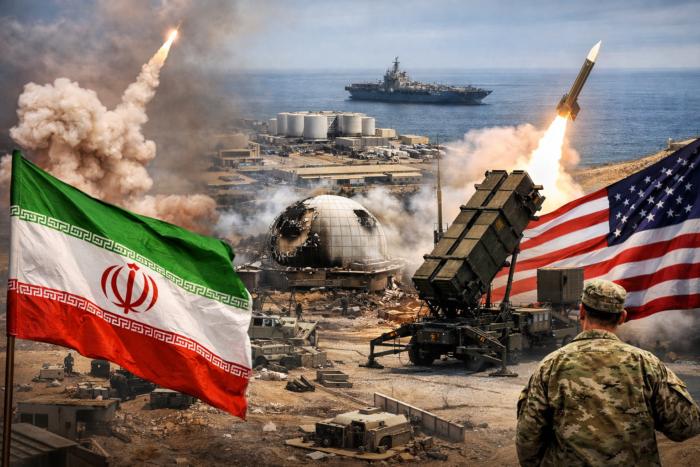
Recent reports of Iranian strikes on American military installations in the Persian Gulf bring to the fore a crucial question for the geopolitical balance in the Middle East: how vulnerable is the United States' network of military infrastructure in the region and what is Tehran's real strategic goal.
According to information based on satellite imagery and international media analysis, the attacks appear to have focused not only on the bases themselves but also on critical communications and missile tracking infrastructure. These systems form the “backbone” of US missile defense in the region, as they coordinate the Patriot and THAAD networks that protect US military installations and allies.
The strategic importance of the bases in the Gulf is enormous. The Fifth Fleet headquarters in Bahrain, Al Udeid Air Base in Qatar, as well as facilities in Kuwait, Saudi Arabia and the United Arab Emirates are key hubs of the US military presence in the Middle East. These bases coordinate operations, monitor maritime traffic in the Persian Gulf and ensure the protection of energy sea lanes.
Analysts point out that Iran has been investing for decades in a strategy of asymmetric deterrence. Rather than competing with the United States in conventional military power, it seeks to develop capabilities that can strike at critical points in the American military system. In this logic, the goal is not necessarily to destroy large military units, but to weaken the communication and coordination networks that allow these forces to operate effectively.
However, despite the attacks, most US bases in the region appear to continue operating, suggesting that the United States military infrastructure possesses significant levels of resilience. The presence of multiple backup systems and the dispersion of facilities across multiple countries make it difficult to completely weaken the network.
The key question that emerges is whether these events signal a new phase of strategic confrontation in the Middle East. In a region where the interests of great powers and regional players converge, even limited strikes can affect the balance and lead to escalation.
The geopolitical reality of the region shows that the confrontation is no longer limited to the military level. It is a clash of technology, information and strategy, where the ability to control communication and surveillance networks may prove to be as important as military power itself.
Watch the relevant analysis video:
"Satellite images and military analysis of the attacks on American bases in the Persian Gulf."
https://www.youtube.com/shorts/g05X8Xe3cU8
photo Greek Radio FL