"Price in 1821". Although the lights of the 200th anniversary have gone out, with all the bitter taste left behind by its official celebration, I return today to this crucial issue, the repercussions of which will haunt our country in the coming years.
Before setting out the facts and reasons that persuaded me once again to address the issue of ethnocentrism and subservience (although PRICE IN '21 has already dedicated many and varied of its activities to it), it is necessary to recall and underline the obvious. That is, my intention is not to appear here as a historian, which I am not, but simply to point out some reasonable concerns, which I want to believe reflect those of the average Greek. That is, to refer to the history of our homeland, as we learned it in schools, universities or through favorite books (among others, Penelope Delta), as we experienced it with our participation in national holidays, student parades and our student years, through songs and recitations with national content, or even through theatrical performances that took us to ancient Greece, to our roots, as we believed, and we appeared in costumes of the time.
There were, of course, long ago, and especially after the intensified claims of Skopje intensified, a small number of people on Greek soil, who were arguing non-existent views about their alleged kinship with Alexander the Great and other similar fantasies. These, however, were generally regarded by the people, but also by our governments at the time, as spies for enemy forces, and were treated as such. The dramatic change, unfortunately, began with the Prespa agreement and, as everything shows, continued and was consolidated with the choices of the way the official Commission Greece celebrates 21.
I am referring to the relevant findings, reviews and the numerous and varied activities of PRICE AT 21 (https://timisto1821.gr/oi-drastiriotites-tis-timisto-21/), which were initially based on the assumption that 21 historians participated in the Greece Commission by "mistake" with views that until recently were considered self-inflicted anti-Greek. However, it soon became clear to us, at the PRICE IN 21, that this was not a "mistake" by the Commission Greece 21, but on the contrary, a completely conscious choice. And if so, then the admitted failure of the official celebration of Polygenesis was also part of the program. A hypothesis, after all, logical because, what to celebrate for the 200 years since the Revolution, when it is said by official members of the Commission Greece 21 that "there was no slavery", that "there was no need for the Revolution", but also when the urge is given to "Do Greeks cut themselves from similar national narratives"? (see 1).
Some of the above views are mentioned in the three-page interview of Mr. Roderick Beaton to the journalist Mr. Vassilis Tsakiroglou (2), on the occasion of his new book "Greece, Biography of a Modern Nation", which is hosted on Sunday "First Subject "of 30.01. 2022 (3). It is also important to add that in a previous year of the interview, these views were rewarded and formalized by the Greek State, since the former President awarded the well-known historian (1).
It therefore seems clear that a tacit decision on the need to "rewrite our history" is already in place. This new story of ours will obviously be deprived of any continuity, through the centuries, between the ancient and the modern Greece. It will be the history of a nation, which is identified with the state of only 200 years. This story, moreover, will have been freed, leaving behind the "narratives" of heroes of 1821, from the secret schools, from the hardships of Turkish slavery, etc., etc., if the Greeks were not "slaves" of the Ottomans, if not there has been "400 years of slavery", and since all of these are imported ideological outputs of the West. So, the Revolution was unnecessary, so for Kaiadas are the historical costumes, so… ..we Greeks must "get serious", taking the Memoranda as an opportunity that will "open our eyes" (see 1 ).
The abyss of the history of a Nation, which until now boasted that it was counting millennia, but which now has to be convinced that it was "imaginative", and therefore must hurry to throw into the fire all the previous textbooks, which contain national "narratives", and of course to give the Turks a sweet look, as they took good care of their ancestors, is indeed an extremely serious matter.
There is, however, a thorn in the side of this campaign to dismantle the Greek past. And this is the deep-rooted tradition, in the souls of the Greek people, which is not easy to uproot, as was clearly seen in the tragedy of Skopjan. Therefore, the successful continuation of this operation must succeed in convincing the Greek people that this is not a "falsification of its history", but a "restoration of the real facts". Such as, e.g. that in Smyrna there was simply "crowding" and not massacre of the Greeks. Such as, e.g. that in Chios the Turks were forced to react against the Greeks, because they had previously been attacked by them. As e.g. that there was no 400-year-old slavery, but a life given to the Turks, and so on.
If, however, this is the case, and those who lead this reversal of our history, have good intentions and strive to get the people out of their long-standing narrative fantasies, one wonders why they avoid sunny streets, and prefer dark basements. Because all these "writers of modern Greek history" do not appear brazenly in the media, to explain to their compatriots, where is the lie and where is the historical truth. Because, the "reviewers" of history give us the impression that they are trying to change our existing / traditional history, looking for hidden paths or even methods with a convincing tone.
The bitter celebration of the 200th anniversary, for the reasons set out above and in more detail in my booklet (4), gave a bitter impression of an attempt to decompose our history, but also to hide it. A similar impression was given by the awarding of scholarships by scientists who unequivocally support the need to "rewrite our history" (1). The same impression was given by the timeless, but never announceable deletion of important historical events of our history, from textbooks.
The Greek people, not only were not asked if they agreed to cede their "soul" to the people of Skopje, but were also exterminated, as their desperate reactions were characterized as Nazi, extreme right-wing or even brainless. And regarding the referendum of 2015, the result of which was not to the liking, inside and outside the Greek territory, it simply suffered, 100%, falsification of its content. As everything shows, the fundamental reconstructions of the will of the Greek people, with methods chosen on a case-by-case basis, have been relatively easily accepted by him until today. However, it must be considered certain that the descent of Greek identity, in all its manifestations, will encounter a violent reaction and insurmountable obstacles. Because, it will be about the "final solution" (as the expression is used for the Holocaust).
However, the salvation of the Greek people presupposes its ability to realize that its Nation, with the heaviest heritage of all centuries, is gradually being deconstructed to become a new Nation and state with a history and culture of only 200 years.
And, exactly, the anxious question is posed as follows: "will there be these possibilities of awareness of the Greeks"?
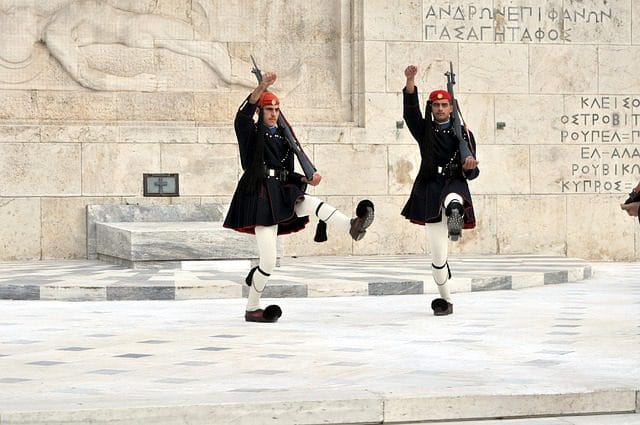
photo: https://pixabay.com/el/