The global economy is entering a new period of financial instability, where the dollar is returning to the center of international power. Despite constant predictions of de-dollarization and efforts by the BRICS, China and other emerging powers to create alternative monetary systems, the reality of recent years reveals something different: in every major crisis, the entire planet continues to seek dollars.
The recent collapse of the Turkish lira, Turkey’s aggressive selling of US bonds, and the growing need for currency swap lines from the US Federal Reserve by many countries are all signs that the world has yet to find a real alternative to the US currency. On the contrary, as geopolitical uncertainty increases, the dollar’s importance as the global reserve currency is growing.
After World War II, the United States built an international financial system based on the dollar. Initially, the dollar was tied to gold through the Bretton Woods system. But in 1971, when President Richard Nixon closed the “gold window,” the American currency needed a new base of support. That base was oil.
The United States agreed with Saudi Arabia and the OPEC countries that the world oil trade would be conducted exclusively in dollars. The so-called “petrodollar” created a permanent and structural demand for the US currency. Any country that needed oil had to first acquire dollars. States stored dollars in their foreign exchange reserves and reinvested these funds in US government bonds. This is how American power, technology, military dominance and economic expansion of the last fifty years were financed.
In recent years, however, China has systematically sought to challenge this system. Through its Belt and Road Initiative, infrastructure investments, and energy deals, China has attempted to persuade oil-producing countries to accept payments in yuan instead of dollars. Russia, Venezuela, and some Gulf states have begun to conduct limited non-dollar transactions. In 2024, the petrodollar agreement between the United States and Saudi Arabia expired without a formal renewal, raising fears that the dollar system would begin to unravel.
However, crises always reveal which currency is truly safe. And right now, Turkey is the most prominent example.
The Turkish economy is facing a multifaceted crisis: energy dependence, trade deficits, high inflation, political instability and growing geopolitical risk. The rise in oil prices due to the conflict with Iran has dramatically increased the country's need for dollars, as Turkey imports almost all of its energy needs.
The Turkish lira came under extreme pressure and the government was forced to use its foreign exchange reserves to support the currency. Within just one month, Turkey sold almost all of its US Treasury holdings, reducing its holdings from around $16 billion to just $1,8 billion.
This move is not a sign of dollar weakness, quite the opposite. Turkey did not sell US bonds because it does not need the dollar. It sold them because it urgently needs dollars to survive, to buy Turkish lira with those dollars so that its currency does not depreciate further and foreign investors do not withdraw their investments from Turkey. This is a critical distinction that is often ignored in the public debate about dedollarization.
The same pattern is seen in other emerging economies. In times of energy shocks, wars or capital flight, central banks are forced to sell US bonds to acquire dollars and defend their currencies.
This creates a vicious cycle. The more countries sell U.S. bonds, the higher their yields. And the higher the yields, the more expensive money becomes worldwide. Already, yields on U.S. 10-year and 30-year bonds are hovering near or above 5%, levels reminiscent of times of severe financial instability. The U.S. borrows in one- and two-year bonds that have lower interest rates of around 3%.
At the same time, the United States is facing a huge debt problem. The US national debt has exceeded $39 trillion and continues to grow at an avalanche pace. This means that Washington is increasingly dependent on maintaining global confidence in the dollar and the US bond market.
This is where the Federal Reserve’s dollar swap lines come into play. Currency swaps allow central banks in other countries to gain direct access to dollars from the Federal Reserve by exchanging their own currency for U.S. dollars. They are essentially an emergency liquidity facility that is activated when the international financial system begins to face a shortage of dollars.
During the 2020 pandemic, and in subsequent periods of crisis, many countries turned to the United States for currency swap lines to stabilize their currencies. This proves that, despite the political rhetoric of a “multipolar and polycentric world,” the dollar remains the only currency that can act as a global haven.
Interestingly, even countries that want to reduce their dependence on the dollar eventually return to it in times of crisis. The dollar system acts as a global safety net. When all else fails, the world seeks access to the liquidity of the US Federal Reserve.
The case of the Middle Eastern countries is particularly revealing. Most of the region’s currencies are pegged to the dollar. This means they require a constant inflow of dollars to maintain their stability. When geopolitical tensions and the closure of the Strait of Hormuz disrupted oil flows, several of these countries found themselves facing a real shortage of dollars as they sold in yuan and rupees.
Then the US Federal Reserve appeared, offering currency swaps and instant access to dollar liquidity. This had enormous geopolitical significance, because it brought these countries back closer to the American financial architecture.
In October 2025, the US bought Argentine pesos and agreed to a US$20 billion currency swap line, of which only US$2,5 billion was used to fend off peso depreciation pressures. A similar mechanism is being discussed between the US and the UAE, which withdrew from the most destructive cartel in human history. The next country likely to move in this direction could be Saudi Arabia, followed possibly by Qatar and Kuwait.
The Turkish lira crisis also demonstrates something even deeper: the national currencies of emerging economies remain vulnerable when not accompanied by a strong productive base, institutional stability, and energy self-sufficiency.
Turkey has been trying for years to emerge as a regional power and hub of the new Turkish geopolitical space through the Organization of Turkic States (OTS). The United States is increasingly seeking to transfer some of the responsibilities and costs for regional security to its allies and partners. Within the framework of this approach, regional powers are expected to form their own security mechanisms and structures, capable of managing local geopolitical balances. The OTS, under the leadership of Ankara, could gradually develop into an organized geopolitical axis along Russia’s southern sphere of influence and stop China’s penetration into these countries, as well as Iran. Moreover, the uncertainty surrounding Iran's future moves and strategy is increasingly pushing Turkey and its allies in the Caspian region to choose a common regional strategy to manage and limit the geopolitical risks stemming from Iran's ambitions. The countries of Central Asia, and especially Kazakhstan, play an important role.
But geopolitical power without monetary stability is limited. Turkey can expand its influence in Central Asia, but it remains dependent on the dollar for energy, imports, and the stability of its financial system.
This is the great paradox of our time. People talk about dedollarization, but crises increase the demand for dollars. Countries try to create alternative monetary alliances, but when pressed, they turn back to the dollar. The real question is not whether the dollar will be replaced immediately. The question is whether the United States can maintain the political, military, and institutional credibility needed for the dollar to continue to be the backbone of the global system.
Because the power of a currency is not based solely on economics. It is based on trust, geopolitical power, institutions, and a country's ability to act as the ultimate guarantor of stability in times of crisis. And so far, despite all its weaknesses, no other power has managed to replace that role of the United States.
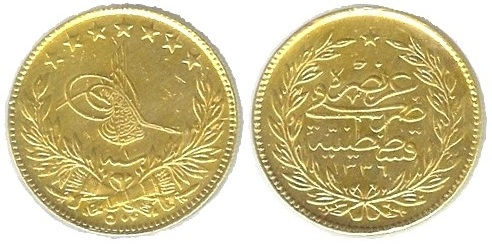
Photo By Unknown author – http://www.ottomancoins.com/, Public Domain, https://commons.wikimedia.org/w/index.php?curid=4116997, https://en.wikipedia.org/wiki/