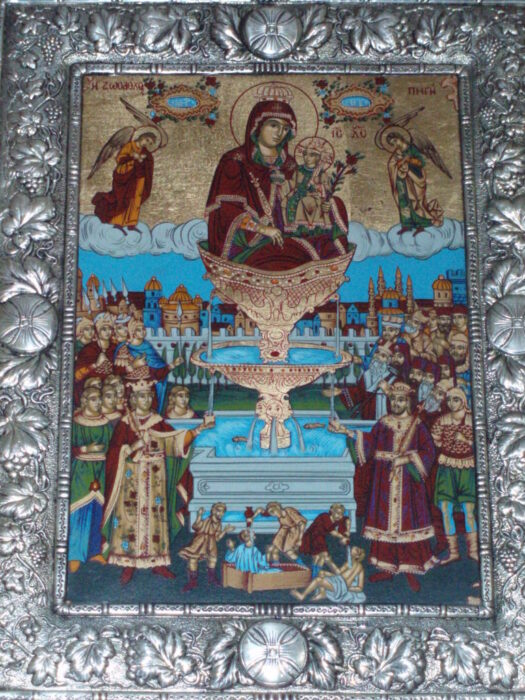
The Feast of the Life-Giving Source is a movable feast, celebrated after the Life-Giving Resurrection of Christ the Savior, on Good Friday. The Virgin Mary, the source of Life, is honored on this day, because she brought into the world the incarnate Word of God. It does not honor any event of Her earthly life (birth, ascension, etc.), but celebrates Her miracles to people., sick or having a problem.
The name "Life-giving Spring of Baloukli" or "Virgin Mary of Baloukliotissa" is given to the area outside the walls of Constantinople towards Silybria, where there was a spring, in "the palaces of the springs", where the emperors spent their summers in the Spring. It took its name from the Turkish word "Balık" which means "fish".
There are two versions of the discovery of this Holy Water.
A) The first version is mentioned by Nikephoros Callistos, according to which an unknown and unknown butcher named Leo is, as a soldier, around 450 AD in a forest of Vasilevousa and hears the voice of a blind man asking for water to quench his thirst. Leo looks for a spring. However, he does not find one and returns sad. Then he hears a voice telling him: "I do not owe you, Leo, I am in anguish, for the water is near." That is, "do not be sad, Leo, the water is near you." The same female voice continues: "Leo, king, take some of this water and give it to the blind man to drink to quench his thirst. And one more thing, anoint his eyes with this and you will immediately understand who I am who is speaking to you." Leo obeyed and indeed found the spring, took water and quenched the blind man's thirst. The blind man's eyes were also opened, after he had previously anointed them with water. Leo's eyes were also opened and he realized that the female voice was that of the Virgin Mary and that the miracles were Hers: of finding the spring., and the recovery of sight of the blind man. Later, a third miracle occurred. The Virgin Mary addressed him as "king" and Leo became emperor in 486 AD with the name Leo I of Thrax, also called Makellis, and whom our Holy Church honors as a Saint on January 20. The name "Makellis" refers to his profession (butcher).
Leo, as emperor, will erect a splendid Temple to remind us of the benefits of the Virgin Mary to him and to all of us.
B) The second version is preserved by the historian Procopius and is placed at the beginning of the 6th century.th century and refers to Justinian. Justinian was hunting in a wonderful landscape with lots of greenery, trees and water. He then sees, as if in a vision, a chapel with a crowd of people and a priest in front of a spring and they tell him: "It is the spring of miracles". He builds a temple there with materials that were left over from the construction of Hagia Sophia. St. Kedrinos reports that it was built in 560 AD.
Regardless of the way the Holy Water was found, it is testified that: Emperor Justinian suffered from dysuria and because he was cured by the water of the spring, in order to please the Virgin Mary, he erected a large Temple, which Basil the Great repaired after the damage caused by various earthquakes. Many miracles were performed at the spring, such as solutions for sterilization and resurrections of the dead. It is also reported that a Thessalian, coming to the spring, died on the way. While he was still breathing the loisthi, he ordered the sailors who accompanied him to take him to the temple of the Spring and pour three buckets of water on him, from its water, and thus bury him. Indeed, the sailors carried the dead man to the spring, as soon as the water was poured on him, he came to life.
When the temple was about to fall, believers saw the Virgin Mary holding the temple from falling until the moment when all the people came out of it.
The water of the Spring cast out demons from people, freed prisoners, cured the lithiasis of Emperor Leo the Wise, gangrene and deadly boils, anthrax, leprosy, lice, swellings in women, effusions in the eyes, albumens and hyalopes. Andronikos III, lies dying in Didymoteicho,He drinks from the holy water of the Spring and is healed.
Writing in the 14th century AD about the holy water of Pigi, Nikephoros Callistos cites, from various sources, a list of 63 miracles, of which 15 date back to his time.
Today, in the courtyard of Zoodochos Pigi, the tombs of the Ecumenical Patriarchs are located. The holy water is located in the underground Church.
In commemoration of the inauguration of the Temple by Emperor Leo, the Church established the annual feast of the Life-Giving Spring, on the Friday of Holy Week.
Operative texts
Ἀπολυτίκιον
Your temple, O Theotokos, has become a paradise, like ever-flowing rivers gushing forth healings, for those who come faithfully, like the Life-Giver from the Fountain, draw water and eternal life, for you intercede for those who are made of you, O Savior Christ, to save our souls.
Κοντάκιον
From your inexhaustible source, O God-grace, you reward me by flowing forth the waters, without ceasing of your grace for the sake of the word; for as I have been holding the Word for the sake of the mind, I beg you to refresh me with your grace, so that I may cry out to you: Rejoice, saving water.
Μεγαλυνάριον
Let us honor with faith the life-giving water of the Source, the manna that flows forth, the immortal freshness, the nectar that is divine, the foreign ambrosia, the honey from the stone.
Photo By User Templar52 – Transferred from el.wikipedia to Commons by Alaniaris using CommonsHelper.(Original text: Own photo), Attribution, https://commons.wikimedia.org/w/index.php?curid=4331192 https://el.wikipedia.org/wiki/%CE%96