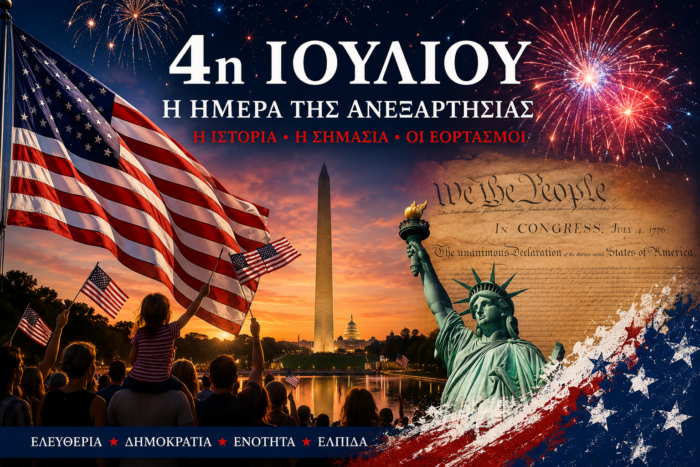
The historical meaning of Independence Day and the way Americans celebrate it
Every year on July 4th, America doesn't just celebrate a national holiday. It celebrates the very idea that a people can stand up, claim their freedom, and build their future on principles, responsibility, and a belief in human dignity.
July 4th is the day the United States of America remembers its birth. It is the day of the Declaration of Independence, when in 1776 the thirteen colonies declared that they would no longer be under the rule of Great Britain. The Declaration was adopted by the Second Continental Congress on July 4, 1776, and became the document that gave voice to a new nation.
What makes this day so important is not just the historical event. It is the words, the ideas, and the courage behind it. The Declaration of Independence was not just a political statement. It was a statement of principles. It spoke of rights that are not granted by governments, but belong to man from birth: life, liberty, and the pursuit of happiness.
For Americans, the Fourth of July symbolizes the beginning of a great experiment in democracy. An experiment that was never easy, never perfect, but always vibrant. America was born through struggle, disagreement, sacrifice, and hope. And each generation is called upon to give meaning to those words anew: freedom, justice, responsibility, unity.
There is even a historical point that few people know about. The decision for independence was voted on July 2, 1776, but the Declaration was officially adopted and announced on July 4. That is why July 4th has gone down in history as the birthday of the United States.
Today, Independence Day is one of the most beloved holidays for Americans. From one end of the country to the other, small towns and large metropolises dress in the colors of the American flag: red, white and blue. Flags fly from homes, streets, public buildings, schools, parks and businesses.
Families gather in backyards, beaches and parks. Barbecues take center stage, with hamburgers, hot dogs, corn on the cob, salads, desserts and traditional American flavors. Children play, neighbors exchange greetings, communities organize parades and people find a reason to stand together, not as strangers, but as members of a larger society.
Fourth of July parades hold a special place in the American heart. War veterans, firefighters, police officers, students, bands, volunteers, local clubs and families march through the streets, honoring history and the flag. It's not just a spectacle. It's a remembrance. It's a gratitude. It's a reminder that freedom is not taken for granted.
In Washington, D.C., in the heart of the American capital, the day has even greater symbolic significance. The National Archives, where the original Declaration of Independence is kept, hosts annual events, readings, and programs for families and citizens. The reading of the Declaration is not a simple ceremony. It is a way to hear again the words that birthed a nation.
And when night falls, the American sky lights up. Fireworks are perhaps the most famous image of the Fourth of July. From New York and Boston to Philadelphia, Chicago, Los Angeles, Miami and small provincial towns, the skies fill with light and color. For a few minutes, people look up. And perhaps in that moment they feel that beyond the difficulties, the differences and the contradictions, there is something that unites them.
But the Fourth of July is not just a celebration. It is also a question. What does freedom mean today? What does it mean to be a citizen of a democracy? How is a nation's independence protected in a world full of challenges? How is unity maintained when societies are tested by division, economic pressures, and differing opinions?
America's strength is not just in its great buildings, its military, or its economy. It is in its people. In the worker, the immigrant, the entrepreneur, the teacher, the doctor, the soldier, the mother who fights for her children, the young person who dreams, the old person who remembers, the citizen who still believes that this country can be better.
For the Greek diaspora, July 4th holds a special emotion. We Greeks know deeply what freedom means. The word is not foreign to our history. We have sung about it, we have fought for it, we have paid dearly for it. That is why when Greeks in America celebrate July 4th, they do not only honor the country that welcomed them. They also honor a universal value that unites peoples, histories, and generations.
America, like every great nation, has its contradictions. It has moments of glory and moments of pain. It has mistakes, struggles, wounds, and achievements. But the Fourth of July exists to remind us that history does not end. It continues through its citizens. Every family that raises a flag, every child that learns history, every community that celebrates together, brings that vision of 1776 to life.
This year, July 4th carries even more weight as the United States marks 250 years since the Declaration of Independence. Two and a half centuries of history, struggle, hope, progress, and the pursuit of the American dream.
The Fourth of July is not just a day of flags and fireworks. It is a day of remembrance, gratitude, and promise. A remembrance for those who dared. A gratitude for those who sacrificed. A promise to future generations that freedom must be protected, honored, and won anew, every day.
Because true independence is not just about founding a nation. It's about keeping its values alive.
Πηγές a historical documentation: Library of Congress, National Archives, National Park Service, National Archives Foundation.
photo Greek News FL