Among the devoted and faithful disciples of the Lord was the Apostle Thaddeus, as the evangelist Mark calls him (3:16), who is also mentioned by the names Levvaios by the Evangelist Matthew, but also as Judah (John, 14,22).
Some argue that the name Thaddeus is a surname. Combining the lists of the Gospel of Luke (6:16) and the Acts (1:13) we conclude that the three apostolic names Thaddeus, Levites, and Judas They obviously belong to the same person. So his real name was Judas and Levi and Thaddaeus were his surnames. The nickname Thaddaeus, as mentioned by the evangelist Matthew (10:3), means "brave" or according to others "magnanimous". This hypothesis is strengthened because "Thaddeus" appears to be a nickname from Aramaic. Taddai = "the one with a heart", that is, the one who "his heart says so"After all, many figures in the New Testament have more than one name (e.g. Simon-Peter, Barnabas-Joseph).
The name Judah was common and customary among the Jews and means "blessed". The early Christians probably called the apostle Jude by his surname, to avoid confusion with his person. Judas the Godbrother and mainly with the name of traitor Judas, which was connected to treason. So we consider that the person with these three names is the same person.
There is another confusion regarding the apostle Thaddeus, with the name Thaddeus, one of the 70 Apostles. M. Galanos, about this Apostle, states: "Some assume that this is one of the 70 apostles, who came from Edessa, but was a Jew. But it can be considered certain that the apostle Thaddeus is the one who goes by this name among the 12 Apostles." It is also significant that in some Latin manuscripts of the Gospel of Matthew, Thaddeus is also called "Judas the Zealot", justifying the characterization "brave", because zealots were identified with valor and bravery.
Some want to identify Judas-Thaddeus with Godbrother Judah, who also wrote the book of the same name Catholic Letter. This is a doubtful and arbitrary assumption, without serious support in the hagiographic texts and ecclesiastical tradition. They are not the same person, because Judas the Brother of God was born in Judea, he was the son of the betrothed Joseph, as he himself mentions in the first paragraph of his Epistle, while Judas Thaddeus was born in Galilee. The Bishop of Hierapolis in Phrygia also wrongly identifies Thaddeus with Judas the Brother of God. Papias (70-163), in the surviving fragments of his work.
According to ancient tradition, Judas Thaddeus was born into a Jewish family in Paneia, a town in Galilee, later Caesarea PhilippiAccording to legend, Judas Thaddeus was the son of Theft and Maria of Clopas, cousin or consort of the Virgin Mary, without it being possible to prove it.
Further information about the life and activities of the apostle Thaddeus is scarce. According to ancient testimonies, he was a religiously educated Jew who had gone to Jerusalem on pilgrimage during the time of John the Baptist. Hearing his sermon and seeing his holy life, he was so impressed that he asked him to be baptized. But then, when
He met Christ and listened to the teaching and became his disciple. He followed Him with devotion and fidelity, without ever creating a problem during His three-year ministry. He listened with attention and awe to the preaching of the salvation of the world, saw His many miracles as a tangible sign of the Kingdom of God and experienced, together with the other apostles, miraculous experiences, which prepared them for the evangelization of humanity. The Byzantine writer of the 14th century, Nikiforos Kallistos assumes the information that Judas Thaddeus was the groom in the Wedding at Cana.
According to church tradition, Judas Thaddeus, after Pentecost, preached the Gospel in Judea, Samaria, Idumea, Syria, and LibyaIt is said that he visited and preached in Beirut and to Edessa, Mesopotamia, today Sanliurfa, Turkey, although at this point there is confusion with the one from the Septuagint, Apostle Thaddeus or "Addai", who came from the Edessa of MesopotamiaThis is also supported by the apocryphal text, purported to be his writings, which was circulated in the 2nd or 3rd century, entitled: "Acts of the Apostle Thaddeus or Levboeus", which is better known as "Acts of Edessa", preserving ancient tradition for his action in this region.
Another tradition states that he also preached in ArmeniaIt is also known that the Armenians honor the apostle Thaddeus and together with Bartholomew and consider them as the founders of the Armenian Church and protectors of the Armenians.
It is characteristic that in many depictions of him in the West, Thaddeus is depicted holding an image of Jesus Christ, known as "Holy" "Handkerchief" or "Image of Edessa", which is associated with Armenia. This reinforces the fact of reverence for him by the Christians of this region.
According to another tradition, the apostle Judas Thaddeus suffered a martyr's death, beheaded with an axe, around 65 AD., either in Beirut of Syria, together with Apostle Simon the Zealot, or in MesopotamiaThe axe with which he is often depicted was the instrument of his death. His martyrdom, like that of Simon, was recorded in the apocryphal early Christian text "Acts of Simon and Judas" and is connected to the collection of passions and legends of the legendary Bishop of Babylon Obadiah or Obadiah.
His sacred relic, after many adventures, arrived in Rome and was placed in a crypt under the St. Peter's BasilicaAccording to another source, his remains remained in Armenia and were preserved until the 15th century.ο century in an Armenian monastery, on an island, north of the lake Issyk-Kul, close to today's Kyrgyzstan. Then he disappeared, perhaps moved to an isolated fort in the mountains. Pamir.
Saint Jude Thaddeus has the reputation of being a miracle-working saint and the patron saint of the hopeless. In the West, he is considered the patron saint of the impossible.
His memory is celebrated on August 21
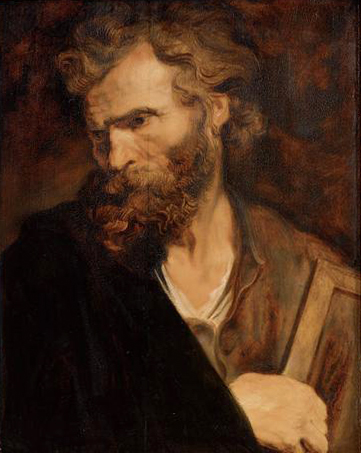
Photo By Anthony van Dyck – Kunsthistorisches Museum Wien, Bilddatenbank., Public Domain, https://commons.wikimedia.org/w/index.php?curid=5266986, https://el.wikipedia.org/wiki/