
Both history and the Church have been sparing in characterizing the "Great". Few received the title "Great". One of them was the leading saint of our Church Basil the Great, who deservedly received this title, because he stamped history with his personality in one of the most critical historical phases of humanity.
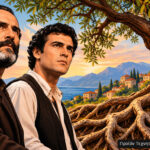
He was born in 330 BC Neocaesarea of Pontus. My father Basil his mother was also a renowned orator of the region Diligence he was a descendant of an aristocratic Roman family. They were fervent Christians. His grandmother played a great role in his life Far away, who was a student of the saint Gregory of Neocaesaria. She introduced him to Christian piety. There were eight other children in the family, most of whom had devoted themselves to the ministry of the Church (Grigorios Nyssis, ascetic Naucratios, nun Makrina, Peter bishop of Sebasteia).
Their well-to-do parents made sure to give their children, in addition to piety, a great education. Basil was taught the first letters by his father. Then he went to study in Caesarea of Cappadocia and then to Constantinople. 351 arrived at Athens to perfect his studies in geometry, astronomy, philosophy, rhetoric, medicine, and grammar. His studies lasted four and a half years until 355. There he was associated with brotherly friendship with Gregory the Nazianzen and Julian, the later emperor. He differed from all other students for his virtues and his strict ascetic life. It is said that his professor Beneficial was impressed by him and converted to Christianity. Together with Gregory, they had founded a Christian student group in the idolatrous Athens and had an important missionary activity.
In 356 he returned to Neocaesarea and he briefly practiced the lucrative profession of lawyer and teacher of rhetoric. The 358, after the death of his brother Naukratiou and his sister's urging Far away, after receiving Holy Baptism, decided to follow the monastic life and devote himself to the service of the Church. After distributing most of his wealth to the poor and the Church, he began a long tour of famous monastic centers of Asia Minor, Syria, Egypt and Mesopotamia to meet holy ascetics and be initiated into the true monastic life. The 360 he retired with his friend Grigorio Nazianzino in a hermitage on the Pontus, on its banks Iri river to isolate. He stayed there until 363 praying and writing his most important works and with the famous "Regulations for solitary life", who became the guide of the subsequent communal monasticism.
The fame of his sanctity reached the Caesarea of Cappadocia. The bishop Eusebius he called him and ordained him an elder. Basil demonstrated enormous pastoral and philanthropic activity. During the terrible famine of 367-368 he saved from certain death all the poor of the wider area of Caesarea. In 370, when Eusebius died and at the behest of the people, he was elected archbishop of Caesarea. Now as a bishop, Vasilios is launching a pastoral and social project of colossal dimensions. He took action against the heretical Martians, who had the support of the Martian emperor Wales. He faced his attempt with vigor and efficiency Wales
and his co-conspirators, to impose the heretical Arianism in his diocese. At the same time, he cleansed the Church of unworthy clergy.
Admirable and unprecedented for his time was his social work. He founded the famous "Bassiliada", a huge beauty complex, which included hospital, orphanage, workhouse, vocational schools, etc. In it, thousands of people found refuge and help, regardless of whether they were Christians or not. Many volunteers offered their services and among them Saint Bishop Basilios, worked as a doctor.
Titan was also his authorship. He was a keen theologian and a great writer, whose work is still a pioneer. His works are divided into doctrinal, theological, hermeneutical, letters, etc. One of his best-known works was "Interpretation in the Six Days", in which his rare erudition is imprinted. His work of the same name is also known "Mass", which is held ten times a year (on the five Sundays of Lent, Christmas Eve, Epiphany, Holy Thursday, Holy Saturday and 1η January). The numerous theological works of the holy Father are for the Church and subsequent theological science, an invaluable legacy.
His strict ascetic life and exhausting work seriously damaged his fragile health. At 31 December of 379 died at the age of just 49 years. His funeral took place on 1η January of 380, with the participation of countless Christians, Gentiles and Jews, who mourned inconsolably for the loss of their great Hierarch and protector. His memory is celebrated on 1η January.
M. Vassilios belongs to the great men of history. He lived at a time when the old pagan world was finally setting and a new world, the Christian one, was rising. He, together with the other great Fathers of 4th century AD, he was one of the carriers of this new world. And even more: this great man made a decisive contribution to the smooth transition to the new cultural reality. He evaluated in a wonderful way the positive elements of the ancient world, which he integrated into the new faith and the new emerging Christian culture. He used with amazing skill ancient Greek philosophical thought and the richness of the Greek language, through which he expressed the eternal and saving truths of Divine Revelation. He was, finally, the pre-eminent God-bearing Father of the Church, who made the Christian faith a way of life and state and the faithful a true "kingdom priesthood", as we sing at the end of his feast day!
photo https://www.pemptousia.gr/2023/12/megas-vasilios-o-korifeos-pateras-tis-ekklisias-mas/
Pemptousia.gr