A child opens their phone “for five minutes” and, when they look up, an hour has passed. The endless scrolling, the videos that follow each other and the notifications that steal sleep are not accidental characteristics. They are the result of design, and children are the most vulnerable to it. For families of the Greek diaspora, and especially for those living in Australia, where the relevant law is already in force, the issue is not theoretical. Now Greece is preparing to follow suit.
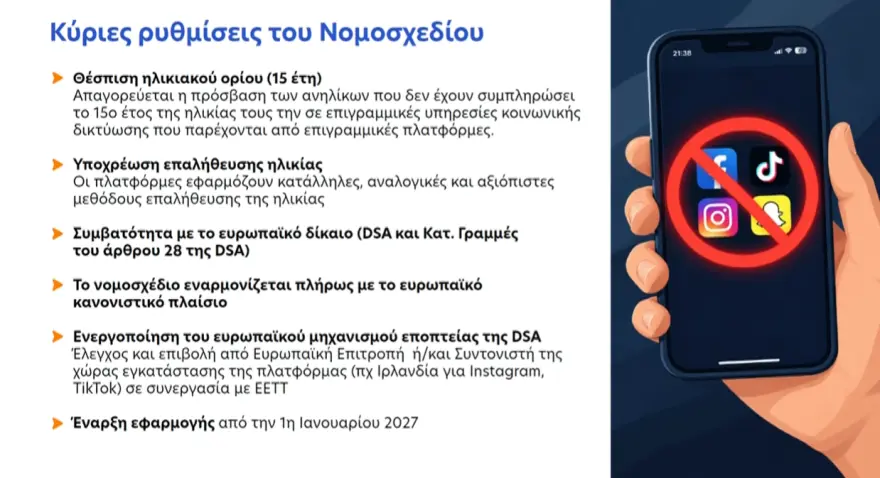
As of January 1, 2027, the new framework sets an age limit of 15 for access to online social networking services. The bill has been submitted to Parliament and, according to Minister of State Akis Skertsos, will be voted on Thursday, October 22. The government presented the measure at an inter-ministerial briefing with the Ministers of State, Health and Digital Governance. The measure had been announced since the spring, and Akis Skertsos recalls that the Prime Minister “was the first to ring the bell” for a protective rule against algorithms that exploit the vulnerability of children. He had also shared his 15-year-old son’s response at the time: “I am in favor because when he opens a mobile phone, he closes a group of friends.” Health Minister Adonis Georgiadis warned that social media has proven to be very dangerous because it is addictive to children, and that children should live in the real world and not just in the virtual one. At the same time, he admitted that the increase in mental illnesses cannot be attributed exclusively to social networks, since other factors are also at play, such as the consequences of the pandemic.
Greece joins a very small group of countries. Akis Skertsos noted that few countries in Europe have taken such a measure. As he mentioned, the other country that has done something similar is Australia, which does not belong to a supranational organization, while Greece is bound by the EU. That is why the Greek initiative is considered pioneering: it is trying to implement in Europe a measure that has so far been tested mainly in Australia, within EU law. So, the question is logically what the results show there.
The Australian experiment: The first results
In Australia, from December 10, 2025, age-restricted social media platforms must take reasonable steps to prevent residents under 16 from creating or maintaining an account. There are no penalties for children or parents, but platforms may face sanctions. For systemic non-compliance, fines can reach A$49,5 million.
The early numbers were impressive. In the first half of December, the major platforms removed access to around 4,7 million accounts identified as belonging to minors under 16. eSafety Commissioner Julie Inman Grant said the early results were encouraging, but warned that it was too early to judge whether full compliance had been achieved. She stressed that success is not measured in weeks or months, but in reducing harm and changing social norms, with potential effects that will be seen for generations. Indicatively, to measure the impact over time, eSafety is conducting a longitudinal evaluation.
The coolest image, three months later
The first formal evaluation of eSafety reveals a more complex reality. This is the first report of a two-year longitudinal study that followed over 4.000 children and families. The key findings:
- The percentage of children under 16 who have an account fell from 52,4% to 42,1%, a small but statistically significant decrease.
- The percentage of those who stated that they use a platform, with or without an account, decreased from 85,9% before the law to 81,5% in three months.
- About 58% of teenagers reported daily use, down from about 60% before the ban.
- Most minors who had an account before the launch were able to either keep it or create a new one, mainly due to the platforms' failure to implement effective age verification.
The study also had an interesting detail: about half of the minors who kept their accounts said the platforms had not verified their age. Others said their account stated they were 16 or older, or that the verification systems incorrectly judged them to be older. In other words, the problem wasn’t so much that kids were “tricking” the systems, but that there often wasn’t effective verification. In its March report, eSafety also noted that while there are fewer minors with accounts, a significant number of children under 16 remain on social media.
The conclusion is not that the measure failed or that it was completely successful. It is that the first months showed a measurable but limited change, and that the quality of the age verification is considered the biggest weakness. eSafety considers this data to be early, as the study has been ongoing for two years.
What does this mean for Greece?
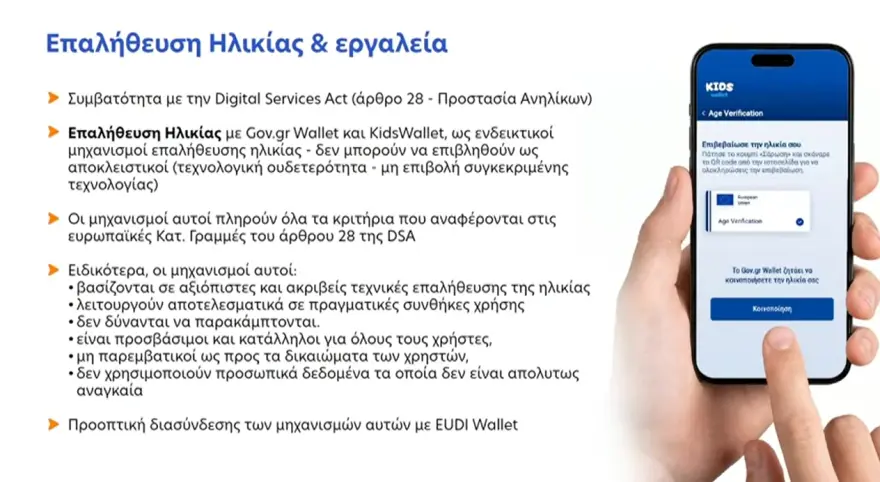
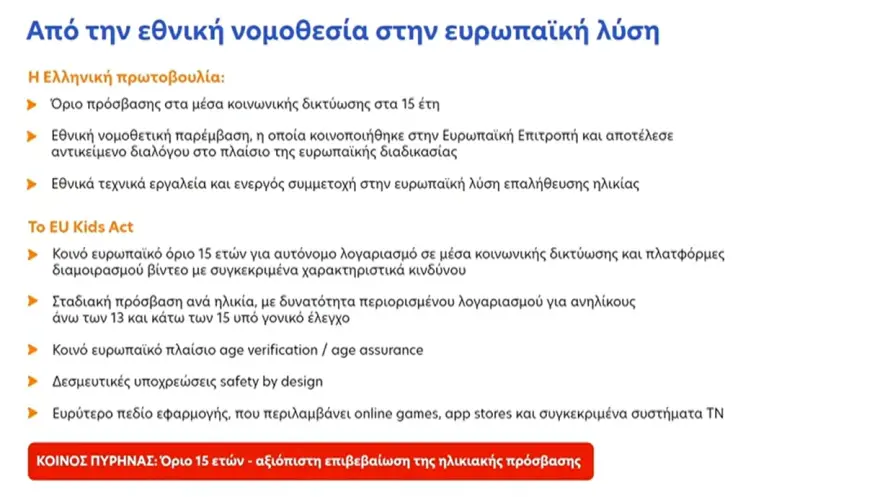
The Greek approach seems to be targeting exactly where the Australian experience showed it to be weak: age verification. The Minister of Digital Governance and Artificial Intelligence, Dimitris Papastergiou, explained that “we do not give any data about our children at all”. The Kids Wallet does not even provide a date of birth, but only a flag, that is, a signal for whether the child is over or under 15 years old. From January 1, 2027, if a platform is certain that a user is under 15, it must lock its applications. If it is not certain, it will generate a QR code that must be scanned with the Kids Wallet. Greece, the ministry points out, already has a functional age identification application that meets EU standards.
The plan does not impose a specific application or a generalised identification of all users. Equivalent solutions compatible with EU law are also allowed. The ministry distinguishes age verification from identity disclosure: the platform only needs to know whether the user meets the threshold. The European proposal EU KIDS Act provides for “zero-knowledge proof” technology, which proves the age requirement without revealing a name, exact date of birth or ID number.
The ministry, however, does not promise miracles. It admits that no technical system is completely immune to circumvention, for example with a VPN, a false age or a foreign account. Its answer is common European standards, cooperation with platforms and effective enforcement, while also monitoring whether children move to services with fewer protection guarantees. Whether Greek regulators will manage to avoid Australia's problems is something that only practice will show.
What does the Greek bill provide?
The central regulation is clear: access to online social networking services by minors under the age of 15 is prohibited. Platforms must implement appropriate, proportionate and reliable age verification methods. This is not a general ban on the internet or possession of a mobile phone. The bill is simple, with six articles, and, as Akis Skertsos explained, it adapts to the European framework without introducing a new regulatory or sanctioning regime. In other words, it does not follow the French effort, which was more ambitious and “hit” European legislation. The ministry notes that the draft was notified to the European Commission and its comments were incorporated.
A special rule applies to calculating the limit: January 1 is considered the date of birth of all individuals in the same calendar year. Thus, a child born in December 2012 does not have to wait for his birthday. On January 1, 2027, the limitation applies to children born in 2013 and after. Children born in 2013 will meet the limit from January 1, 2028 and those born in 2014 from 2029. Those who already have an account are not exempted. The Greek plan does not provide for an exemption with parental consent before the age of 15 nor a special limited account for ages 13 to 15.
Dimitris Papastergiou clarified that the regulation concerns Instagram, Facebook and TikTok, while its application to Snapchat is under investigation. The criterion is the provision of a social networking service and not just the commercial name, and the list is not closed.
Why they say intervention is needed: The evidence
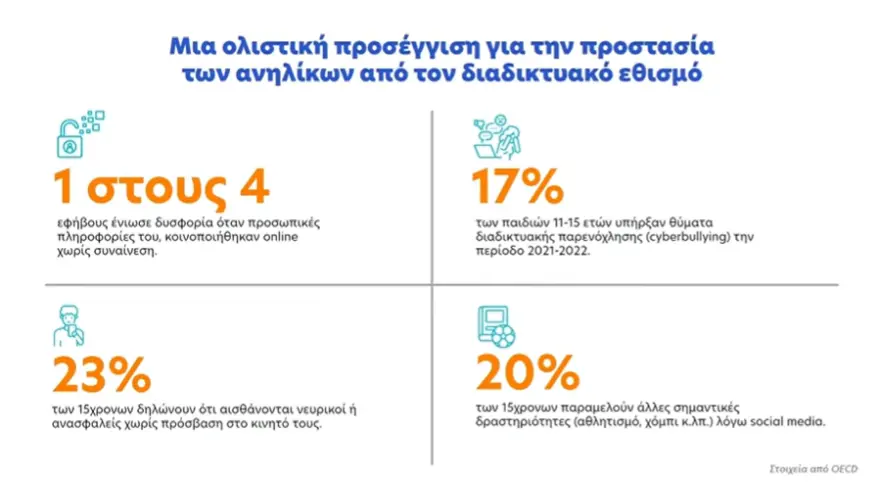
The ministry emphasizes that it does not claim that every use of social media causes a mental health problem in every child. The effects depend on age, vulnerability, content and method of use. However, there is data that, according to the ministry, justifies preventive intervention. Akis Skertsos reported that at least one in four children is at risk of exposure to harmful content, online bullying and use that is not suitable for children. Adonis Georgiadis presented data on how early use begins:
- More than half of high school students started at the age of 10 to 12.
- One in four report excessive use.
- One in five children report feeling nervous, insecure, or distracted when they don't have access to their cell phone.
The material also refers to the comparative EU Kids Online 2026 survey, with 28.465 children aged 10–16 from 19 European countries, where only 48% stated that they feel safe online. In the Greek Safer Internet Center survey of February 2025, with 2.500 students aged 10–18, one in four middle and high school students stated excessive use. The ministry emphasizes that these are self-reports and not a clinical diagnosis of addiction, and that the documentation of the risks does not prove that the limit will solve the problem. Its effectiveness must be evaluated in practice.
Who is responsible and where is the violation reported?
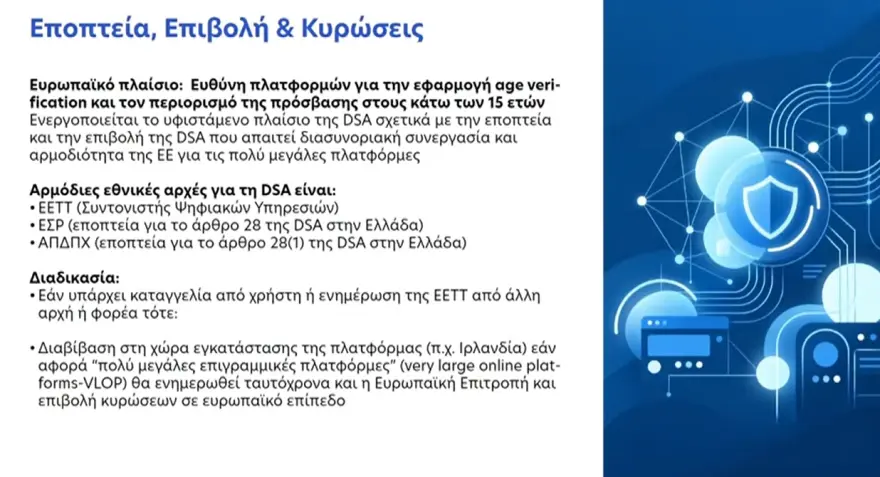
The basic principle of the bill, as in Australia, is that the burden is shifted from families to companies. As Akis Skertsos said, the goal is to move “from individual responsibility of parents and children, to corporate responsibility, to state regulation.” No fines or penalties are foreseen for children and parents. Adonis Georgiadis gave a concrete example: “if platforms implement poorly, you will be able to go to court to claim compensation. If they do not do what is foreseen, the platforms will pay.” Akis Skertsos added that the legislation “sends a message that the rules are uniform for everyone.”
The plan is part of Law 5099/2024, the implementing law of the Digital Services Act (DSA). For providers established in Greece, the ESR and the Data Protection Authority supervise the implementation. EETT is the Digital Services Coordinator and receives complaints, which it forwards to the competent Coordinator when the provider is established in another Member State. No new supervisory body or new independent fine system is created. The sanctions of the European framework can reach up to 6% of the global annual turnover, but are not automatically imposed for every incident.
What's changing for teenagers aged 15 to 17?
Families often ask what happens to teenagers who are just over the limit. According to the ministry, children aged 15 to 17 do not fall under the Greek age ban, as long as they meet the limit using the special method of calculating the provision. This does not mean that they are exempt from any protection. They remain minors and are entitled to the protections of the European framework. Meeting the limit does not equate to unlimited use nor does it exempt providers from their protection obligations. For parents, dialogue, privacy settings and parental control remain useful tools. There is no general obligation to register for a specific application, and those who want information can use parco.gov.gr.
Children's rights to expression and information
The discussion is not just about protection. It touches on rights that children have: access to information, expression and social participation. The ministry explicitly recognizes this and notes that digital environments also offer learning, creativity and support. The regulation, as it emphasizes, concerns specific social networking services before the age of 15 and does not establish a general ban on the internet or technology. It seeks to limit early exposure to risks associated with problematic use, sleep disturbance, harmful content and unwanted contacts. The European proposal also targets specific design features, such as endless scrolling and recommendation systems that seek prolonged engagement.
The ministry admits that proportionality must be documented and that protection must be combined with accessible and safe opportunities for information, communication and expression. Digital literacy and parental tools do not oppose the limit, but complement it: children must learn to evaluate content and ask for help, but these alone are not enough against designs that reinforce problematic use. Akis Skertsos summed it up: the government is positive about the use of technology for education, information and entertainment, but believes that a regulatory framework must be put in place.
The European dimension
The European framework is still a proposal. The EU KIDS Act is not a valid regulation and needs approval by the European Parliament and the Council. It is broader than the Greek plan, as it covers video-sharing services, online games, app stores and artificial intelligence systems such as digital companions. For ages 13 to under 15, it provides for a special limited account with mandatory parental tools and a daily limit of up to one hour. For children under 13, it only allows a narrow exemption through a parent account on specially designed video services. The date of 1 January 2027 concerns exclusively the Greek regulation and not the European framework.
How will success be judged?
The ministry defines success more broadly than the number of accounts closed. It will look at actual compliance, problematic use, children’s sleep and well-being, as well as unjustified exclusions, verification errors and movement to less secure services. The implementation will be evaluated systematically, with scientific input and with the participation of parents, teachers and children. The question that arises from the Australian experience is whether an age check that actually works can make the difference that the original law did not there. The answer will be given in the coming years, from Athens to Melbourne.