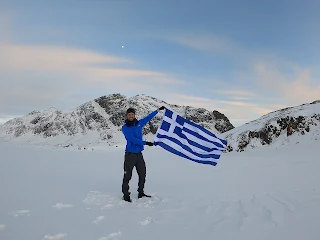
In our effort to understand the daily life and cultural identity of this unique place, we discovered the presence of a Greek in Greenland, Christos Koniaris, who lived in Greenland and gave us a valuable insight into life and the conditions that prevail there. Through his personal experience, we gain a more vivid picture of the island, its people, its challenges, but also the special cultural and social characteristics that make it so unique.
Christos Koniaris, Civil Engineer, was in Greenland in 2021 for studies and work, and since then his life has been connected to the island, as he spent many years there. He talks to us about his experiences and gives us a valuable insight into everyday life, the customs and traditions, but also the challenges the country faces due to colonialism and its modern social and political situation.
How long have you been in Greenland and how did it come about?
While I was studying Civil Engineering at the University of Xanthi, I was looking for master's degrees abroad. One day, my eyes fell on a master's degree in Denmark, which gave you the opportunity to spend a semester at a university in Greenland.
Immediately, a small flame ignited inside me and I said I would do whatever it took to make it happen. So, with a lot of effort, I managed to find myself for the first time, for six months, in the small town of Sisimiut, Greenland, in 2021. I arrived there during the COVID pandemic, but there were no cases, so I didn’t experience all the restrictions that were in place in the rest of the world.
However, in Greenland you are constantly cut off, not only from the rest of the world, but also from the settlements themselves, as there are no roads connecting them. The only way to get around is by small planes, ships in the summer, or, if we are talking about truly isolated areas, then only by helicopter, sled or snowmobile.
I lived there for another two years and returned to Denmark with the project delivery at the end of November 2024.
What is life like in Greenland?
It is difficult to give a general answer, because the differences from region to region are enormous. For example, in Nuuk, the capital, the quality of life is no different from a northern European city. You can find almost everything—from cinemas, swimming pools and cafes to shopping malls and bars. In contrast, in smaller communities, everyday life is completely different: in some places there is no easy access to basic goods, while in more isolated areas residents even share communal toilets.
So, I will try to describe my experience from the two places where I lived: Nuuk, the largest city in Greenland, with about 19.000 inhabitants, and Sisimiut, the second largest city, with about 5.600 inhabitants.
Both cities have a sizeable Danish population. In general, due to the colonial history, there is a constant tension between Danes and Greenlanders, but in everyday life they live together peacefully. However, many Greenlanders believe that the Danes treat them as inferior.
Life in Greenland is peaceful, the pace is slow and almost everything depends on the weather. The people have a deep connection with nature and are very active. In the summer they are mainly engaged in hunting and fishing, while in the winter they are engaged in snowmobiling and cross-country skiing. Even when the temperatures are well below zero, you are almost certain to see many people running on the streets every day.
Family plays a central role in Greenlandic society. It is common for children to stay with their parents until they are quite old, and family ties are very strong. The people are friendly, but they may seem closed off at first. After a while, however, they become very warm and welcoming.
In terms of customs and traditions, traditional Inuit culture is still present, despite the influence of Denmark. Kayaking and dog sledding remain important both as a means of transportation and as part of the cultural identity. However, dog sledding can only be found in the areas of Greenland north of the Arctic Circle, as it is not allowed to transport these dogs outside the Arctic Circle, so as not to alter their breed.
On Greenland's National Day (June 21), people wear their traditional costumes and participate in various celebrations. One of the most special customs of this day is a hunting competition, where several boats set off at the same time in search of a seal, and the winner is considered the one who brings back a seal first.
Another important custom concerns children, who start learning to hunt at a young age. When they manage to hunt their first reindeer, the family holds a big celebration to honor this milestone in their lives.
How does the colony from Denmark affect?
Colonialism is a particularly sensitive issue for Greenland and, especially at this time, is at the center of public debate. It has left a profound and lasting impact on the country, affecting its economy, culture, as well as its social and political autonomy.
Denmark, through an extensive modernization program, has implemented measures to improve the health system, education, and infrastructure, with the aim of improving overall living conditions in Greenland. However, due to its small population, the country cannot fill all the required jobs, such as doctors, engineers, teachers, and police officers. As a result, a large part of these jobs are filled by Danes, who are either permanent residents or come to work for a specific period of time, usually 3 to 6 months.
Furthermore, options for higher education in Greenland are limited, leading many young people to move to Denmark for studies.
However, this forced modernization of the country has apparently led to the closure of many communities, forcing part of the population to move to larger cities. This change has resulted in the shrinking of traditional lifestyles, while factors such as the introduction of alcohol, tobacco, and drugs have contributed to the worsening of social problems.
Today, Greenland continues to face challenges such as high unemployment, alcoholism, and suicide rates. Many attribute these phenomena to the changes brought about by colonialism and the country's forced adaptation to new social and economic realities.
Many women in particular have spoken about oppression. Is that something you saw, noticed in Greenland?
Yes, as far as I know, the Danish government has been accused many times of actions that were carried out secretly in the past. One of the most famous incidents is the “social experiment” in the 1950s, where 22 children were removed from their families and sent to Denmark, with the aim of “being domesticated”. Many of them never saw their families again and lost contact with their language and culture.
More recently, another shocking incident has been revealed where thousands of women and girls in Greenland were forcibly sterilized, through the insertion of intrauterine devices (IUDs), often without their consent. This occurred mainly in the 1960s and 1970s, as part of a family planning program that was allegedly aimed at reducing the Greenlandic population. It is said that if these interventions had not been carried out, Greenland's population today would be around 150.000, instead of the current 56.000. Many Greenlanders describe these practices as "direct genocide", while some Danes reject this accusation, saying that it is a "health system error" and not an "attack by the Danish state on Greenland".
What is the favorite/most famous food in Greenland?
The diet in Greenland is based on what they can hunt depending on the season. They mainly eat reindeer, seal, whale, halibut, salmon, shrimp and muskox. There are various ways to cook them, but many of them are also eaten raw.
I was particularly impressed when I heard about the traditional food kiviaq. It is a fermentation method that has been used for centuries to preserve food during the harsh Arctic winters. To make it, about 300-500 small seabirds, mainly auk birds, are placed whole (with feathers and all internal organs) inside the skin and body of a seal. The seal skin is carefully sewn and sealed with blubber to prevent air from entering. It is then placed in the shade under rocks for several months, usually 3-4, to undergo natural fermentation. When it is time to eat, the seal is opened and the birds are removed. Their fermented meat acquires a soft texture and a strong flavor. Kiviaq is usually consumed raw and is considered a delicacy at celebrations, birthdays, and important social events.
How is the economy on the island?
Greenland's economy is based primarily on fishing, with shrimp being the main export product, followed by Greenland halibut. Fishing is the most important industry, as the climate and harsh, rocky terrain do not allow for agriculture.
In addition to fishing, tourism is a major source of income, mainly through cruises and ecotourism. Greenland's impressive landscapes, combined with glaciers, whales, colorful houses and the Northern Lights, attract visitors from all over the world.
Now, with the new airport in Nuuk and the future airport in Ilulissat, Greenland's most popular tourist destination, tourism is expected to increase dramatically. The new air connections will allow direct flights from various European countries, as well as the US and Canada, facilitating access and bringing even more visitors to the country.
Of course, there is interest in natural resource extraction, as Greenland has significant deposits of metals, such as rare earths, uranium, and oil, but as far as I know, their exploitation is limited.
Trump wants to buy Greenland. How is the world reacting? What does the average Greenlander want?
It's not the first time Trump has expressed interest in buying Greenland, but this time it seems he was serious. Denmark's response from the start was clear: Greenland is not for sale!
However, Trump Jr. recently visited Greenland, trying to get the message across that the locals want to become Americans. According to friends of mine in Greenland, they met unemployed people on the streets, gave them money, hats, and free food, and tried to convince them to make a video saying they wanted to join the U.S. However, it seems that the vast majority of the population – about 85% – disagrees with this view.
Overall, Greenlanders do not want to belong to either Denmark or the U.S. Their main demand is full independence, although this may entail serious political and economic risks for the country.