(theological commentary on Holy Wednesday)
The Holy and Great Week is the holiest festive period of our Church and is a very rich pumping station of spiritual supply for the faithful. The holy Fathers, with an abundance of wisdom, decided to remember on these holy days persons and events, which have a strong didactic character for our spiritual course and advancement.
One of these faces is that of the sinful woman, who anointed the Lord with precious myrrh. We commemorate this important event on Holy Wednesday where, according to the holy synaxar of the day "We commemorate the harlot woman who anointed the Lord with myrrh. The most divine fathers established that this little thing happened before the saving passion.".
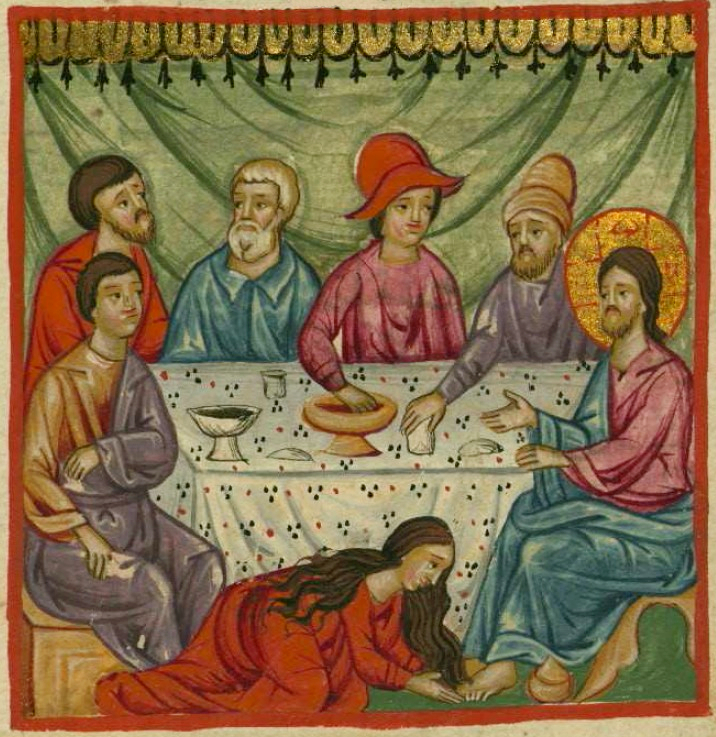
According to the Gospel narrative, before entering Jerusalem, the Lord was invited to a dinner at the home of a rich man named Simon, who belonged to the class of Pharisees. Some sinful woman, when she learned that the Lord had come to the city, asked to know in which house he had settled. And while they were eating and talking, suddenly that woman entered the house, holding in her hands an alabaster vessel full of precious myrrh. He went to Jesus' place and after standing behind Him, he knelt down and began to weep and wail bitterly. He immediately opened the container and began to generously pour the myrrh and wash Jesus' feet with it. Along with the precious myrrh she mixed her hot tears, which flowed like a river from her eyes. After emptying the vessel she untangled her rich hair and wiped His feet with it, kissing them incessantly.
This sudden and unprecedented event became the cause of a severe scandal for the "proper" co-celebrants of the dinner. The Pharisee host wondered and meditated: This one is a prophet, does he not know who this woman is and let her touch him? Is he not afraid of contamination by a whore? The heart-knowing Christ answered Simon the short parable of the money-lenders. Someone told him, he lent money to two people, to the first five hundred dinars and to the second fifty. When they had to pay them back, they didn't have them and the lender gave them away. And Simon asks: which of the two will owe more favor to the lender? Simon answered: the one who was given the largest amount. You answered correctly, Jesus said to him. Look at this woman. I entered your house and you did not wash my feet with water, but she washed them with her tears and wiped them with her hair. You didn't greet me, but she never stopped kissing my feet. You did not anoint my head with oil, but she anointed my feet with precious myrrh. Is it not worth saying to her: "your many sins are forgiven, because you loved me so much"? Turning to his wife he said: "your sins are forgiven". Then the fellow believers began to question: who is he who can forgive sins? Christ again says to the woman: "Your faith saved you, go to hell".
The woman, it seems, she was notorious for her sinfulness. They all knew her and that's why they were surprised when they saw her "violating" their "moral asylum" meeting. She was not supposed to "contaminate" their "proper" living rooms with her presence. They wanted and tolerated her only as a harlot, roaming the shelters and the dirty and dark streets, to satisfy their fornicating sinful desires. They wanted her as a vessel of sinful pleasure and nothing more. Not in the social and religious life of the city
it had a place, it was the miasma, which they had to avoid. That's how Simon the host thought, when he saw her entering his "proper" house and "taking" it. Much less likely to touch the rabbi's distinguished guest.
The Jewish religious tradition had (and has) as its basic doctrine the principle of "give and take» of man and God. The keeper of the divine commandments, even formally and (even worse) hypocritically, without inner change, demanded from God a reward, and God was obliged to respect this "transaction" and satisfy his demand! The prostitute, of course, according to these concepts, was completely rejected by God, because she had no visible sign of observing the divine law. She was cursed and rightly rejected by the pharisaical hypocritical society. Somehow the dinner co-hosts thought so too, and that's why they reacted that way.
The body of this sinful woman had certainly given herself over entirely to the tumult of sin and corruption, and worst of all she had drawn another into corruption. But, in the recesses of her soul, smoldered a dim flame of redemption. Her mental world was not completely corrupted. The presence of the Savior Christ in that city acted in her heart as a mighty wind, which fanned the weak flame of redemption and made it a red-hot furnace, an unbridled urge for repentance and salvation and that is why she ran to Him in this characteristic way.
But through our Lord Jesus Christ, the regime of law and wages has irretrievably passed away, and the age of grace and mercy has dawned. God is beyond and above all cheap dealing and enslavement. That is why the Lord criticized in the most intense way the hypocritical and utilitarian approach of God, something that the Jewish society could not understand and accept. God, as infinite love, is moved by love and mercy. He loves His creatures and especially man with excessive zeal, so that:For God so loved the world that he gave his only begotten Son, that whoever believes in him should not perish but have eternal life. For God did not send his Son into the world to condemn the world, but that the world through him might be saved.” (John 3,16-17), even"of his own son there was no appeal, but in favor of everything he handed him over" (Rom. 8,32).
Christ inaugurated a new understanding of sinful man, completely different from that of Jewish society and later "Christian" Puritanism. Sinful man is not evil by nature, because evil does not have an ontological character. It is not part of his being. Evil is an intruding disease of the soul, something analogous to the diseases of the body, which the apostle Paul characterizes as "snake virus» (Rom. 3,13), the bite of a sycophant and according to the holy Damascene: "evil is nothing else, it is the departure of the good, until the darkness of the light departs", and man has not "in his nature he sins, but rather he hates her" (PG94,973,924). Saint Maximus the Confessor characterizes sin as "miss" and the sinner as "wrong". Needless to say, the concept of sin according to Orthodox teaching has nothing to do with the antichrist judicial concept, the violation of laws and the imposition of penalties for the restoration of the "moral order", of Western "Christianity".
Consequently, the sinner is a spiritually sick person who needs help and ways of healing. The first medicine – antidote against spiritual
disease, Christ gave and it is repentance, i.e. the conversion of mind and inclination from the failure and disease of sin. Repentance is the most powerful lever, which destroys the edifice of sin and regenerates man, because it brings him back from "despite nature" At "By nature" his condition and course, what the apostle Paul characterizes as "old man" (Eph.4,22.Col.3,10) and "new man" (Eph. 2,15, 3,10. Col. XNUMX, XNUMX) and which according to Saint Chrysostom: "virtue is by nature and vice by nature, just like sickness and health" (PG62,21). Repentance opens the way to heaven and even to the most sinful of people, as the Lord said: "Amen I say to you, that publicans and harlots will bring you into the kingdom of God ... (that) publicans and harlots believed" (Matthew 21,31,32), because they are more aware of their sinfulness than those who have a false sense of holiness. It is no coincidence that the first tenant of heaven is the penitent thief on the cross, "I lock my fiancees"! It is not a random phenomenon in the history of our Church, where the greatest saints are in constant repentance!
Our holy Church is not like other religions, it is not even a religion, in the sense that the world considers religion. The Jewish religion, even the most perfect of the pre-Christian world, could not accept the repentance of the harlot, which Christ accepted and restored her to the position that suited her. Our Church is a spiritual healing center for souls, which regenerates sinners, accepting their repentance, and reconnects them with their all-merciful Creator. Saint Cyril of Jerusalem emphasizes: "The Church is called catholic... and because of the catholicity it heals and cures all kinds of sins, those committed by soul and body" (Catechism 18,23, PG33,1044). No religion does such a thing, on the contrary, it binds the sinner to incredible obligations of a religious nature, exacerbating his problem. Our Church is the "inn" that the Good Samaritan left the wounded man who had fallen to the robbers to be healed and even free of charge, at the expense of his benefactor (Luke 10,34:XNUMX)!
The dedication of this day to the blessed former harlot woman was done deliberately by the holy fathers. Her figure stands out as a bright landmark in the middle of the journey to the Divine Passion to show us how our Redeemer Christ came "you ask and you save the apololos" (Luk.19,10) and "he gave his soul a ransom for many" (Mark 10,45). How He is the only savior of the world, the One who forgives sins and regenerates man in whatever situation he is in and all he asks is our repentance and nothing more. The rest is up to Him.
So he asks us to repent and break down, like the harlot, and to show practical repentance so that we can consciously and worthily follow our Christ in His Passion and Resurrection. After all, sin is a form of spiritual fornication and in this sense we are all prostitutes! Let us cast off the demonically inspired feeling of hopelessness and humbly ask our Savior to open "the springs of our tears" and forgive him "vivid and moonless love of sin" us, which is nestled and rooted in our soul. To realize that repentance, as the highest gift, renews our celestial path towards Christ and our completion. A good Christian is not he who, full of pomp and selfish self-sufficiency, claims to have reached the level of holiness and
no more struggle is needed, but he is in constant repentance. That is why the holy hymn writer of M. Wednesday mentions that I (every believer),"in favor of the whore of anomie"!
Photo By Ilyas Basim Khuri Bazzi Rahib (likely a Coptic monk). – https://art.thewalters.org/detail/17922/gospels-5/, CC BY-SA 3.0, https://commons.wikimedia.org/w/index.php?curid=44898060, https://el.wikipedia.org/wiki/