We remembered and were moved when we spoke last Saturday about Angelos Sikelianos.. And we were happy that for many other friends, the great Angelos and his great era came back to life within them..
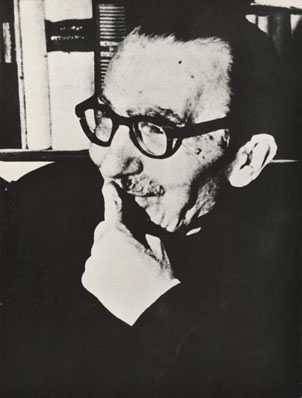
The time has come, however, to remember the other great of that great era... Nikos Kazantzakis. To rediscover the eternal values that are being lost in a broken Europe... To overcome, as much as possible, the despair of our time.
“Tragic acrobat above chaos.” Restless, researcher, philosopher, for the whole world. A point of reference for Greece. And especially for the Maniat sea that marked it forever. I still remember my grandmother Mario Maniatissa, from Ano Doli, who told me about some “mourlous” who once dug near the port of Kalogria to find…”gold”… How could I imagine that during the years of the Drama School, I would have had Yannis Kakridis and Kimon Freier as teachers. And I would learn that these “mourlous” were Kazantzakis, Sikelianos and Alexis Zorbas.. And one day I would become.. Kazantzakis, even if for a few minutes, in a Greek film..
He wrote and said a lot. And they wrote and said a lot, about him.. Most of it is known. We will limit ourselves to recalling a few excerpts from his Beliefs, his Theses, his Anxieties.. Most of it, perhaps, unknown. Small breaths, in the global suffocation of everyday life..
…”There are no Ideas.. There are only People who ride these Ideas and they take on the stature of the person who carries them..”
. “..In all my novels, there is not only myth. I revealed memories of my childhood. My grandfather, my father, my mother's tears, the sufferings of my homeland..”
“….When I began to write novels accessible to the general public, some people became alarmed and persecution and slander came into action. They wanted to burn my books and cast anathema on the author. But the great masses of the people loved them and started reading me. They realized that I was fighting those responsible for their misery, those who systematically leave them illiterate, and so my books became wildly popular…”
"… The four pillars of the world: Bread, Wine, Fire, Woman…" -
“….I am an enemy of tradition when it is exploited by the upper classes to remain eternally immovable, supposedly in its name, at the head of every authority.…
…..But I am a faithful servant of tradition when it adapts to the reality that elevates man. ..With this constant help and with their infallible instinct, little by little, the new creators find their own, free, walk and avoid some irritating, often foreign, sirens that lead them to paths of a carnivorous, artificial happiness..”
(Our student friend Angelos, a fanatical “student” of Kazantzakis, responds, on behalf of the new creators, with a few words from the great Poet of the 70s generation, Evgenios Trivizas: “No evil is pure…worse..” “If there were more imagination, the world would be more beautiful and exciting..” “Childhood is not lost.. Sometimes it hides behind nostalgic memories and sometimes it masquerades as seriousness and maturity.”)
“…Greece has lived and suffered for centuries in its diversity, and the Greek intellectual has only to bend to its history to draw from there the themes of his inspiration.”
"The Greek miracle is not only called beauty. It is also called freedom. So how is it possible for a writer to sing of her beauty and remain indifferent to her tears?"..
“… The highest virtue is not to be free, but to fight for freedom…”
“….A people who suffer, wants to have us by their side. Greece suffers. And that is why it seeks heroes.. And when it finds them, it travels to the heavens. But when it does not find them, it does not descend to Tartarus. It does not descend even when some of its heroes betray it. It ascends alone, holding in its hands and in its heart a flag that others call madness. So this madness, we, for centuries now, have called hope..”
So let us mention him as well as the Maniatissa mourner:
….”Wild birds and tame birds, don't chirp today.. How did the wise Kazantzakis from Stavros die?
In Mani, the Cretan teacher was well-known. He was kind and beloved and respected by everyone.
In Stoupa and Kalogria, there by the sea... He sat on the ground and wrote books.
He was a son of freedom and a fighter for Freedom.. And the priest excommunicated him because he did not become a martyr.
And the Greeks, the "gnostics", were very bitter about it. And he went abroad and acquired a thousand good things.
The foreigners accepted him, gave him positions of authority.. They loaded him with honors, awards and diplomas!
Tell me, what did we gain by banishing him? ..We only suffered losses and showed foolishness! "
Photo From N. Kazantzakis Museum – http://www.kazantzakis-museum.gr/icon-detail.php?block_id=http://147.52.130.130/content/images/00441.jpg&parent_block_id=2369, CC BY 3.0, https://commons.wikimedia.org/w/index.php?curid=22904570, https://el.wikipedia.org/wiki/