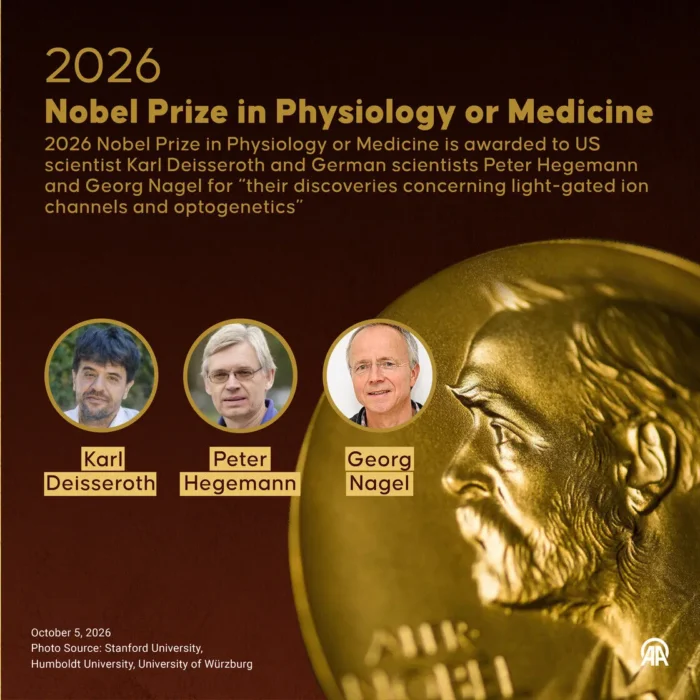
The Nobel Prize in Physiology or Medicine 2026 was awarded today, Monday 5 October 2026, jointly to the American Karl Deisseroth and to the Germans Peter Hegemann and Georg NailThe three scientists were awarded for their revolutionary discoveries regarding light-sensitive ion channels and the development of optogeneticsThis is a groundbreaking method that allows the control and mapping of nerve cells in the living brain using light, opening new horizons in neuroscience.
What is optogenetics?
Η optogenetics is a groundbreaking biological technique that allows scientists to control the activity of cells (mainly neurons) using light.
The term comes from "opto-" (light) and "genetics", because it combines the use of optical technology with genetic engineering.
How does it work in simple words?
- The discovery in nature: Some microorganisms (such as some algae) have genes in their DNA that produce special proteins (photosensitive ion channels). These proteins react to light: when light falls on them, they open and allow an electrical charge to pass into the cell.
- Transport in mammals: Scientists take these "photosensitive" genes and, using genetic engineering, insert them into specific nerve cells in the brains of living organisms (e.g., mice).
- Light control: They then insert a very thin optical fiber into the brain. When they turn on the light (e.g. a blue LED), the modified cells are activated or deactivated instantly, as if they were flipping a switch.
Why is it so important?
Before optogenetics, scientists used electrodes or drugs to stimulate the brain, but this blindly affected all neighboring cells.
Optogenetics offers absolute accuracy: researchers can target only a specific type of cell, at exactly the moment they want it (in milliseconds), without affecting the rest.
Where does it help?
Understanding the brain: It helps map brain circuits to learn how memories, emotions, and behaviors are created.
Disease study: It is used to investigate serious conditions such as Parkinson, the Alzheimer'sThe depression, addiction and epilepsy.
Vision restoration: The first clinical trials are already underway in humans to restore part of the vision in people with blindness (by converting other cells in the eye into photosensitive ones).
The development of optogenetics is one of the most brilliant examples of scientific collaboration and bridging different disciplines (botany, physiology and neuroscience).
The Pioneer Scientists
The Nobel Prize in Medicine 2026 recognized the contribution of three scientists who transformed an observation of nature into a powerful tool: Peter Hegemann & Georg Nail (Germany): In the early 2000s, workers in Germany discovered and isolated a specific protein, the dodopsin (channelrhodopsin), from a green microscopic alga. They discovered that this protein acts as a gate (channel) that opens as soon as it receives blue light, allowing ions to enter the cell. They showed that if you transfer this protein to any another cell, it automatically becomes photosensitive.
Karl Deisseroth (USA): The neuroscientist and psychiatrist from Stanford University took this discovery and transferred it to the brain. The 2005, managed to insert the gene for this protein into rat neurons in the laboratory and control them with light. Two years later, the 2007, achieved the big leap: to control the behavior of live and freely moving mice just flashing a light in their brain.
Applications in Medical Research
Optogenetics is not just a theory, but a tool already used in thousands of laboratories worldwide. Its main medical applications include: Blindness Restoration: This is the most advanced clinical application. In patients with retinitis pigmentosa (a condition where the light-sensitive cells of the eye are destroyed), scientists are using optogenetics to modify the remaining healthy cells of the eye, making them themselves sensitive to light. The first clinical trials in humans have already shown that blind patients were able to partially regain the ability to perceive shapes and objects. Parkinson's Disease & Movement Disorders: The method allows researchers to map precisely which brain circuits are malfunctioning. This helps improve the method Deep Brain Stimulation (Deep Brain Stimulation), making the electrical implants used in patients much more targeted and effective. Alzheimer's Disease & Memory: Through optogenetics, scientists have managed to "turn on" specific cells in experimental animals and bring back lost memories, proving that the problem in the early stages of Alzheimer's is not the total erasure of memories, but the inability to excavate them. Depression, Anxiety and Addictions: By activating or deactivating the brain's dopamine and reward system circuits, scientists are understanding how anhedonia (the loss of pleasure) is caused and developing more effective drug treatments. Diabetes and Cardiology: The technique is now moving beyond the brain. Researchers are using it to control insulin production in pancreatic cells using light, and as "optical pacemakers" to regulate heart rate without the need for electrodes.
Bibliography:
https://www.nobelprize.org/
Vlachos, F. (2019). Optogenetics: The technique that illuminates the brain. Journal "Neuron", issue 12, pp. 34–41.
Karolinska Institutet (2026). Press release: The Nobel Prize in Physiology or Medicine 2026. Stockholm.
photo https://www.aa.com.tr/en/info/infographic/54286
ANADOLU AJANSI