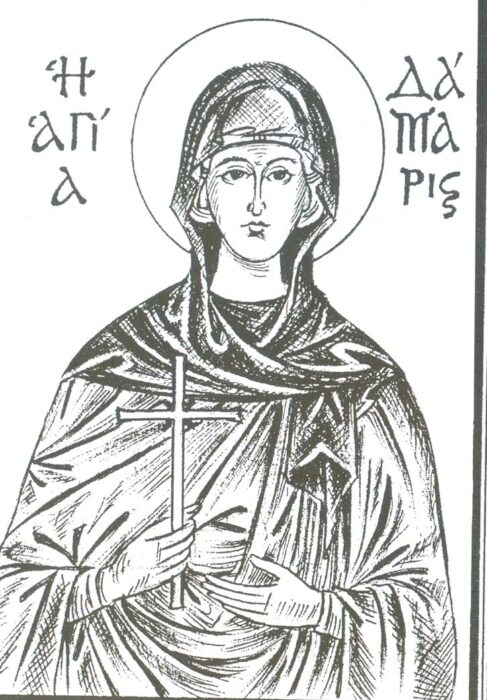
The holy author of the book of the Acts of the Apostles, Evangelist Luke, recounting the events of the Apostle Paul's visit to Athens in 51 AD. in the seventeenth chapter, he refers to the few persons who believed in the Apostle's preaching and formed the first nucleus of the local church of Athens. Among them is mentioned a woman named Damaris. He quotes the holy text: "And what men attached to him believed, including Dionysius the Areopagite and a woman named Damaris and others with them" (Acts 17,34).
It is known how the great Apostle encountered enormous difficulty in his missionary work in the closed city, having meager results. He succeeded in convincing few, but eminent persons, such as the supreme judges, Saint Dionysios Areopagite and Agios Ierotheos and with them only one woman her Damari, who became the first Athenian Christian.
We know nothing more than the biblical account. But we speculate that to mention her in the sacred text means that she was a prominent female figure in Athenian society, who came from a noble family and held a high social position. This is also inferred from the fact that he was included among the two great men, Dionysios and Hierotheos, who held the highest offices, i.e. they were supreme judges, members of Areos Pagos. They were perhaps related to them. Some speculate that she was of Jewish origin and that her name was derived from the Hebrew Tamar. However, the sacred text does not mention a Jewish community in Athens, to which Paul would take refuge, as he used to. With these few persons he founded the church of Athens, ordaining as its first Bishop Saint Ierotheos.
Her association with the two prominent court men suggests that she was very likely to have acquired a high education, despite the fact that women, even in Athens, were marginalized, confined to the gynokonites, and few had the opportunity to study. It seems that Damaris belonged to the minority of the few educated women who, having metaphysical concerns, found the answers they were looking for in the preaching of the Apostle Paul. She found what was hidden in her soul, the longing for salvation, salvation!
Despite the apparent glory that Athens maintained in those years, it was in fact in serious spiritual and religious decline. The famous old schools of philosophy had lost their prestige, taught by infamous opportunists and profiteers with shallow philosophical ideas and ridiculous sophistry. This is evidenced by the way they treated the Apostle Paul. Perhaps he felt his first great disappointment that he never visited Athens again, despite the fact that he had been to Greece at least twice more.
We speculate that the church of Athens thrived, due to the strong presence of the fanatical pagans and the pagan priesthood, which from the classical years persecuted every different religious belief and questioning of the ancient Greek religion, with the horrible "about impiety" persecutions, because of which hundreds of people lost their lives and thousands were persecuted. It is very likely that the young Church of Athens experienced absolute contempt from the arrogant pagans and fanatical pagans or even persecution. But the personalities of Saint Ierotheos, who
became the first bishop of Athens and Agios Dionysios with his enormous education and social influence in the Athenian society, contributed to the preservation of the church and its growth.
Damaris also contributed a lot to this effort. With her education, her social position, her natural gifts and her virtues she managed to attract many women to the Christian faith. She catechized the women, entering the isolated gyneconites. After all, as is well known, the word of a woman in the pagan world had not the slightest value to men, except in women's circles, in which it was considered derogatory for men to speak. In them Damaris passionately preached the saving principles of the new faith. We can imagine the surprise, admiration and joy of these women, hearing for the first time that they are equal to men, that they are not vessels of pleasure and slaves, as the ancient world treated them, but creations and images of God. It was unheard of for them that they could participate in the life of the community on an equal basis with men, since only male Athenians were considered Athenian citizens, foreigners, slaves and women being excluded. In a population of half a million inhabitants, less than twelve thousand men had civil rights!
The fervent and devout Damaris dedicated her life completely to the service of the Church and perhaps her property. We also speculate that the local church ordained her a deaconess, to facilitate her missionary work, according to the custom of early Christian communities. Alongside her missionary work, she also carried out great charity work, in a society of savagery, incredible individuality and inhumanity. After all, philanthropy was one of the main features of the qualitative difference and the new way of life advocated by the evangelical message. It is well known that the pagans could not understand the philanthropic zeal of the Christians, and Christian charity exerted a great fascination on the persecuted and marginalized pagans, on the unfortunate slaves and women, who were outcasts of society, and found refuge and value in the saving arms of the local churches.
We do not know about the end of her life. Perhaps she suffered a martyr's death by the fanatical pagans, who saw paganism put on the sidelines, the boundaries of women's isolation overturned, and the Christian faith spread with particular vigor.
Her memory sleeps is honored on October 3 together with the memory of Saint Dionysios. The city of Athens, to honor her, dedicated a large street to her in the Pagrati district, the Damareos street. Its sequence was written by the well-known great hymn writer Fr. Gerasimos Mikragiannanitis.
The memory of Saint Damares reminds us of the fact that, through the evangelical preaching, the feminine nature, despised for centuries, becomes a value again. We have the practical recognition, for the first time in history, of the woman as an equal human person with the man. For the first time, her testimony became credible, as well as her contribution to social becoming valuable. Until then, the woman's testimony was not accepted even in the courts. In the honored faces of these holy women of our Church, the feminine nature is honored, which the matron Eve, with her disobedience, had discredited and men had put her on the absolute sidelines. Christ came, Who broke down every barrier that separated human faces and together lifted the depreciation of the woman, reducing her to a real human being.
The woman gained her lost honor from Christ and is truly recognized in our Church and not in the pseudo-feminisms of the world! The saints were blessed to experience the first and true feminism, the true restoration of woman to her rightful place. A feminism completely different from today's, which, instead of liberating women, makes her a slave to sinful passions. This truth was later expressed by the apostle Paul in his teaching: "ok a male and a female" (Gal. 3,28). everyone, "those who have been baptized into Christ", we are one body, the Body of Christ. If today women enjoy rights, they owe them to the saving message of Christ and not to worldly wisdom and secular institutions!
photo https://www.saint.gr/2577/saint.aspx, SAINT.GR
ORTHODOX COMPANION