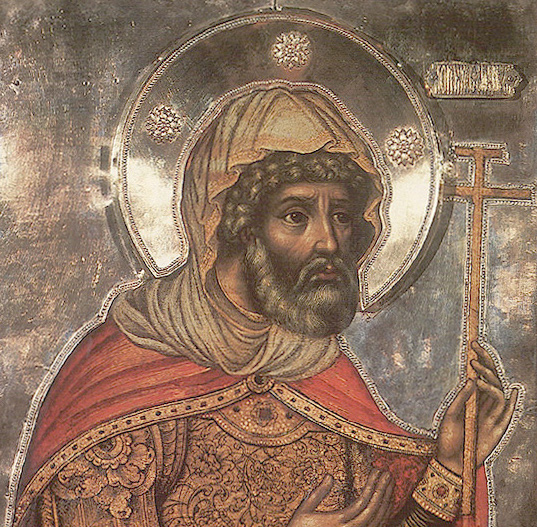
One of the main figures in the Crucifixion of the Lord was also the leader of the Roman military detachment. Centurion, who had been ordered by the Roman commissioner Pontius Pilate to oversee the crucifixion of Jesus.
The Holy Gospels refer to the Roman officer, Centurion – Centurion, the so-called Longino, whose name survived the apocryphal "Gospel of Nicodemus"Its name may come from the Greek word "lance". This is a sympathetic and emblematic figure, who, although he contributed to Christ's martyrdom out of duty, was able to understand His unjust passion and proclaim, under the Cross, His divinity.
According to ancient ecclesiastical tradition, he was born at the beginning of the 1st m. X. century in Cappadocia, in the village Sandal. He was of Jewish origin and made a professional career in the Roman army. In fact, for his bravery and his sobriety, he reached the position of centurion, that is, to command a group of one hundred soldiers. At that time he happened to be serving in the Palestine, under the orders of the Roman commander Pontius Pilate.
When Christ was delivered to Pilate, as "enemy of Rome"", with the accusation, "subverting the nation and hindering the paying of taxes to Caesar, saying that he himself is Christ a king" (Luke 23:2) and condemned "guilty of death" (Matt. 26:67), to die as a criminal by crucifixion, he had been ordered to be placed at the head of the detachment of His crucifixion, along with the other two thieves.
According to the accounts of the Holy Gospels, he saw and experienced all those shocking events of the crucifixion. From the first moment, he understood his innocence and felt deep sympathy for him. No act of violence on his part is mentioned. He watched with pain the theater of the absurd and listened with pain to the shouts and curses of the Jews: "His blood be on us and on our children" (Matt. 27:25). He listened with bitterness to the mockery of the innocent sufferer, remaining sullen. At the moment when Christ breathed his last, the entire creation was shaken and the earth shook to its foundations and was plunged into darkness, at noon, for three hours, he understood that the crucified Jesus was not an ordinary man and therefore he confessed that "Truly this was the Son of God" (Matthew 27:54). It is the first confession, beyond the circle of Christ's disciples, of His divinity!
His duty was also to ascertain the death of the three crucified ones. According to the Evangelist John, from the check he made, he confirmed that two thieves were still alive and ordered a soldier to crush their hands and feet, to hasten their death. On the contrary, he determined that Jesus had died. To be more certain, he pierced the side of His spotless Body with a spear and from it flowed blood and water, which means that the death of Christ was real. Tradition states that the blood from Christ's side flowed onto his face and immediately cured him of a chronic and painful eye disease. This event shocked him and confirmed his faith in the divinity of Christ. He then went to the governor Pontius Pilate to report the execution of his mission, assuring him of the death of the condemned. Pilate was astonished at the short death of Jesus.
After the burial of the Lord, the Jews asked Pilate to put a guard at the tomb, to prevent a possible theft of the body of Christ by his disciples (Matt. 28:13). He was again assigned to be placed at the head of a military detachment, to guard the tomb. There he again had the opportunity and blessing to experience the miraculous event of Christ's Resurrection. In the middle of the night, he and the detachment were shaken, because “There was a great earthquake, for an angel of the Lord descended from heaven and came and rolled back the stone from the door and sat on it. His appearance was like lightning, and his clothing was white as snow. For fear of him the guards shook and became like dead men.” (Matt.28:2-4). The shocking event further strengthened his faith in the divinity of Christ. I was moved to hear the words of the angel announcing His Resurrection to the Myrrhbearers and the Apostles!
Without wasting time, he went to Pilate, to whom he recounted the great miracle, assuring him that there was no possibility of the body of the condemned man being stolen. When the Jews approached him and tried to bribe him to say that he himself had supposedly fallen asleep and the guards and disciples had stolen the body of Jesus, he categorically refused to accept such a thing, shouting: "My eyes saw the miracle and my soul the truth. I assure you that neither I nor the other two soldiers slept, even for a moment. The truth is stronger than your silver. You labor in vain to darken that which shines brighter than the sun. I will continue to confess the Resurrection of Christ."
Then Longinus resigned from his office, sought out and found the Apostles, was catechized and received holy Baptism. He then retired to his homeland, Cappadocia, in Sandal, together with two of his soldiers, who had also believed in Christ, establishing an early Christian community in that region, perhaps the oldest in Asia Minor. There he began to preach the Christian faith, converting many of his fellow Jews and Gentiles to Christ. This angered the fanatical Jews, who hated him mortally, because he confirmed the resurrection of Christ and converted their fellow believers to the Church. In order to take revenge on him, they denounced him to the emperor of Rome Tiberius (14-37 AD), for treason against the Roman State because he supported a man convicted of a crime against Rome. Tiberius accepted the charges and ordered Pontius Pilate to arrest and punish the renegade former officer of the Roman army as an example.
He sent a detachment to Cappadocia to arrest Longinus and bring him to him to punish him. When the detachment reached Sandiali and broke into his house in search of him, he, unperturbed, did not try to escape, but provided a rich meal and offered hospitality to the leader of the detachment and the soldiers. They gratefully accepted the hospitality, without knowing who the host really was.
Meanwhile, the soldiers were searching for Longinus in the area, without result. After several days of searching, without result, and while they were ready to return to Jerusalem and face the consequences of their failure, Longinus revealed himself to them, that he was the one they were looking for, leaving them stunned! He even urged them to arrest him and execute Pilate's order! They hesitantly led him out of the city and beheaded him, along with his two soldiers.
To assure Pilate of the successful outcome of their mission, they took with them the heads of Longinus and the two soldiers. Upon arriving in Jerusalem, they presented them to the Roman ruler, who threw them out of the window into a nearby ravine.
But the honest head of Longinus was not to remain in the stench of the mire. A pious widow woman from Cappadocia happened to be blinded. She believed that the honest head of Longinus would give her light. That is why she decided to travel to Jerusalem to find and worship the honest head of the holy Martyr and invoke his help, with her son as her guide and assistant.
When they arrived in Jerusalem, her son fell ill and died. The woman, full of sorrow and despair, returned to the Holy City, with the strong hope that she would find the holy coffin. Divine grace and the help of the saint led her to the mire where she had been thrown. She begged passersby to help her reach the place where the garbage was dumped. Arriving there, she began to search the dirty water with her hands, until she felt that she was touching a skull. As soon as she touched it, the darkness in her eyes was removed and she saw the saint's coffin shining like the sun!
With tears of joy she praised God and, taking her in her arms, embraced her and brought her to the house where she lived. There she cleaned her, perfumed her, filling her soul with heavenly joy. The next day she saw Saint Longinus again, bathed in light, with shining eyes and holding her only son by the hand, smiling and happy, he said to her: "Do not cry, my dear, I will show you the place where your only son is, in the glory of the Lord, and you will regain the light of your eyes. Remember what I once told you about Christ, our Savior, about his Passion and Resurrection, what I saw with my own eyes. And know that your son is near Jesus.".
After this, that pious woman received great consolation. She took the honest cara and returned to her homeland of Cappadocia. She placed it in her monastery, making it a place of worship for myriads of believers in the region and a source of healing for thousands of patients.
His memory is celebrated on 16 October.
Thus God glorifies those who honor Him and have good intentions, such as Saint Longinus the Centurion, who, although he contributed, out of duty, to the crucifixion of our God-man Redeemer, acknowledged His innocence, confessed His divinity, and God made him a precious vessel of His Grace! This means that even the greatest sinner, if he sincerely repents, is forgiven and saved! This is the greatness and uniqueness of our Christian faith!
photo https://www.romfea.gr/pneumatika/65742-agios-megalomartys-logginos-o-ekatontarxos,
ROMFEA gr