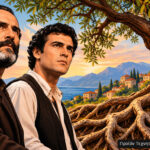

The Cappadocian Fathers put their own stamp on the development of Theology during the 4ο AD century in the Church. They are in essence the founders of the orthodox doctrine and the crystallization of the authentic teaching of our Church. One of them was the saint Gregory the Nazianzen, the so-called Theologian.
He was born in 329 AD in Arianzo of Cappadocia, near the town Nazianzo, that's why it got the name A Nazi. His parents, Gregory and Nonna they were noble landowners. His father was a former pagan who had converted to Christianity and was later ordained bishop of Nazianzu. The young Grigorios grew up in a Christian environment and his rare gifts were evident from an early age.
The financial acumen of his parents allowed him to receive a great education. After all, he also passionately loved letters and education. She studied in the best schools Caesarea and later, in 351, he went to Alexandria and then to Athens to complete his studies in rhetoric and philosophy in the famous schools there, having as his professors the famous professors Imerio and Optional and as his classmates M. Basilio and Julian, the later emperor. The performance of his studies in Athens was such, as were his rare abilities, that he was appointed professor and taught rhetoric and philosophy there for a year.
He then returned to Nazianzu, where he was baptized a Christian by his bishop father. Then he began to write his first theological work on Holy Baptism. 360 moves, following the invitation of his old friend Vassilios, to Pontus, to do asceticism with him near Erie River. In 361, following his father's request, he returned to his homeland, where he ordained him elder, against his will, because Gregory wanted to follow the monastic life. He left for a while for her Annesoi, where he practiced for a short time with Basil, who forced him to return again to Nazianzus, where he found the Church divided by the Martians and his father accused of heresy. Within a short time he managed to unite the Church again.
In the same year he ascended the imperial throne Julian (361-363), who decided to resurrect the definitively dead ancient pagan religion. At the same time, he declared a silent persecution against the Church. Gregory opened a correspondence with his old friend the emperor, proving that his practices had nothing to do with Greek culture, which was supposedly defended by the religious Julian. The death of the Apostate emperor in 363 closed this sad chapter of history.
But a new adventure faced the Church, Arianism, which was supported by the female emperor Wales. Gregory fights hard to preserve Orthodoxy in Asia Minor. In 370 M. Basilios is elected bishop Caesarea and in 372 he ordains Gregory bishop of Sassimon again without his will. But he soon moved to Nazianzu, and after his father's death in 374, he took over the widowed diocese. 375 retired to Monastery of Seleukia until the death of Basil in 379.
In the same year the Synod of Bishops of Antioch decided to send Gregory to Constantinople to confront the Martians, the
who had taken over all the temples. She turned a little house into her temple of Saint Anastasia and there he delivered his famous theological discourses, defeating the heretics. 380 by decree of the emperor Theodosius I was elected Archbishop of Constantinople and the following year he presided over it Second Ecumenical Synod. When some bishops questioned the regularity of his election to the archbishopric throne of Vasilevusa, in an admirable act, he resigned and returned to his homeland, where he shepherded the diocese of Nazianzu until 383. Meanwhile, his health seriously deteriorated and he retired on his family estate, where he lived peacefully with prayer, exercise, and fasting. There he wrote his famous theological writings and composed his poems of immeasurable poetic value. He slept peacefully on January 25 391. He was declared a saint, Father and universal teacher of our Church. His memory is commemorated on January 25, day of his sleep and on January 30 together with the other two Hierarchs, M. Vasilios and I. Chrysostomos.
Saint Gregory belongs to the great Fathers of our Church and at the same time to the great personalities of history. Historians are admired for his kindness and greatness of mind. His education, his spiritual cultivation, his rhetorical skill combined with his deep faith in God made him one of the leading theologians and writers of our Church. He is the theologian of God's Word, who formulated in the most clear way the belief about God of our Church. Thanks to him, the horrible and dangerous heresy of Arius, which threatened the saving truth of the Church, was defeated. But also as a poet, Saint Gregory was unparalleled. Even his prose is a poem and for that reason later hymn writers, such as John the Damascene, they used the same words in their hymns, as in the canonical rules of Christmas and Easter!
He is finally the one who managed to unite the Greek spirit with the Christian faith in an amazing whole. His surviving correspondence with the landless apostate Iulianos reveals the qualitative difference between the two men. On the other hand, Gregory expresses the genuine and real Greek spirit of progress and respect for otherness, while the religious-obsessed emperor expresses the old pagan world of fanaticism, obsessions, superstition and intolerance, which was expressed with cruel persecutions against the Church! His phrase to Julian is typical "they Greekize it because it is very important", proving to his former classmate and friend Iulianos that his foreign policy is a far cry from Hellenism, which he thought he was serving! History decided: the dreamy pagan emperor was immediately condemned as an apostate and a failure, while Gregory was highlighted as a supreme spiritual personality, whom the centuries despise!
photo https://sansimera.gr