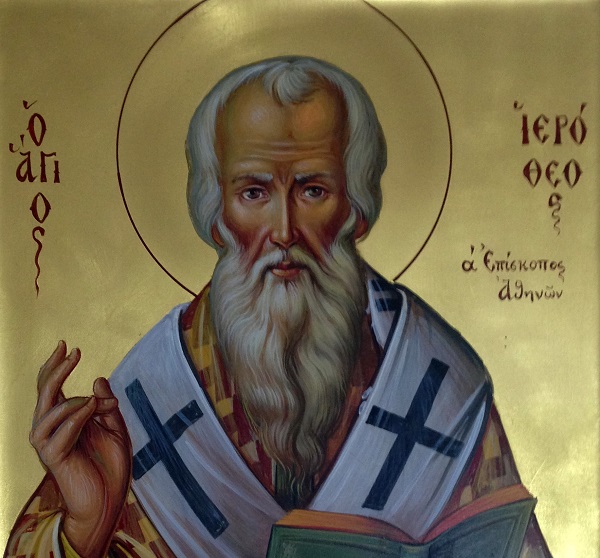
The city of Athens has been the cradle of world civilization since ancient times. It was here that the first democracy in the world was born and for the first time, man was recognized as a valuable being and human rights began to be respected. It was here that the greatest philosophers of antiquity were born and worked, literature was cultivated and art reached its peak. But this city of wisdom and civilization can also be proud of its Christian heritage, in which a multitude of saints, martyrs and saints emerged throughout its history. One of them is Saint Hierotheos, its first Bishop.
The Church of Athens is apostolic, because it was founded by Apostle Paul, during the second apostolic of tour, about 51 ADAs we read in the book of Acts of the Apostles, the great Apostle to the Nations, toured Greece, with his associates Silas and TimothyAfter them Philippi, The SKG and Veria, arrived by boat at Faliro and went up to Athens, to preach the Gospel in "Clean Asty", as it was called then, that is, the "glorious city", because of its ancient glory.
But it no longer had its former glory and fame. The great ancient philosophers were disappearing and their place was taken by childish and money-loving teachers, and the old renowned schools had fallen into decline and became hotbeds of superstitious rituals by the adherents of the collapsing ancient religion. It is very significant that history has not recorded any important philosophers after the 4th century.ο BC century!
The apostle Paul, as the sacred text states, visited the city and was enraged. "considering the city an idol, they destroyed it" (Acts 17:16), that is, full of idols. Among them he found the altar "The Unknown God", giving him the impetus to speak about this unknown God, who is the Triune God. He was called to speak to the Areo Pago, delivering an amazing speech, which was preserved for us by the holy author of the Acts of the Apostles (17:22-34), and which unfortunately did not have any significant results. He was probably ridiculed by his childish pagan listeners, especially when they heard about the resurrection of the dead.
Nevertheless, "And certain men joined him and believed, among whom were Dionysius the Areopagite, and a woman named Damaris, and others with them." (Acts 17:34). Among them was Hierotheos, who was fortunate enough to become the first Bishop of the Church of Athens.
Both Dionysius the Areopagite and Hierotheus belonged to the intellectual aristocracy of Athens, they were supreme judges, members of the Areopagus. The two men constituted two of the nine members of the Supreme Athenian Court, a truly supreme function in Athenian society.
Hierotheos was born in Athens around the end of the 1st century.th BC century, during the reign of the emperor of Rome, he was August (27 BC - AD 14), shortly before the birth of Christ. He came from a prominent family and had received the highest education available to noble Athenians. He had studied mainly Platonic philosophy at the famous Athens School of Philosophy, which still had some of its past glory.
Tradition has it that he was pious and God-fearing, accurately fulfilling his religious obligations in the public worships of the "gods"
city. In fact, there is information that he had also been initiated into the Eleusinian Mysteries, to which educated aristocrats had the privilege of being initiated.
However, he himself, despite performing his religious duties and publicly declaring his devotion to the state cult, as the highest state organ, was, deep down, an agnostic, unable to reconcile himself with the primitivism of the ancient pagan religion and, above all, with the superstition into which the Athenian society of his time had sunk.
He is also referred to as a just and humanist, both in the exercise of his judicial duties and in his private life, having engraved in his soul the innate moral law, which the Creator dictated to human nature when he created man, and for this he enjoyed the esteem of his fellow citizens.
The preaching of the apostle Paul had, as we mentioned above, a very limited effect, despite the fact that the great apostle exhausted his knowledge of Greek philosophy and his rhetorical ability. The superstition and spiritual decline of the Athenians prevented his preaching of salvation in Christ from bearing fruit.
It seems that the agnostic Hierotheos listened attentively to the principles of the new faith and was captivated by the messages of the Gospel. With a spirit of humility, he opened his heart to the entry of the "the true light, which enlighteneth every man, coming into the world" (John 1:9), and filled his soul, empty of spirituality, with the mystical energy of the Holy Spirit. After a brief catechesis, he received holy Baptism and joined the small, young Church of Athens.
As a Christian, Hierotheos' life changed. His faith in Christ, the true incarnate God, grew stronger and stronger, so that he soon emerged as a prominent member of the Church of Athens, being elected its first Bishop, apparently ordained by the apostle Paul, before departing for Corinth.
The Byzantine scholar and ecclesiastical writer Efthimios Zygavinos (1050-1120), preserving an ancient tradition, states that Hierotheos was the first to meet Paul and that he introduced him to his fellow Areopagite. Dionysius. Perhaps this is why the holy author of the Book of the Acts of the Apostles does not mention him among the persons who adhered to Paul, because Hierotheos, before them, had already believed in his preaching, had been baptized and ordained Bishop of Athens. He was not simply adhering to Paul, but was already integrated into the young Church of Athens. Also, Zygabenus mentions the information that Hierotheos was a teacher of Dionysius. This is also confirmed by the so-called famous "Areopagite Writings", which are attributed to Saint Dionysius the Areopagite.
Hierotheos, as Bishop of the Church of Athens, also emerged as a very capable ecclesiastical man. He distinguished himself as a dynamic and charismatic hierarch, working with zeal for the conversion of a multitude of pagans to the Church of Christ. His great education, his philosophical training, his rhetorical skills, his influential social position and the respect of the Athenians for him, contributed to thousands of pagans abandoning their decadent idolatry and joining the saving embrace of the Church. Thanks to this great and dynamic personality, the Church of Athens was established on solid foundations and grew, in the cradle of nationalism and fanatical pagans.
Hierotheos is also referred to as a great theologian, thinker and writer. As we mentioned above, he was the teacher of Saint Dionysius, as well as the great Apologist Athenian. Aristides, who undertook to defend the persecuted Church and was martyred at the beginning of the 2th AD century. The surviving codex is awe-inspiring, a profound theorem on the mystery of the Holy
Trinity, which is in the library of Holy Monastery of the Great Lavra of Mount Athos and is attributed to Saint Hierotheos.
But Hierotheos also distinguished himself as a charismatic ecclesiastical hymnographer of the ancient Church. The "Areopagite Writings" preserve the ancient tradition that Saint Hierotheos was one of the holy men who were fortunate enough to be present at the funeral procession of the Most Holy Theotokos, who was also transported in a cloud to Jerusalem. It is reported that the holy man preceded the funeral of the God-bearing Body of the Mother of God and sang exquisite hymns in Her honor, which he had composed himself. In Synaxaritis by Victor Mattheou it is reported that "When the holy Apostles arrived at the Tomb of the Lady Theotokos and, bidding Her farewell, each one uttered divine and divine praises to Her, and all of them uttered various praises. The Hierotheos uttered such praises to our Virgin Mary that surpassed all others, and I dare say, they were so excellent and amazing that these holy Angels could not, in every detail, as he uttered them.".
We have no further information about the subsequent activities of Saint Hierotheos. It is understandable that the zealous and God-fearing hierarch illuminated the Church of the Small Town for many years and served the people of God, glorifying God. We do not know whether he suffered persecution from the fanatical pagans, who watched with panic as the pagan error was extinguished. We assume that he too suffered persecution, like all the believers of those difficult times. Tradition states that He slept peacefully at a ripe old age at the end of the 1th AD century and was buried in Mansion south of the small church of the Virgin Mary, which he had erected himself. On 11ο In the 16th century, a Holy Monastery of the same name was founded in his honor, and was re-established in 1930, where his honorable and miraculous relics are kept, as a precious treasure! His relics are also preserved on Mount Athos (Saint Paul's Monastery) as well as in the chapel of Saint Andrew (Archdiocese of Athens). In the suburb of Peristeri in Attica, there is a beautiful church in his honor.
His memory is commemorated on October 4.
HOLY METROPOLIS OF KIFISSIA, AMAROUSIA, OROPOS AND MARATHON