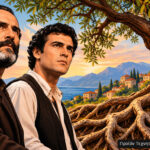

The Apostolic Fathers they are a separate category in our Church. They are called Apostolic because they are the immediate successors of the Apostles and therefore derive their authenticity from them. One of them is Saint Ignatius the God-bearer. A truly great father figure and universal teacher of our Church.
We have not been saved many things from his personal life, but from his ecclesiastical activity and his great writing work. It came from Antioch and he obviously had Greek origin and education. He was born to Christian parents, who raised him with faith in the true and piety, in an environment of fanatical pagans. Tradition says that when he was young he found himself in Jerusalem and there was one of the children that Christ blessed, he took him in his hands and showed him to His listeners and told them that unless man becomes like this child, he cannot enter the kingdom of heaven.
Ignatius was ordained an elder by the Apostles and later became bishop of the great city of Antioch. From them he was taught the Christian faith and for this reason he emerged as a bearer of the genuine apostolic tradition. In the great city of Syria, full of idols and pagans, there was a bright spiritual beacon, which dispelled the black darkness of pagan faith. Thousands of people, hearing his saving words and seeing his works and holy life, embraced the new faith. Let us not forget that Antioch was the cradle of the first Church, where the Jews had sent from Jerusalem the Saul – Paul to break it up.
We should also not forget that in Antioch there was a famous "sanctuary" of the ancient religion and a famous oracle in the suburb of Daphni. The pagan priesthood and the numerous soothsayers there were alarmed by the dramatic decrease in pagan followers, and therefore oracle seekers, thus reducing their income. Finally, we should not forget that the persecutions against Christians by the Roman state were already in full swing. That is why the holy bishop of the city, Ignatius, became their target.
The religious and bigoted emperor Trajan (98-117), after a brilliant victory against the Tartars, thought that this was the result of the favor of the pagan "gods". Apparently he was persuaded of this by the obscurantist priests of the idols and who called for the intensity of persecution against the Christians who refused to sacrifice to the demonic false gods. A wave of savage persecution began to spread throughout the empire. Thousands of Christians were dragged into martyrdom and led to death. Rivers of blood flowed.
At that time Trajan was in Antioch, where he was preparing war against them Persian. His priests Daphnei Apollonos they approached him and expelled Ignatius, as allegedly dangerous to the Roman power. He was accused of refusing to worship the "gods" of the city and state, of worshiping some trifling crucifix for God, and of not participating in the orgiastic pagan festivals, but preaching temperance. That prevents citizens from enjoying the pleasures of life. The emperor ordered that he be brought before him to hear from himself about these accusations. Let him see who this bishop is who despises his orders and defies his fears.
Ignatius stood with unprecedented courage in front of him and sarcastically apologized for his faith. He confessed that the true God is the Triune God, revealed to us by His incarnate Son Jesus Christ. How the various "gods" of paganism are false, non-existent as "gods", demons, who want to usurp the true God. He abominably refused to sacrifice to idols.
His refusal was the beginning of his end. He was bound in chains and sent to Rome to be tried by the imperial court, where he usually inflicted a gruesome death by the public slaughter of wild beasts on those Christians who did not sacrifice to idols. Old Ignatius was dragged by wild and inhuman soldiers by road to Rome. In spite of all his sufferings, tortures, privations and old age, he joyfully walked the path of his martyrdom. On the way he learned that the Christians of Rome were plotting his salvation. But he declared to them that he wished the martyr to become his body "bread of Christ, ground by the teeth of beasts"! He begged them not to deprive him of this joy and honor! This is his famous letter "To Romans".
Through Asia Minor, Macedonia and Epirus, crossed by ship to Italy and arrived at Rome, where he was tried and sentenced to death by being devoured by beasts. He was driven to the sublime Colosseum, where a crowd of people gathered to witness the gruesome sight. They let the lions and tigers fast for a week and then released them into the stadium in front of the defenseless old bishop. That haughty man, without a trace of fear, prayed and summoned the beasts, which rushed and devoured him, amid the shouts of the heathen multitude. The few remaining relics were secretly collected by the Christians and hidden in the catacombs. The martyrdom occurred around 109 or 110 AD. His memory is celebrated on December 20.
Saint Ignatius, the Apostolic Father, as we mentioned above, was one of the most important father figures of our Church. He wrote seven great Epistles (Pros Romans, Philippians, Ephesians, Magnesians, Trallians, Philidelphians, Smyrnaeans and Polycarp), in which he develops his famous theology about the unity of the Church, about the bishop and the Eucharist.