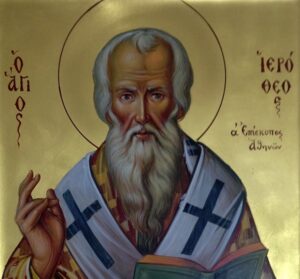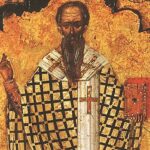
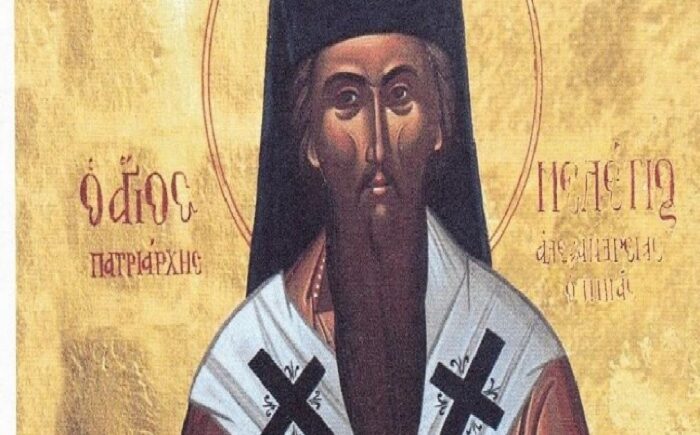
During the difficult times of Ottoman slavery, Divine Providence favored the emergence of great spiritual figures who served, illuminated, and supported the Church of Christ and offered invaluable services to our enslaved people. One of them was Saint Meletios Pigas, Patriarch of Alexandria, a great figure of the 16th century.
Born in Chandaka (Heraklion) of Crete 1549 by pious, virtuous and wealthy parents, who instilled in his soul deep piety and a virtuous life. From an early age he showed a great inclination towards letters and for this reason his parents made sure that he received the best possible education, close to the greatest teachers of his time, among whom was the famous hieromonk Meletios Vlastos. He was taught the Greek and Latin languages, grammar, philosophy and rhetoric by him. He was also taught the virtuous and moral life by this great teacher, which followed him throughout his life.
After his formal studies in Crete, and at the age of eighteen, he went to Italy, in the famous University Padua, to complete his studies. He studied philosophy, theology, medicine and law. But the spiritual climate there was extremely hostile to Orthodox students, who were under strong pressure to accept Western evil principles and unfortunately many succumbed, later coming to Greece and converting to Papism. Despite his young age and the unbearable pressures of the papists, Meletios remained steadfast in the Orthodox faith, he did not think of giving in to their evils.
He also had to deal with another serious problem. The papal universities, in order to grant degrees to their graduates, required an oath of allegiance to the "Papa"! Meletius found himself in a great dilemma, but in the end he did not succumb to blackmail, refusing to declare submission to the "Papa" and faith in the papal infidel doctrines. He rejected with anger every profane thought of denying Orthodoxy and embracing Papacy. He preferred to be deprived of the university parchments, rather than the treasure of the Orthodox faith, the only saving faith! It was his first great confessional heroic act, which marked his subsequent turbulent course. His saying is very characteristic G. Valletta: "This bravery of his, this harsh test of his conscience, national and religious, opened before the eyes of the young student all the dark depths of papism and made him set as the primary purpose of his life the fight against it and the liberation of the fatherland from its destructive influence. Then he formulates a life program; to put on the cassock and become a soldier of Orthodoxy to save his island and Greece and the entire Orthodox East from the danger of Latinization, which at that time caused the educated Greeks worse anxiety and fear than the Turkish yoke...» (Meletios Pigas, Chrysopigi, Athens 1958 p. 28).
After eight years of study in Italy, he returned to his birthplace of Crete and embraced the monastic life at the age of 25. He became a monk in Holy Monastery of Agarathos, where the abbot was Sylvester, later Patriarch of Alexandria.
Early on, he showed remarkable zeal for the monastic life and a virtuous life. At the same time, he decided to utilize, for the sake of his enslaved compatriots, his knowledge and advantages. With the blessing of the abbot, he left the Monastery and toured the cities and villages of Crete, encouraging the persecuted Romans, teaching the Orthodox faith and vigorously fighting, repelling with strong arguments, the suffocating propaganda practiced by the ruthless papal Jesuit missionaries (missionaries), who literally threshed the island and converted Orthodox Christians en masse to the heretical Papacy by unlawful means, even by force. The main axis of his teaching was the firm faith in Christ, free from Western heresies, the commitment to Orthodoxy, the only true Church, and Greekness. For this reason, he became a target of fanatic papists, who sought his silencing, but also his physical extermination!
After the election of its abbot, Silvestrou as a Patriarch of Alexandria, between the years 1565 and 1569, Meletius followed him and settled in Holy Monastery of Sinai, where he was ordained a hieromonk. But Patriarch Sylvester, appreciating his zeal for Orthodoxy, his education and his other qualifications, invited him to the Patriarchate, to work missionaryly and to organize the clergy and monasticism. And indeed he responded successfully to the ministry assigned to him.
Meletius, a restless spirit and possessed of a fervent zeal for the unity of the fragmented Christian world, made earnest efforts to persuade the heretical Westerners to abandon their errors and return to Orthodoxy. He focused and addressed himself mainly to the Protestants, who had recently (1519) seceded from the papal "church", protesting against papal monstrosities, abandoning the papists, considering any discussion with them futile. He opened a correspondence with the theologians of the University of Tubingen, who, as is known, had opened communication with prominent Orthodox people and exchanged letters. Among them was Meletius, who in his letters tried to convince them that the truth is found in Orthodoxy. But unfortunately, as is known, these contacts did not come to fruition.
Of course, his life was not rosy in the Egyptian metropolis. Papists, Protestants, Copts and other heretics created serious problems for him, for his anti-heretical action. But Meletius remained steadfast in his work, indifferent and facing with patience and strength the obstacles and problems that they created for him.
In 1582, Patriarch Sylvester appointed him as his commissioner (representative) in Cairo, to work missionaryly and organize the parishes there. Meletios accepted his new ministry with enthusiasm, performing remarkable pastoral and missionary work there as well.
The fame of his personality and his actions reached far and wide, and even to the Russia, where the emperor invited him to Moscow, to form the Russian Church. Meletius accepted the proposal, but on his way to Russia, he passed through Constantinople, where he witnessed the tragedy that the Orthodox there were experiencing from the Turkish oppression. He was asked to remain and work for the wintering Church. He obeyed, remaining for three years working with unusual zeal for the relief of the oppressed and persecuted Romans.
In 1590, after the death of the Patriarch of Alexandria Sylvester, he was called to take over the patriarchal throne, with the unanimous consent of the clergy and people and the approval of all the faithful. He proved worthy of his election. With modesty and prudence he continued to work in his new post. With appropriate and subtle manipulations he managed to wrest the Sultan away, to free the Patriarchate from the unbearable debts and with fundraisers, mainly in Crete, he strengthened the finances of the Patriarchate.
The 1593 went to Istanbul to take part in the Resident Synod under patriarchy Jeremiah 2 (1536-1594). In it, Meletios proposed the declaration on the Orthodox adherence to the decisions of the Ecumenical Councils, in the annual convocation of the Resident Council. Then the Synodal Volume recognition of Moscow Patriarchate. With his persistence, this great ecclesiastical man entrenched the Orthodox faith, in an era of terrifying spiritual ferment and challenges from Western action in the Orthodox space of the East.
At the same time we also have the appearance of Unia in Eastern Europe and mainly in Poland, which, with unspeakable persecutions, massacres and violence, was converting a multitude of Orthodox to the Papacy. Meletius, when he was informed of the serious problem there, sent as Patriarchal Exarch his nephew Cyril Loukaris, who collaborated with the exarch of the Ecumenical Patriarchate, in order to confront the spread of Uniate and Papism. But the 1597 Luke is forced to flee Poland to escape imprisonment and execution by fanatical Uniate papists. The year 1599 Patriarch Meletios sends Lucaris back to Poland where he remained until the beginning of 1601, and then moved to Moldavia-Wallachia to support the Latin Orthodox who are wintering there.
Meletius did not neglect the heretics in his care. Cutters Egypt and Ethiopian, trying to bring them back to the Orthodox faith and integrate them into the true Orthodox Church, unfortunately without spectacular results.
The 1594 The Ecumenical Patriarch Jeremiah II died and Meletios accepted offers to assume the Ecumenical Throne. However, this humble ecclesiastical leader refused, preferring to remain on the second throne, the Throne of Alexandria. He served only as a regent of the Ecumenical Throne between the years 1597 and 1598.
Slept the year 1601 At the age 52 years old and the Church, appreciating his holiness and his enormous work, ranked him among its hagiological deltas, defining his memory in the 13 Σεπτεμβρίου.
Saint Meletius is one of the Confessors Patriarchs, who devoted his life to strengthening the Orthodox faith. His zeal for the unity of the fragmented Christian world and his efforts to convert heretics to the Church led some of his contemporaries to consider him a "pro-Western", which is not true. As a deep connoisseur of papal and Protestant heresies, he became a fierce critic of them. This is evidenced by a surviving letter of his, written in 1538 to his friend the learned bishop of Kythera Maximo Margounio (1549-1602), in which he develops an antithetical argument. He particularly resisted, with vigor, against the Unia, which is, as is well known, the "Trojan horse" of Papacy, for the overthrow of Orthodoxy.
He also developed a rich writing career, such as: "On the Immaculate Mysteries”, “On the Pope Catechism”, “Orthodox Teaching”, “Stromatais”, “Against Luther and Calvin”, “Chrysopigi” etc. which exude the aroma of Orthodoxy and have a confessional character. It is also characteristic that, while in his writings he used colloquial language, in his sermons, he used the common language, so that his listeners would understand him.
He is generally considered a rare personality, a chosen vessel, for the service of the Church and the Nation in those difficult years. Some consider him to be one of the most important and admirable ecclesiastical men after the fall of Constantinople (1453).
photo E KRITI.GR