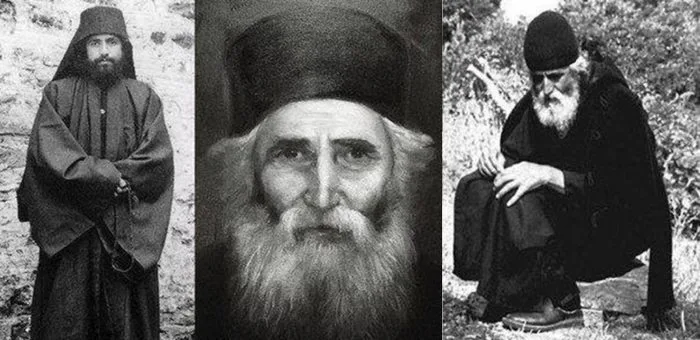
The continuous emergence of saints in the two-thousand-year history is the permanent miracle in our Church. A great ascetic had said that when saints stop emerging, the end of the world will come. The 20thth century brought forth a multitude of new-found saints. One of them is Saint Paisios the Saint.
Was born in July 25, 1924 in Farasa of Cappadocia and were called Arsenios Eznepidis. His parents Precursor and Eulampia they were pious people and had eight other children. It took its name from the also newly appeared saint, Arsenius of Cappadocia, who gave him his name to leave him as a monk at his foot, as he said. At September 14, 1924 fled with his family to Greece, as refugees. They came out to Piraeus and from there they went to Corfu, where they stayed in the castle. After a year and a half they left for her Igoumenitsa and from there to Konitsa, where they settled permanently. Arsenios finished primary school and spent his childhood there. As a child he was fascinated by the solitary life and discussed with his parents his dream of becoming a monk. In the meantime he worked in a carpentry shop and learned the trade of carpentry. He specialized in making coffins.
The 1945 served in the army as a radio operator. He had the misfortune to live and fight in the fratricidal civil war (1945-1949). He often took the place of family soldiers fighting on the front lines, preferring to get hurt himself rather than those who had obligations. It was fired 1949 and decided to go to Mount Athos to fulfill his youthful desire to become a monk. But he was forced to return to Konitsa, to restore his sisters. The 1950 he returned again to Mount Athos and settled in Skete of Agios Panteleimonos and then to Esfigmenou Monastery, where he received the "race wish", taking the first name Embarrassing. He stayed at the Monastery for four years and showed wonderful zeal, obedience, humility and industriousness. He studied the writings of the Fathers, especially his Abba Isaac of Syros.
The 1954 settled in Philotheou Monastery, where it happened, the 1956, and his solitary haircut and received the name Paisius. He stayed in the Monastery until 1958, but after a "inside information" he returned again to Konitsa and settled there Holy Monastery of the Nativity of the Virgin in Stomio. There he worked spiritually converting many heterodox to Orthodoxy and supporting materially and spiritually the poor of the region. He stayed there four years and acquired the reputation of a holy man.
The 1962 moved to Mount Sinai, where he was isolated for two years in their cell Agioi Galaktionos and Epistimis. He was much loved by the monks and the Bedouins, to whom he distributed food and money, which he earned with his hard work.
The 1964 he returned to Mount Athos, from where he never left again. You installed it Skete of the Holy Forerunner of Iberia and became a subordinate of the Russian monk Tychon, with whom he stayed until the 1968.
The 1966 became seriously ill and was hospitalized in SKG, where one of his lungs was removed. During his convalescence he was accommodated at Sanctuary of Agios Ioannou Theologus Sourotis. It 1967 when he recovered, he again went to Mount Athos and settled in PetsAt Lavriotiko his cell Hypatiu. The following year he settled in Stavronikita Monastery and
he served in various manual jobs, despite his poor health.
The 1979 moved to Koutloumousiou Monastery and settled in the abandoned cell of Panagouda. There the first signs of his holiness were seen. His fame began to spread far and wide. He was considered a charismatic monk and multitudes of tormented people turned to him for his advice and blessings. Thousands of testimonies from his visitors confirm that God had gifted him with a gift of insight and foresight. He read the souls of his visitors like an open book! They received thousands of letters, which he did not have time to read. Also, his numerous visitors created a problem of peace for the neighboring monks, which made him very sad.
Despite his busy daily schedule, he did not neglect his ascetic life. He fasted hard, prayed incessantly and rested only 2 to 3 hours a day.
His health problems continued to worsen. His hard exercise and refusal to accept medical help seriously deteriorated his health. The 1993 bleeding started. In November he went to the Hermitage of Souroti. There he became seriously ill. He was taken to the hospital, where he was diagnosed malignant tumor in the large intestine. He calmly accepted the news, as the fulfillment of an old desire for his spiritual progress. You often said "cancer has put thousands of people in heaven". At February 4 1994 he was operated on, but some time later metastases were diagnosed. He was suffering from high fevers and shortness of breath. End June 1994 his doctors announced that he was dying. At July 11, the feast of Saint Euphemia, he received kneeling communion of the Immaculate Mysteries and the following day, July 12, fell asleep. His remains were buried in the Hermitage of Agios Ioannou the Theologus in Souroti, with the participation of thousands of believers.
His tomb became a place of pilgrimage for myriads of believers and hundreds of biographies and records of his speeches began to be written. In the infallible conscience of the believer he was a saint. Typically, his canonization took place on January 13 2015 and his memory was appointed to be celebrated on 12 July, day of his final sleep.
The neophyte saint Paisios was a genuine embodiment of the orthodox monastic ideal and is even considered one of the pioneers of the revival of modern monasticism on Mount Athos. At the same time, he was a zealot for the saving Orthodox faith, criticizing with his well-known mild and humble style the heresies and heresies, especially the modern panheresy of ecumenism.