Biblical figures occupy an important place in the liturgies of our Church, because their testimony about Christ is of great importance, because they lived in His time and many of them knew Him personally. One of them was Saint Lazarus, the four-day and personal friend of the Lord.
He came from the town Bethany, which was near Jerusalem and means "House of Palms". He was about as old as Christ. He had, according to the holy Gospels, two sisters, the Martha and Mary, with whom he lived together. Apparently their parents had died, because they are not mentioned by the evangelists. They evidently belonged to the pious Jews, who had a strong expectation of the Messiah and lived by prayer, almsgiving and justice.
It seems that Christ had passed through Bethany several times and had settled in the hospitable home of Lazarus and his two brothers. This pious family was moved by the preaching of Christ, because they recognized in His person the perfect teacher and therefore they connected with Him in friendship. The Evangelist Luke saved a typical incident from one of the many visits of the Lord to the house of Lazarus (Luke 10,38-42). Christ taught the two sisters. As for Martha "tour about much ministry", and Maria sat down "at the feet of Jesus and hear his word" (Luke 10,38:42-XNUMX).
Shortly before His entry into Jerusalem, the Lord, to undergo His voluntary Passion, received a message from Martha and Mary that Lazarus was seriously ill and they begged Him to go and heal him, as He had healed so many others. But Christ did not hurry immediately, but deliberately delayed, assuring the messengers that "this sickness is not unto death, but for the glory of God, that the son of God may be glorified through it" (John 11,4:XNUMX). But Lazarus died and was buried in a cave tomb.
Christ, after staying two days in the place where he was, took his disciples and returned to Judea and headed to Bethany, despite the fact that his disciples warned him of the danger of being stoned by the Jews. On the way he assured them that "Our friend Lazarus is asleep, but I am on my way to awaken him. His disciples said, Lord, if he lies down, he will be saved. And Jesus swears about this death, they did not believe that he is talking about the sleep of sleep. Then when Jesus said to them, Lazarus died, and I am glad for us, that you may believe that I was not there" (John 11,12-15).
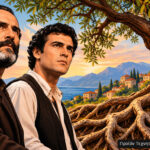
The enthusiastic Martha, when she learned that Christ is coming to the mourning Bethany, ran to meet Him and with complete trust in Him said to Him: "Lord, my brother is dying. But even now I saw that whatever you ask of God, God will give you". Jesus tells her plainly: "thy brother riseth" (John 11,24:XNUMX) and solemnly assures: "I am the resurrection and the life. He that believeth in me, though he die, yet liveth; and he that liveth and believeth in me shall not perish for ever" (John 11,26). Then he asked to be led to the monument and to remove the stone from the cave door. Then Maria warned him: "Sir, he's already alive, isn't he?". Christ told her how "Did they tell you that if you believe before the glory of God?" (John 11,40:XNUMX). After they rolled the stone, the Lord stood in front of the monument and raised his eyes to heaven and said: “Father, I thank you for that you hear me I did not see that you always listen to me, but they said to the crowd present, so that they would believe that you sent me" (John 11,41). Then he called out in a loud voice: "Lazarus out". The miracle happened, Lazarus lived and came out of the tomb bound in burial clothes. Christ commanded him to be untied and to walk.
This great event made many believe in Christ. Some ran to the Pharisees and announced the miracle. Those hard-hearted and hypocritical people, along with the Jewish priesthood, not only were not moved and did not believe in the miracles and power of Jesus, but their hearts became more and more hardened. The high priest Caiaphas said this amazing thing: "You have not seen anything, nor do you reason that it is expedient for us that a man should die for the sake of the people and that the whole nation should not perish" (John 11,49-52). They decided to kill the popular rabbi, who had the power to raise even the dead. They also decided to kill Lazarus, who had become a symbol of the people's admiration for Jesus, "They were deliberating the high priests, let Lazarus also be possessed" (John 12, 9-11).
That's why he left for Cyprus. They later met him there Paul and Barnabas, whom they ordained bishop of Kiti, exercising enormous pastoral work and performing countless miracles. He was then 30 years old and lived another 30 and slept about it 63 AD. and his remains were placed in a luxurious marble urn. His tomb is preserved to this day and is a source of miracles. The 899, the emperor Leo VI (886-912) transported his holy relic to Constantinople, where he placed it in a Monastery which he built in the saint's name. In return he built her a splendid temple Larnaca, Cyprus in his honor, which survives to this day. Later the relic was transferred to Ephesus and from there it disappeared. A fragment is located in Larnaca, Cyprus, which was found under the Holy Altar in 1972. His memory is commemorated on Saturday of Lazarus.
photo, https://augusta-stylianou.pixels.com/