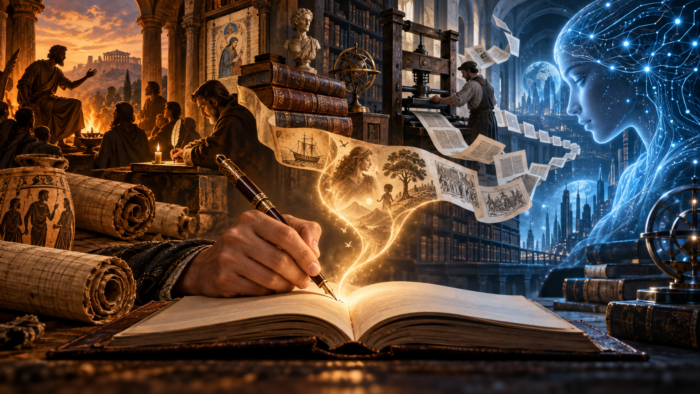
A historical journey from oral tradition and the first manuscripts to the present day, where a book can be "written" in a few minutes
Before books appeared, before there were publishing houses, libraries, and printing presses, there was the human voice.
The first stories weren't written. They were told.
They were born around the fire, within families, communities, ceremonies and great moments of peoples. They were passed down from mouth to mouth and from generation to generation. It was man's way of preserving his memory, honoring his dead, explaining the world and teaching his children who their ancestors were.
Before literature became the art of the written word, it was the art of memory.
From spoken word to the first texts
With the discovery of writing, stories gained permanence. They no longer depended solely on the memory of the storyteller. They could travel through time and reach people who would be born centuries later.
The Epic of Gilgamesh, originating in ancient Mesopotamia, is considered one of the oldest surviving works of literature. Written on clay tablets, it spoke of the fear of death, friendship, power, and the human quest for immortality.
Thousands of years have passed, but the great questions of man have remained the same. In ancient Greece, oral tradition met the written word. The "Iliad" and "Odyssey", works associated with the name of Homer, did not only tell of wars and adventures. They spoke of honor, rage, loss, return, family and homeland.
Odysseus wasn't just traveling to Ithaca. He was traveling to human identity.
Later, ancient Greek theater brought literature to the forefront of society. Aeschylus, Sophocles, Euripides, and Aristophanes didn't just write plays for entertainment. They posed questions about power, justice, responsibility, war, democracy, and human destiny.
Literature became a mirror of society and at the same time a court of its conscience.
The years of the manuscript
For many centuries, each book was a small treasure. Texts were copied by hand, word by word and page by page. Creating a copy could take months or even years.
In monasteries, libraries and spiritual centers, ancient texts, religious works, chronicles, poems and philosophical treatises were preserved. Many works were lost forever. Those that were saved have come down to us thanks to the work of people who dedicated their lives to copying and preserving knowledge.
Back then, a book was not an object of quick consumption. It was a memory, an asset, and a legacy.
Typography is changing the world
In the mid-15th century, the development of movable metal printing by John Gutenberg radically changed the history of the book.
Texts could now be reproduced in much larger numbers and reach more people. Knowledge began to emerge from the closed circles of palaces, monasteries, and wealthy families.
Printing helped spread the ideas of the Renaissance, the Reformation, and later the Enlightenment. The book gained social and political power. It became a means of education, questioning, and liberation.
Every major technological change has affected literature. But printing did not replace the writer. It gave him the opportunity to be heard.
Literature becomes the voice of man
During the Renaissance, man returned to the center of creation. Shakespeare revealed the greatness and the dark side of human nature. Cervantes, with "Don Quixote," spoke of the conflict between dream and reality.
The Enlightenment used reason to challenge authority and defend reason and freedom. Romanticism brought emotion, nature, revolution, and personal anguish back to the forefront.
Realism and Naturalism recorded the lives of ordinary people, poverty, social inequality and the cruelty of the industrial age. Literature no longer spoke only of kings and heroes. It spoke of the worker, the woman, the child, the poor and the socially excluded.
In the 20th century, two world wars, genocides, dictatorships, refugees and social upheavals changed writing again. Writers sought new forms of expression. Modernism broke old narrative structures. Poetry became a cry, testimony and resistance.
In Greece, from Dionysios Solomos and Alexandros Papadiamantis to Konstantinos Cavafy, Nikos Kazantzakis, Giorgos Seferis, Odysseas Elytis, Yannis Ritsos and so many others, literature kept the language, history and soul of Hellenism alive.
These people weren't writing because they had to "produce content." They were writing because they had something they couldn't hold inside.
From book to screen
The digital age has given new opportunities to writers. E-books, online publishing, and self-publishing have opened doors that were previously closed. A new author could now present his work without waiting for the approval of a major publishing house.
This freedom was of great value. But it also brought a new problem. Speed began to replace quality. Visibility began to count more than content. The number of posts, followers, and sales became more important to some than the language, research, and truth of the work.
The book began in many cases to be treated as a fast-moving consumer product.
And then genetic artificial intelligence appeared.
When the machine started writing
Today, an artificial intelligence program can create a poem, a short story, or even an entire draft of a book in a matter of seconds. It can imitate literary genres, suggest characters, correct sentences, and construct stories.
This technology can function as a tool. It can help with research, organization, language editing, or overcoming certain practical difficulties. The crucial question, however, is different:
Who is the creator after all?
The United States Copyright Office clarified in 2025 that a work can only be protected by copyright when it includes sufficient human creative input. Simply entering instructions into an artificial intelligence system is not, in itself, considered authorship. US Copyright Office
The Authors Guild has been recording the great concern of authors since 2023. In its survey, 91% of participants said that readers should be informed when a work has been created, in whole or in part, by artificial intelligence. 94% called for the adoption of a code of ethics for its use in the publishing industry. Authors Guild
At the same time, there is a major debate about whether books and other works have been used to train artificial intelligence systems without prior permission or compensation from their creators. The U.S. Copyright Office acknowledges that this is a complex issue, with dozens of court cases and no simple answer that applies to all cases. Report on artificial intelligence and intellectual property
Did they all become writers overnight?
Today we see books appearing at an unprecedented speed. People who have not cultivated the language, have not read literature, and have not gone through the long and laborious process of writing can ask a machine to deliver them a finished text.
Then they put their name on the cover and introduce themselves as authors.
Herein lies the great problem of our time.
Writing is not just the construction of correct sentences. It is experience, memory, observation, anguish, knowledge, doubt, and personal cost. The writer does not simply write what happened. He documents the way he himself experienced the world.
The machine can describe death. But it has not lost a human being.
He can write about his mother. He has not felt her embrace or her absence.
He can describe love. He has not loved, he has not been betrayed, and he has not waited.
She can talk about being a refugee. She hasn't abandoned her homeland carrying her entire life in a suitcase.
It can combine words that millions of people have used. But it has no personal memory, consciousness, or soul.
The tool and substitution
It is not fair to condemn every use of artificial intelligence. A real writer can use a digital tool for proofreading, translating, organizing, or researching, just as they used dictionaries, typewriters, and computers in the past.
The essential difference lies in who is holding the steering wheel.
If the idea, the experience, the voice, the choice of words and the ultimate responsibility belong to the human, technology remains an assistant. However, when the machine produces the work and the human is limited to signing it, then we are not talking about assistance. We are talking about substitution of creation.
Artificial intelligence is not the enemy of literature in itself. The enemy is ease masquerading as talent, copying masquerading as inspiration, and the lack of personal voice hidden behind well-formed sentences.
Can literature survive?
Literature has survived wars, censorship, persecution, book burnings, and major technological upheavals. It will survive artificial intelligence, too, but only if readers continue to seek out the true human voice.
The future will not be determined by whether we use technology. It will be determined by whether we remember the difference between a tool and a creator.
The real writer is not the one who presses a button and receives a finished book. He is the one who erases, rewrites, doubts, aches, researches, and takes responsibility for every word that bears his signature.
From ancient fireside stories to today's digital texts, the essence of literature has remained one: one person trying to communicate with another person, even if they are separated by places, languages, or centuries.
If we remove the person, words may remain.
However, literature will not be left behind.
"The machine can combine words; only man, however, can imbue them with memory, pain, and soul. Without these, there is text, but no literature."
— Ioanna Lazarou
photo Greek News FL