The new surge in inflationary pressures comes at a particularly sensitive time. The global economy had not yet fully returned to stability after the successive crises of the previous period, when new geopolitical tensions began to weigh again on energy markets, transport and supply chains.
The current situation has its roots in the pandemic. Factory closures, disruptions to global supply chains, sharp shifts in demand, and large-scale fiscal and monetary support measures created strong inflationary pressures. Then, Russia's invasion of Ukraine and sanctions against Russia further weighed on energy and commodity prices.
In 2024 and 2025, the picture seemed to be improving. Inflationary pressures were easing, trade routes were adjusting, and limited monetary easing had begun. However, inflation and interest rates remained higher than expected.
The key feature of the new wave of inflation is that it is not primarily driven by excess demand. Prices can rise even as households cut back on consumption and businesses postpone investment. The source of the pressure lies on the supply side: wars, sanctions, blockades, export restrictions, and threats to critical shipping lanes are altering the cost and availability of energy, food, and raw materials.
This does not mean that market forces cease to operate. On the contrary, it is the markets themselves that transmit to prices the shock caused by political and military decisions. The difference is essential, because Another policy requires inflation caused by excess demand and another requires inflation that starts from restrictions on supply..
How geopolitical risk is transmitted to prices: The mechanism often starts before there is even an actual shortage of products or energy. If, for example, the likelihood of a strategic sea route, such as the Strait of Hormuz, being blocked increases, buyers start securing supplies earlier. Insurance companies raise risk premiums, carriers adjust freight rates, and suppliers build into prices the potential higher costs of replenishing stocks.
This creates a geopolitical risk premiumThe price of a cargo can increase without the cargo itself having suffered damage or without the supply having actually been restricted yet.
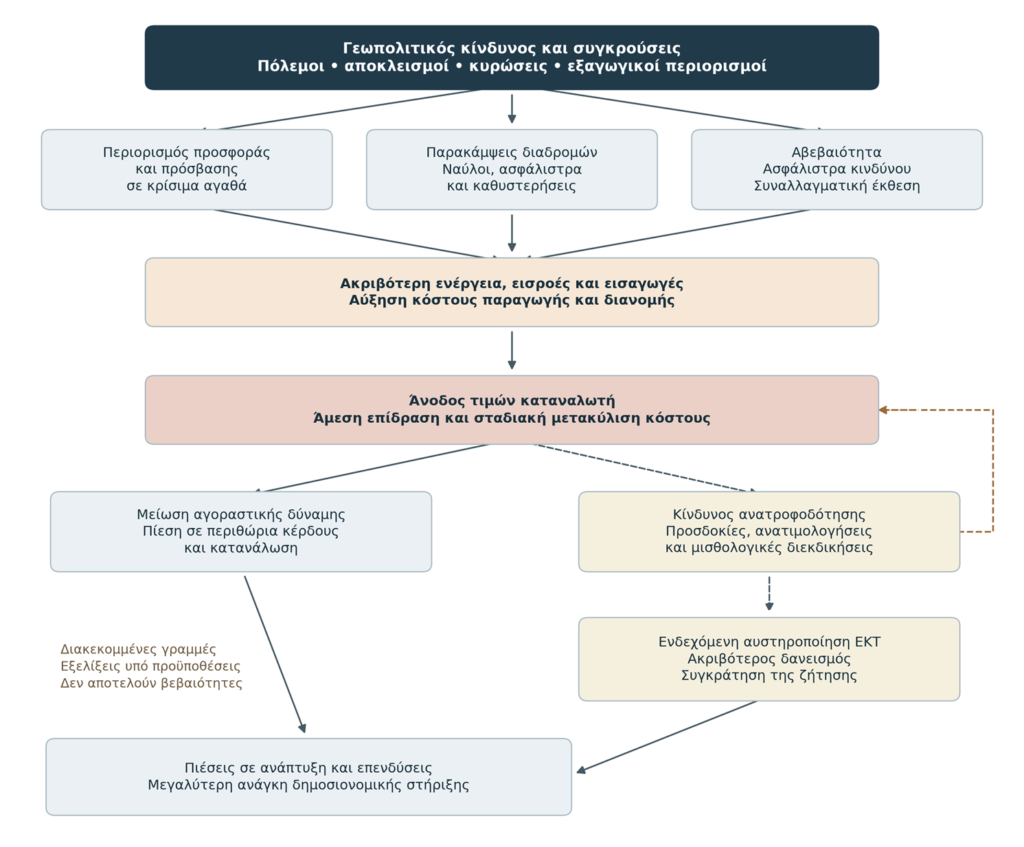
Figure. Conceptual synthesis of the inflation transmission mechanism.
If the threat eventually materializes, the appreciation gains real basis. Conversely, a credible de-escalation can quickly limit this premium.
The second channel is transportation. When a ship is forced to bypass a dangerous route, the number of sailing days, fuel consumption and working capital required increase. The same ship can make fewer trips in the same time, thus reducing the actual transportation capacity. In addition to the higher freight rates, there are insurance premiums, storage and financing costs for the increased inventories.
The third channel is production itself. More expensive natural gas burdens industry and fertilizer production. More expensive oil increases costs in transportation, agriculture, and distribution. Electricity affects almost every productive activity, from food refrigeration and pumping stations to manufacturing plants and hotels.
Thus, a food can become more expensive without its production having decreased. It is enough that the costs of fertilizer, irrigation, packaging, refrigeration and transportation have increased simultaneously.
However, the pass-through does not occur immediately or in the same way in all sectors. Inventories, long-term contracts, competition and subsidies can delay or limit the passing on of costs to the final consumer. However, if price increases persist, businesses revise price lists and employees demand increases to restore their purchasing power.
At this point there is a risk that the initial external shock will turn into more persistent inflation. A clear distinction is also needed between accuracy and inflationA permanent increase in the price level does not mean that prices will continue to rise at the same rate. Declining inflation mainly means that prices rise more slowly, not that they necessarily return to previous levels.
The financial channel: Geopolitical risk can also be transmitted through financial markets. If international uncertainty leads to a strengthening of the dollar against the euro, energy imports priced in dollars become more expensive even if the international price of oil or natural gas remains unchanged.
At the same time, increased uncertainty leads investors to demand higher returns. Financing costs rise and businesses may postpone investments. This also has a long-term consequence: if new production capacity is not created, the economy becomes less able to adapt to future shocks.
Why Europe is particularly vulnerable: Europe is at a disadvantage due to its high dependence on imported energy. According to Eurostat, in 2024 net imports covered around 57% of the European Union's energy needs.
Diversifying suppliers certainly reduces dependence on a particular country, but it does not eliminate exposure to international prices. If a major source of supply is disrupted, all buyers turn to the same alternative markets, driving up prices even from suppliers that are considered safe.
The problem is not limited to household energy bills. The more European income is spent on imported energy, the less resources are left for consumption and investment.
Energy-intensive industries also face a serious competitiveness problem vis-à-vis countries with lower energy costs. Chemicals, metals, fertilizers and construction materials are inputs for a large part of manufacturing. Therefore, the increase in energy costs is spread across the entire production base.
If companies cut production or move investments out of Europe, a temporary energy crisis could have a permanent production footprint. Here lies the risk of stagflation: higher prices alongside weaker growth.
The special case of Greece: Greece has additional sensitivities due to energy dependence, geography and the large role of transport.
According to Eurostat, oil and petroleum products accounted for 84% of the country's energy imports in 2024. The percentage refers to the composition of energy imports and not total energy consumption. Nevertheless, it shows how easily an oil price increase can spill over into transport, production and the external balance.
For households, the pressure is greater because basic goods have low elasticity of demand. The ELSTAT Household Budget Survey for 2024 shows that food and non-alcoholic beverages absorbed 20,7% of the average monthly expenditure.
When the prices of these goods rise, households cannot easily reduce their consumption. Instead, they reduce spending on clothing, recreation, services or other activities, which results in pressure being transmitted to the local economy.
Small businesses are caught between two opposing pressures: on the one hand, input costs are rising, and on the other, customers have less purchasing power. If they pass on all the costs to prices, they may lose sales. If they absorb them, profit margins and liquidity are reduced.
Even greater is the importance of insularity. In Crete and the other islands, the cost of transportation is embedded in food, building materials and business supplies. At the same time, tourism can be doubly affected: by higher operating costs and by a reduction in travel spending by European visitors.
The difficult dilemmas of economic policy: The European Central Bank faces a particularly difficult problem. Higher interest rates cannot open the Strait of Hormuz or increase global oil production. But they can curb demand and prevent a vicious cycle of rising prices and wages.
The costs are obvious: higher interest rates mean more expensive loans, less investment activity and more pressure on businesses and households.
Fiscal policy has a similar dilemma. Generalized subsidies can temporarily reduce costs for consumers, but they shift the burden to the state budget and can keep demand for imported energy artificially high.
A more effective approach is temporary and targeted support for vulnerable households and viable businesses, with clear criteria. At the same time, competition controls and transparency in cost-passing are required. The fact that the initial cause of an appreciation is geopolitical does not mean that every price increase is justified.
The long-term answer is resilience: The most important answer, however, lies not in short-term price management but in reducing vulnerability itself.
Europe and Greece need greater energy diversification, energy savings, renewable sources combined with storage and stronger networks, more suppliers and alternative transport routes.
Creating more secure supply chains certainly comes at a cost. It may be more expensive to maintain inventory, alternative suppliers, or redundant infrastructure. But these costs must be weighed against the potential damage of a major disruption.
The new reality shows that price stability is no longer exclusively the responsibility of the central bank. It requires coordination of monetary, fiscal, energy, industrial and foreign policies.
Geopolitical inflation cannot be completely eliminated as long as economies remain exposed to wars, blockades, and disruptions in international flows. However, the intensity with which an external shock is transmitted to the domestic economy can be limited.
For Greece and Europe, this means that economic resilience must now be considered part of the policy of price stability. The country that has more alternatives in energy, supplies, transportation and financing will be better able to absorb the next geopolitical shocks.
The crucial issue, therefore, is not to predict when the next crisis will appear. It is to shape an economy in which the next crisis will cost less. In the medium term, the global community must begin to cooperate to jointly confront those few countries that, through geopolitical blackmail, disrupt the production and movement of goods and create inflation in countries, which inflation entails a reduction in the purchasing power of citizens, creates social instability, which leads to extreme choices, political instability and ultimately to misgovernance and much worse problems.