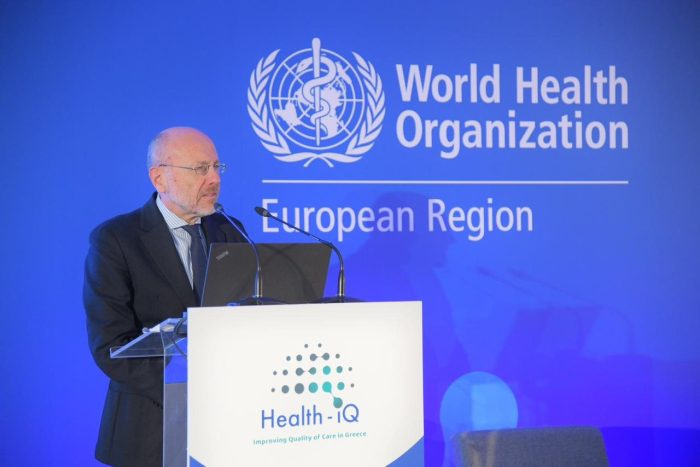
The Ministry of Health and the World Health Organization (WHO) Europe - through the Office for the Quality of Care and Patient Safety in Athens - jointly organized on Friday, February 16, 2024, the opening event for the "Health-IQ" program, at the Stavros Niarchos Foundation Cultural Center.
The event, which marked the launch of the HEALTH-IQ project, was based for its presentation on the initial analysis of the state of the quality of care in Greece, conducted by the Technical Working Group for the project. Discussions focused on addressing challenges related to quality of care and patient safety in Greece, as well as exploring strategies to improve public health.
The pandemic of the disease COVID-19 highlighted the need to strengthen the health systems and made it necessary to measure and evaluate the quality of the provided Health care and the Health Services of Greece.
What is Health IQ and how was it created?
Health-IQ aims to identify and develop a robust and evidence-based approach to measuring and improving the quality of care and patient safety in our country. Improving Health in Greece, which must be:
- Safe
- Based on scientific evidence
- Sustainable and human-centered
- Accessible to everyone
Inspired by the WHO European Work Program 2020–2025, United Action for Better Health and the WHO Regional Director's vision for Europe to leave no one behind, the WHO /Europe identified the need to support countries in their efforts to create high quality health care systems.
In line with this vision, WHO/Europe is collaborating with Greece in the framework of the country's National Development Program for the period 2021–2025, with the main objective of restructuring the National Health System (NHS) of Greece. To this end, it is necessary to adopt a systematic approach to the evaluation and improvement of the quality of health care and services, which is why the HEALTH-IQ collaborative project was created.
HEALTH-IQ is focused on developing a robust methodological guide for measuring and improving quality in healthcare.
It places a strong emphasis on patient-centered services in various health care settings, including Primary Care, Hospital Care, Long-Term Care, Public Health access, prevention procedures for non-communicable diseases (cancer, cardiovascular disease, diabetes, obesity and chronic respiratory diseases) and Mental Health.
This ground-breaking initiative aims to improve the quality of health care - through also relevant patient assessments - cost-effective health systems and equitable access to services. This includes creating a framework for healthcare institutions to measure their quality performance and report on patient experience, facilitating continuous improvements in service delivery. While the project focuses primarily on the Greek healthcare landscape, it is designed to disseminate health quality standards and best practices to other countries facing similar challenges in the WHO European Region.
The opening event on February 16, 2024
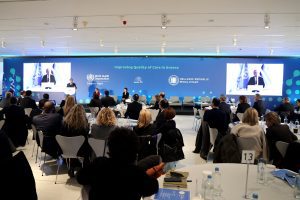
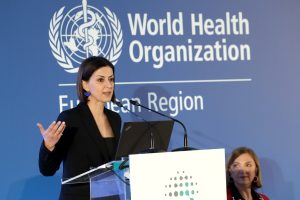
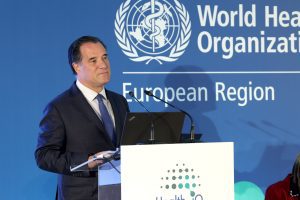
The event began with greetings from the Minister of Health, Adonis Georgiadis, the Deputy Minister of Health, Irini Agapidakis, and the Regional Director of the WHO/Europe, Dr. Hans Kluge.
The event was attended by the Deputy Minister of Health, Marios Themistokleous, the Deputy Minister of Health, Dimitris Vartzopoulos, the Secretary General of Health Services, Lilian Vildiridis, the Secretary General of Strategic Planning, Dr. Aris Angelis, the Director of the Department of Health Policies and Systems of the WHO/Europe countries, Natasha Azzopardi Muscat, and the Head of the Office of Quality of Care and Patient Safety of the WHO in Athens, Dr. João Breda.
Dr. Hans Kluge: Improving the overall quality of healthcare services "The HEALTH-IQ project is an innovative initiative, a collaboration between the Ministry of Health of Greece and WHO/Europe," said WHO/Europe Regional Director, Dr. Hans Kluge. “Through this project, we aim to develop a comprehensive set of indicators to assess the quality of healthcare services. Our mission is clear: to improve the overall quality of healthcare service delivery for the entire Greek population, leaving no one behind."
Adonis Georgiadis: A landmark initiative for healthcare quality
During his speech, the Minister of Health, Adonis Georgiadis called Health-IQ a landmark initiative that will reshape the quality of healthcare in our country. "In an era of successive crises in the health sector that imperatively highlights the demand for strong, resilient and innovative health care systems, the collaboration between the Greek Government and the World Health Organization of Europe under the respected leadership of Dr. Hans Kluge is proof of our commitment to the well-being of our fellow citizens. Health-IQ will fundamentally change the way healthcare works in Greece, including the way services are provided, evaluated and configured in the country", the Minister of Health emphasized, among other things, and concluded:
"...since 2013, our country's cooperation with the World Health Organization has risen to another level. We must not lose any available European resources, we must not be left behind anywhere in any program, we would be laughed at if the European Union gave us resources and we did not manage to use them in the best possible way."
Dr. João Breda: Turning to innovation and excellence
"Today, once again, Greece is leading the way!", said the Head of the Office of Quality Care and Patient Safety of the WHO in Athens, Dr. João Breda. The HEALTH-IQ Program, developed in collaboration with the Greek Ministry of Health under the auspices of the WHO Office for Quality of Care and Patient Safety in Athens, marks the shift to innovation and excellence. The project includes the development of a framework for the measurement and evaluation of health services provided, with the aim of transforming health systems in a more human-centered direction as well as the dissemination of new quality standards."
Irini Agapidaki: Population model in Primary
"It is very important that we have the opportunity through this program to have the mapping of the indicators that will allow us to draw up a policy based on the data", said the Deputy Minister of Health, Irini Agapidakis, and added among other things: "The plan that we have prepared at the Ministry of Health has some pillars that you will see very big changes in the next period. We are talking about a population model in Primary, we are going to do an Integrated Public & Primary Healthcare Model with the World Health Organization in our country, which I think will be something that will give immediate results, but it will also be a legacy because the long-term results are those that will bear important fruits, reduce deaths that could have been avoided, improve the life indicators of the population and significantly reduce economic inequalities in health and especially in childhood - which for me is extremely serious."
Marios Themistokleous: Reforms that will lead the NHS into a new era
"The Health IQ Project is a big step towards improving quality through recording, measuring and evaluating quality and accessibility, ensuring that every patient receives high-quality care," said Deputy Minister of Health, Marios Themistokleous.
"As the Ministry of Health, we are vigorously advancing reforms in the field of Health that will lead the NHS into a new era. Reforms based mainly on three pillars. Firstly, in upgrading the building infrastructure of the National Health Service. With total resources of more than 400 million euros from the Recovery and Resilience Fund, we are renovating and upgrading more than 80 hospitals and 150 health centers throughout the country. Secondly, we are proceeding with the digital transformation of the NHS, completing major projects such as the activation of the Individual Electronic Health Record and the creation of digital management of oncology patient care. And thirdly, and very importantly, we are strengthening the staff of the National Health System with 10.000 recruitments that will strengthen our hospitals, health centers and EKAV. Our commitment is to upgrade the level of hospital care in Greece, creating a new relationship of trust between citizens and the National Health System, which will be based on higher standards of quality and services. Our excellent collaboration with WHO and Dr. Joao Breda, the Head of the Office of Quality of Care and Patient Safety of the WHO in Athens, is a key element for the continuous development of the NHS, contributing substantially to our reform work".
Dimitris Vartzopoulos: Guarantee for the completion of the psychiatric reform
"The implementation of the ambitious program will be the best guarantee for the completion of the psychiatric reform that we are legislating in the near future", pointed out the Deputy Minister of Health, Dimitris Vartzopoulos.
"The draft law that will soon be posted for consultation focuses on the radical restructuring of the organization and administration of the Mental Health Services system. This is how we complete the psychiatric reform that began in our country three decades ago. Important features of the reform include a patient-centred approach, taking advantage of digital technologies and the creation of a National Network of Mental Health Services, as well as a strategy for prevention and treatment of addictions. Special emphasis is placed on combating social exclusion and stigma. In all of the above, the initiative that begins today will decisively contribute to Greece's commitment to promote a modern, human-centered health system that prioritizes well-being and safety."