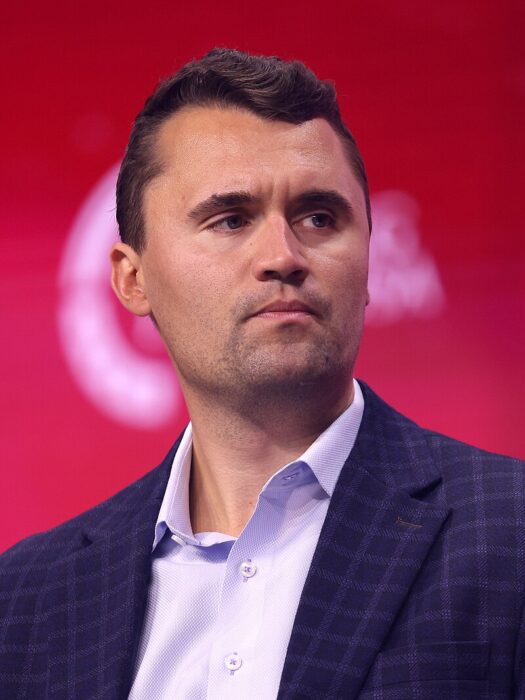
September 10, 2025, will go down in America’s memory as a dark day. Charlie Kirk, a man who – whether one agreed with him or not – had the courage to speak out, was killed by a sniper’s bullet at a university event in Utah. In front of 3.000 people, his voice was violently cut off. And with it, something deeper was cut off: the belief that ideas are met with ideas, not bullets.
FIRST AMENDMENT US CONSTITUTION
Congress shall make no law respecting an establishment of religion, or prohibiting the free exercise thereof; or sheltering the freedom of speech, or of the press; or the right of the people peaceably to assemble, and to petition the Government for a redress of grievances.
How did we get here? How is it possible in the land of the First Amendment, in the land where the Constitution guarantees freedom of speech, that a man pays with his life for speaking out? How is it possible that we live in a society where disagreement finds no outlet in dialogue but in outright violence?
Charlie Kirk was no saint. He was polarizing, he provoked reactions, he stirred up crowds. But isn't that what democracy is all about? To tolerate the voices that irritate us, that shock us, that we don't like? If the price of freedom is to listen only to those who are convenient for us, then we're not talking about freedom; we're talking about silencing.
Kirk's murder is more than a tragedy. It is a warning. If today a man loses his life for expressing an opinion, tomorrow who will be next? And if we allow fear to define who speaks and who remains silent, then what kind of society will we leave to our children? A society where "silence means survival"?
Freedom of speech is not a gift bestowed upon us by governments or parties. It is a fundamental, non-negotiable right. It is not protected for popular voices, but for those who are annoying, for those who dare to say something different. When a man is killed for his words, then the entire democracy bleeds.
Today we mourn not only Charlie Kirk. We mourn an America in danger of forgetting itself. And we ask: Will we allow fear to win? Will we let bullets replace arguments? Or will we stand, as the Constitution calls us, as defenders of freedom, even when we disagree with the one who exercises it?
With George Floyd in 2020, the image of his murder by a police officer was broadcast worldwide in real time, shaking the collective feeling and touching on an issue that had been burning for decades: racism and police violence against African Americans. Thus, protests broke out in dozens of cities, which in some cases took a violent form.
In the case of Charlie Kirk, we have a political assassination. It's not police brutality, it's not racial injustice — it's an attack on a political commentator who expressed a specific, controversial ideological line. That's why the social reaction is more "restrained":
- For some, Kirk was polarizing and unempathetic.
- For others, his murder is a "warning" for freedom of speech, but the narrative does not mobilize massive crowds, because society is deeply divided.
- Furthermore, political violence is often met with silence or embarrassment, because no one wants to "justify" the other side.
The question you ask is the central one: Why double standards? Why does the whole country revolt when a person is murdered by the police, but when a person is murdered for his views, society remains silent?
And here's where the harshest conclusion comes in: America reacts selectively, depending on who the victim is and what narrative is politically convenient. But freedom of speech and the right to life are neither right nor left. They are non-negotiable.
Trump says Charlie Kirk killed in shooting | Special Report
video
CBS News
Photo By Gage Skidmore – https://www.flickr.com/photos/gageskidmore/54670961811/, CC BY-SA 4.0, https://commons.wikimedia.org/w/index.php?curid=172612805, https://en.wikipedia.org/wiki/