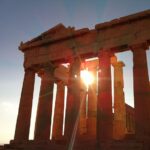

Amazing climate, wealth of works, advantageous geographical position for trade and the glorious past of Ancient Greece, will always attract the curiosity of travelers and the attention of politicians to the islands of the Archipelago.
B.M. Bronevsky,
Officer of the Russian fleet in the 3rd Mediterranean campaign of the Russian fleet under the command of the Russian admiral Ndmitry Nikolayevich Senyavin 1805-1807
Excited by his gentle Struggle Greek people for freedom, a whole host of Russian romantic poets of the time cannot remain unparticipated in the more general philhellenic-liberal trend, this whole artistic wave, which surrounds Europe. Inspired by the overwhelming need of the offspring "of Minos, Lycurgus, Solon, Miltiades, Themistocles, Aristides» for physical, physical freedom, spiritual self-sufficiency, national sovereignty, rush into their creative struggle and, with their pen, with their words, immortalize the general sentiment of the time for the freedom of the peoples and the creation of national states.
The article in question lists poems by Russian Philhellenic poets, from the excellent edition "The Greek Revolution of 1821 in the mirror of Russian poetry", with selection, introduction, editing by the outstanding Greek scholar, professor Sonias Ilinskaia-Alexandropoulou, published in 2001 by "ESTIAS" bookstore I.D. KOLLAROU & SIAS S.A. [this is a bilingual edition, in Greek and Russian] with the substantial support and contribution of the then Greek Ambassador of Greece to Russia Dimitris Kypraiou. We invest the poetry with some excerpts from the memoirs of Russian travelers, who visited Greece in the given period and recorded their impressions from their contacts with the Greek population.
As the professor rightly points out in the foreword of the publication Ilinskaya-Alexandropoulou, who are "...the publication, in Greek and Russian, of this collection is a due act of justice, causing satisfaction and hopes that the chapter they open will stimulate the interest of Greek and Russian scholars and will have continuity».
ALEXANDER PUSHKIN – (1799-1837).
My faithful Greek woman, don't cry – he has fallen like a hero!
The enemy impaled him in the chest with a pencil.
Don't cry - as you greeted him with an oath you had bound him
May it be on the road of honor that is blood and destruction!
Then, he felt heavy for his flight,
His hand triumphantly extended to his child,
With tearful eyes he blesses it bitterly,
Of freedom the banners waved sadly,
A myrtle sprig he put around the sword,
Aristogeiton – threw himself into the battle in a weakened state,
He was sacrificed – his work is done.
1821
Translated Stratis Paschalis
ALEXANDER PUSHKIN – (1799-1837).
TO A GREEK WOMAN
You were sweetly born to blaze
Every poet's imagination,
To disturb, to captivate
With this lively charm of yours,
Your sweet, otherworldly voice
And the mirrored, bright look,
Your bold foot, you are forged
For caresses, you are born for passions.
Lila's the poet in his dreams
Don't see your own beauty,
And made you a heavenly painting,
Looking at you with deep despair,
His exquisite and eternal love;
And perhaps in your distant land,
In the sun, the hot sun,
The bard who has all the gifts of the estrus,
He saw you in one of his dreams, that's why
Your face from that time
It remained inside him forever as a talisman;
And maybe the magician was intoxicating your heart
On the lyre playing songs multitude,
And a fatal shiver involuntarily
Did your proud breast quiver?
And you were leaning on his shoulder... my dear,
No, no, my jealousy, oh how it burns me,
And I feel a knife in my soul!
I haven't had happiness in so long,
But now it's strange – I'm living it.
I am tormented by a mysterious melancholy,
Because whatever I love is a mistake.
1822
Translated Stratis Paschalis
ALEXANDER PUSHKIN – (1799-1837).
Arise, O Greece, and set up the fight,
And show the prowess of your lads,
And get rid of that old anger of yours
Of Olympus and Pindos, of your Thermopylae!
In these eternal black mountains,
The new Freedom was born,
In Athens the marbles that are all laurel,
And the mausoleums of the ancient leaders.
The land of gods and heroes the land,
It burns with the fire of a fair fight,
He breaks the shackles and goes and sings now
Tyrtaeus and Byron and Thuria of Feraeus.
1822
Translated Stratis Paschalis
Dionysios Tsokos, CC BY-SA 3.0, via Wikimedia Commons