How is the situation in the Middle East assessed, taking into account the statements of the American president and the Iranians?
I believe that Donald Trump's recent statements about a possible agreement with Iran, combined with Tehran's public reluctance towards negotiations, create the appearance of a contradiction. In reality, however, as far as I know, this is a familiar diplomatic tactic of two sides talking without openly admitting it. It should be noted here that international politics does not evolve in terms of public statements, but in terms of balances of power. And at this stage, what we are observing is not a conflict or an agreement, it is a negotiation under pressure. So let's look at things a little more analytically.
The United States strategy
Trump's statements about a possible deal are not an indication that there is already a result. On the contrary, they are a negotiating tool. With these statements:
the image of the American negotiating initiative is strengthened, political pressure is exerted on Tehran,
a message is sent to prevent military escalation,
The impression is cultivated that there is a diplomatic way out without concessions. This strategy is not new. On the contrary, it is a characteristic element of American foreign policy when an agreement is sought without an immediate concession of power.
Iran's stance
Iran's reluctance to negotiate does not mean a rejection of peace. It means a rejection of unconditional negotiations. Tehran seeks: lifting of economic sanctions, guarantees of credibility after the US withdrawal from a previous agreement, recognition of its geopolitical role in the Middle East. At the same time, the Iranian leadership cannot politically appear to be negotiating under pressure. For this reason, it maintains a tough public stance, while leaving channels of communication open.
What's really going on behind the scenes?
The simultaneous existence of optimism on the one hand and caution on the other is an indication that there are indirect contacts through third countries, possible frameworks for an agreement are being examined, reactions from international players are being tested, and public commitment is being avoided before terms are formulated.
In other words, there is no agreement, but there is a process.
The role of regional instability
A determining factor in shaping the situation is the broader geopolitical balance in the Middle East and especially Israel's stance. The likelihood of military involvement increases significantly if there is a strike on nuclear facilities, regional escalation through Iran's allies, a new security crisis in the Persian Gulf
However, none of the major powers currently appear to be seeking general war.
Where are we headed?
The data show that the international situation is neither conducive to immediate conflict nor to complete peace. The most likely outcome is a limited de-escalation agreement or a prolonged balance of tension. The so-called “agreement” that is being announced will not mean the end of the confrontation between the United States and Iran. It will simply mean a temporary stabilization. In reality, what is unfolding today is not the end of a war, but the management of a conflict that no one wants to become a real war, as I see and understand it.
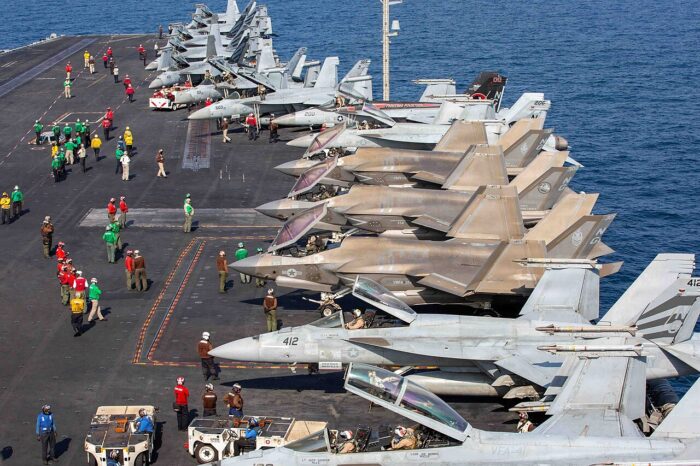
Photo By [null Courtesy] – This image was released by the United States Department of Defense with the ID 022726-D-DO477-1018 (next). This tag does not indicate the copyright status of the attached work. A normal copyright tag is still required. See Commons:Licensing.العربية ∙ বাংলা ∙Bahaso Jambi ∙Deutsch ∙ Deutsch (Sie-Form) ∙ English ∙ español ∙ euskara ∙ فارسی ∙ français ∙ italiano ∙ 日本語 ∙ 한국어 ∙ македонски ∙ मेलाइलेम ∙ Plattdüütsch ∙ Nederlands ∙ polski ∙ पुच्ट ∙ português ∙ русский ∙ slovenščina ∙ svenska ∙ Türkçe ∙ українська ∙ 简体中文 ∙ 繁體中文 ∙ +/−, Public Domain https://commons.wikimedia.org/w/index.php?curid=185298604, https://en.wikipedia.org/