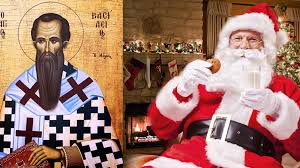
Reference to the elf of the same name - caricature of the holidays
The twelve day holidays, as the days from Christmas to Epiphany are called, are an important celebratory station in the consciousness of the Orthodox New Greeks. For believers this holy period is an opportunity for spiritual upliftment and contemplation. For the vast majority of people, however, it is an opportunity for ephemeral worldly and cheap pursuits. Under the influence of Western European secular and materialistic culture, the spiritual meaning of these holy holidays was set aside and priority was given to all kinds of consumerism and material pleasures. For them, Christmas is now synonymous with commerce and entertainment. Not of course that these are not part of our life and should be eliminated from it, but they should be practiced in moderation and priority should be given to the essence which is the celebration of the most important event in human history, the incarnation of God for the salvation of the world, as the supreme gift of divine mercy for the human race and the whole creation.
The main "person" of commercial activity these days is "Santa Claus", the well-known cranky good-natured old man, in red clothes, who, loaded with a sack, comes somewhere from the Arctic North and (supposedly) distributes gifts to the children. In television advertisements, the unscrupulous merchants even went so far as to present him even in provocative and sinful scenes, which is unacceptable for a saint of our Church.
It has been emphasized many times by ecclesiastical factors that this unlikely guy, a creature of the imagination of Western Europeans, is not and cannot be related to any of the venerable and serious saints of our Orthodox Church, even though he bears the names of our famous saints, such as Saint Nicholas to foreigners (Santa Claus) and Saint Basil to us. Recent research has proven that the origin of this strange Christmas creature has its roots in pre-Christian pagan antiquity. To the ancient Greeks the exuberant Poseidon and to the Latins the corresponding Neptune "brought" gifts to people. The old man - Winter - gave gifts to the northern peoples. In medieval Italy the old woman - Befana - brought the gifts. In other words the "mascot" of Christmas, "Santa Claus", is an elf, a pagan imaginary figure, who became an integral part of the consumer frenzy of these days.
It is known that the establishment of the Christmas holiday took place in AD 25. century in the West and in the East at the beginning of the XNUMXth AD. century, mainly as a replacement for the great pagan festival of the "Invincible Sun", the Iranian military god Mithras, which was celebrated with great pomp on December XNUMX throughout the Roman Empire. The fathers of our Church designated this day as the day of the birth of Christ, the imaginary Sun of Justice, thus managing in a short period of time to eradicate the pagan holiday and let the Christian one prevail. But the strong habits of the pagan past were not easy to cut from the souls of the people, that is why many pagan elements of secondary importance were mutated and joined the new faith and especially as folklore in the now brilliant Christian holidays. In this case, the pre-Christian one
good-natured old man assumed a Christian name and joined the popular soul as an integral part of its religiosity.
The names he received, either of Saint Nicholas or Saint Basil, are not accidental. These two important saints of our ancient Church were great humanitarians and social workers of society. The practice of charity by Saint Nicholas, bishop of Myron of Lycia (+340) was proverbial. His holy synaxari is full of countless incidents of real help to the distressed people of the wider area of his diocese and of unwarranted checks against the unjustly powerful. For the faithful Orthodox Saint Nicholas is the saint of kindness, mercy and charity. But also Saint Basil (+379) is the par excellence social theoretical and practical father of our Church. His entire life has been a constant struggle to alleviate human poverty and misery. The famous "Vassiliada" of Cappadocia, the life work of the saint and a model charitable institution for all times, bears witness to the supreme contribution of this leading ecclesiastical man. In the Christian consciousness these two social saints came to be the perpetual benefactors of all kinds of charity, and therefore the pre-Christian mythical dispensers of gifts to men were replaced by them.
In my opinion, it is not bad, in principle, to cultivate in the popular psyche, and especially in children, the idea that a saint distributes kindness and goods to people. The harsh reality makes us need unreal and metaphysical help. "Santa Claus" is the "machine god" who overcomes objective difficulties, such as human misery, and (supposedly) brings happiness. The ugly part of the case is that the humble "St. Basil", as depicted, is not related to the ascetic Saint Basil, who died young, 49 years old, skeletonized and emaciated from constant social work and giving. The worst thing is that the commercialization of the Christmas holidays turned this even mythical "Santa Claus" into a means of advertising all kinds of products, such as alcoholic beverages, even ... women's underwear!
Unfortunately, we live in an age of intense consumerism. The highest value is now profit, on the altar of which everything is sacrificed. Belief in God, morality, respect for the human personality are parameters subordinate to economic development, which is the supreme demand of modern man. Today's man seeks to cover as many of his financial needs as possible, mistakenly thinking that this way he can satisfy the existential void he has in his soul. Jesus Christ the master of the world and history, whose divine birth we celebrate these days, is almost unknown to him. His redeeming gift does not touch him at all. That is why he likes redemptive substitutes such as the mythical "Santa Claus" of Christmas. This "saint" suits him, because he is made in his image and likeness: consumptive, carefree, unproblematic, jovial... He is the new type - model man of the "New Age", who launches the unproblematic (animalistic) life, submissive to the "imperatives" of modern times and who reduces consumption as the highest value. The mischievous elf - caricature of the holidays, who goes by the name "Santa Claus", shows the way to such a way of life, superficially beautiful and fancy, but deep down, gruesome and inhuman, foreshadowing the future of the world bleak and uncertain!
photo https://vimaorthodoxias.gr