Visual artist Sofia Mitraki transforms social reality into an image, symbol and reflection
Written by Ioanna Lazarou
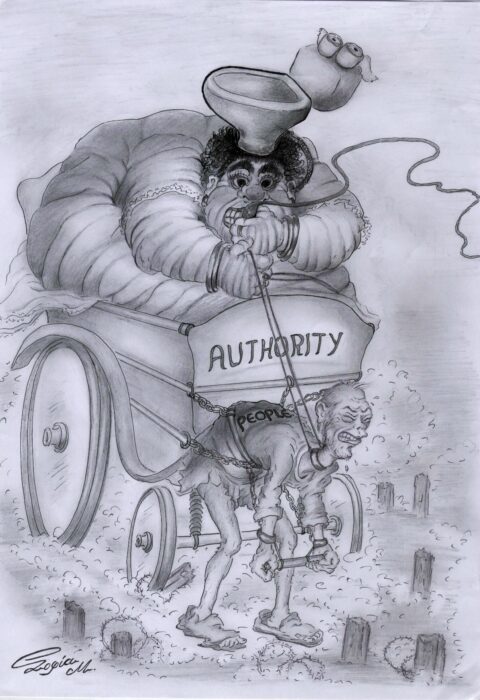
Can a drawing describe an entire society? Can a pencil reveal what words have difficulty expressing? In the cartoon by artist Sofia Mitraki, the answer lies before our eyes.
The artist presents a harsh, ironic and deeply symbolic scene. A large figure sits comfortably on a large vehicle. The word “AUTHORITY” is written on the carriage. In front of her, an exhausted, thin and barefoot man, with the word “PEOPLE” written on his body, is bound with chains and forced to drag the entire weight.
The image does not leave the viewer indifferent. It does not simply ask us to look at it. It forces us to stand before it and ask ourselves: Who ultimately serves whom?
The reversal of the true mission of power
In a democratic society, power exists to serve the people and protect the common interest. In the cartoon, however, this relationship is reversed. The people are not transported by the vehicle of the state. They are the ones who drag it.
“Power” appears overfed, heavy and satiated. It occupies almost the entire upper part of the composition. “The People”, on the contrary, is skeletal, exhausted and bent. His body bears witness to fatigue, pain and long-term exhaustion.
The difference in the size of the two figures is not just a humorous exaggeration. It is the very essence of the message. The heavier the power, the more the people who carry it bend.
Chains don't just connect man to the carriage. They symbolize economic dependence, fear, social weakness, overtaxation, bureaucracy, and every mechanism that limits civil freedom.
The people are presented as free only in name. In reality, they are bound to a system that constantly demands strength, work, and sacrifice from them, without offering them the corresponding protection.
The power of visual exaggeration
Cartoons do not faithfully copy reality. They deliberately distort it in order to reveal the truth hidden behind its external image.
Sofia Mitraki uses the technique of caricature and exaggerates the features of “Power.” The body becomes huge, the hands heavy, the gaze intense and the expression almost smug. The figure causes laughter at first glance, but the laughter quickly turns into discomfort.
This is exactly what successful social cartooning does. It attracts us with exaggeration, but holds us with meaning.
Faced with the excessive volume of power, the body of the people is drawn weak and worn out. His back is hunched, his limbs seem exhausted, and his face reflects pain. There is no trace of comfort or dignity in his posture. There is only the effort to take one more step.
The contrast between the two figures creates the central tension of the work: one enjoys the burden that the other is forced to bear.
The techniques that serve the message
The work is drawn in black and white, with pencil and tonal gradations. The absence of color enhances the harshness of the image. Nothing distracts the eye from the figures, the chains, and the power relationship that develops between them.
The shadows add volume and weight, especially to the figure on the carriage. The strong lines on the people's faces and bodies convey a sense of decay. The vehicle is rendered heavy and cumbersome, like a whole mechanism that continues to move forward only because some powerless person sacrifices his last strength.
The composition follows a mainly vertical development. The power is at the top, the people at the bottom. This choice visually creates a clear hierarchy. The one who decides is at the top. The one who pays the price is at the bottom.
The chains and ropes form strong diagonal lines. They direct the gaze from the carriage to the man and make the relationship of oppression impossible to ignore.
The bare, inhospitable landscape, with its cut or destroyed features, completes the sense of abandonment. There is no flourishing society around them. There is a world exhausted, just like the man who crosses it.
Allegory as the language of art
The artist does not paint a specific political figure nor does she limit the work to one country or one era. She chooses two general concepts: “Power” and “People”.
With this choice, the cartoon acquires a timeless character.
It could refer to any society where institutions are removed from the individual. In any era where the few enjoy what the many produce. In any system that constantly demands new sacrifices from the citizen, without recognizing his fatigue and dignity.
Allegory allows the viewer to place their own experiences within the work. Another will see economic inequality. Another political exploitation. Another the tax pressure, social injustice or the indifference of a power that has forgotten whom it must serve.
This is the power of art. It doesn't always give a ready-made answer. It creates the right questions.
The artist sees behind the surface
A true visual artist doesn't just observe what's happening. He perceives the relationships behind it. He sees the distance between official statements and the everyday life of the citizen. He takes a complex social reality and transforms it into an image that is immediately understandable.
The journalist uses words. The cartoonist uses lines, shadows, symbols, and exaggerations. Both, when they serve their work honestly, seek the same thing: to illuminate what some would prefer to remain in the dark.
Cartoons may be humorous, but they are not frivolous. They may cause laughter, but often behind that laughter lies a painful truth.
In this particular work by Sofia Mitraki, the humor is bitter. Exaggeration is not used to simply entertain the viewer, but to awaken them.
An image that concerns us all
The question the cartoon leaves is simple and at the same time deeply political:
How much further can a people progress when the burden they carry is constantly increasing?
The artist doesn't need many words to present her answer. A heavy vehicle, a hypertrophic power, a bound man and some chains are enough.
The art of cartooning does not embellish reality. It strips it bare.
And when the pencil is in the hands of an artist who observes, feels, and dares, a black and white image can acquire a stronger voice than an entire political discourse.
"Cartoons do not distort reality. They magnify what society has learned to overlook."
photo Project: Sofia Mitraki