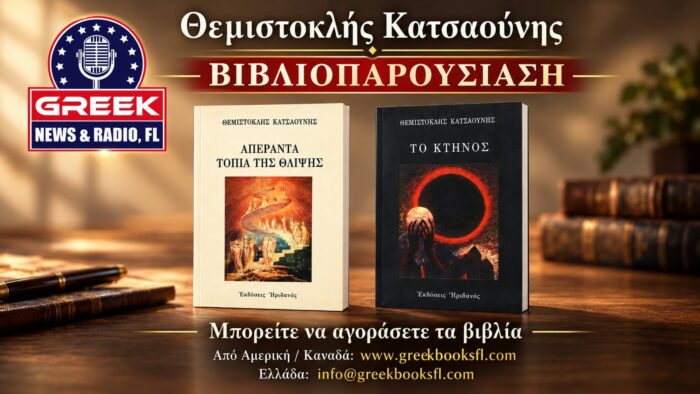
The "Immense landscapes of sadness" by Themistokles Katsaounis is a work that escapes the classical structure of poetry, choosing the form of the prose poem to explore human existence, memory and the journey of man through time.
The choice of the prose poem (or poetic prose) proves ideal for this particular undertaking. By breaking the strict boundaries of traditional rhyme and stanza structure, Katsaounis gains absolute freedom of speech. His writing acquires the flow of an internal monologue, allowing thoughts, memories and emotions to pour out like a torrent, drawing the reader into a shared experiential experience.
Katsaounis uses the title "Affliction" not as a sterile melancholy, but as a existential background. The central theme of the book is man's journey from "nothing" (the stone and the cell) to his need to conquer the universe, knowledge and light. The author places man within a huge cosmic puzzle, emphasizing both his insignificance in front of infinity as well as his immense inner strength.
The existential search in Vast landscapes of sadness is not limited to the individual level, but acquires cosmic dimensions. The author reminds us that man, born in the heart of a star and originating from the universe, carries within himself the history of creation itself. Within this “empire of the sky”, Katsaounis converses with “supermen” of the spirit: from the drunken Arthur Rimbaud who composes his immortal poems in a Paris bar, until Edison who discovers the lamp. In this way, sadness is transformed into a driving force of creation and evolution.
Through titles such as “Tracing the Paths of Memory” and “Between 8 and 12 Years,” the book functions as an internal mirror. The writing is deeply experiential. The poet brings back memories of childhood, family, and adolescence, presenting sadness as the necessary price of adulthood and self-awareness.
The writing style is characterized by a flowing, honest rhythm where the subject bares his emotions without a mask. As characteristically stated in the book's preface:
“I am the young man looking for love. I am the madman who wanders the streets alone at night… I am the marginalized rebel with no hope of victory… I am a monster in the eyes of others!”
Through these repeated aphorisms, Katsaounis builds the identity of a hero who clashes with stereotypes and social acceptance.
The book is not lacking in social commentary, poems such as "To Comrade Hippocrates" or "Rage" show a creator who does not remain closed in on himself, but converses with social reality, injustice and the need for revolution and change.
Conclusion
"Immense Landscapes of Sorrow" is a dense, internal and deeply emotional book. This is not an easy, "light" read. It requires the reader to immerse themselves in their own thoughts. Its international recognition (and the award in Italy) confirms that the themes it deals with, time, loss, hope and human destiny, are universal.
The universality of the book's themes was confirmed by its significant international distinction, as Themistocles Katsaounis was honored with the International Italian Literary Prize “Antonio Filoteo Omodei” in Catania, Sicily for the Italian edition of the work (Paesaggi immensi dell' afflizione). Furthermore, the collection has been widely accepted abroad, having also been translated into German and Albanian.
photo Greek News FL