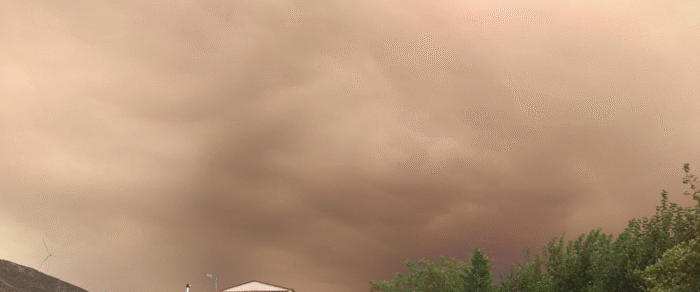
The moment the fire stops screaming and leaves behind a world I don't recognize.
I woke up with the light distorted. It was not morning, it was something between dawn and despair. The sky was the color of ash, and the sun, if it was still there, was hidden behind veils of smoke. The birds - those that had survived - had fallen silent, as if they knew that whatever they chirped would not reach anyone's ears.
In my yard, the walnut leaves were dripping black sap. And the air smelled of charcoal and lost summer. I didn't have to look far to understand that the fire was approaching... you feel it before you see it. It's the sudden dryness in your mouth, the invisible heat rising from the soil, the shadows running across the stones.
All day long we heard the drone of helicopters. Some said it was the sound of hope. I heard it like the beating of a heart that was struggling. And among them, sirens, voices, and the wind changing direction, as if nature itself was playing with our end.
Fire doesn't look like anything. It's not just flames. It's a living thing, hungry, impatient, unyielding. It crawls through pine trees, climbs logs, jumps roads. I saw it reach the clearing near my house, engulfing in seconds what had taken decades to grow.
I ran with a bucket, knowing it was futile. Fire doesn't go out with water. It only goes out when it has no more food. But at that moment, the need to do something - anything - was stronger than reason.
On the street, I met people with red eyes, and not just from the smoke. An old man was carrying a cage with two pigeons. A little girl was holding her cat, her tears mixing with sweat. At the edge, a woman was standing in front of her burned-out house without crying. That's when I realized... there is a place beyond crying, where the soul simply empties.
The fire never ceases to remind you that you have nothing of your own. Not your house, not the trees, not the air. Everything belongs to the moment, and the moment changes face without warning.
At night, the flame became a sea. It flowed over the mountains, dripped from the branches, spread like a red wave. From afar, if you didn't smell the smoke, you would call it beautiful. But this beauty is betrayal, it enchants you to come closer.
And when, after days, it faded or rather became saturated, I was left staring at the vast blackness. The green fields I had seen until now were now shadows. The stones were the color of darkening blood. In place of the pine trees, only their skeletons stood like witnesses.
And yet, in this wilderness, there was something that remained constant. An olive leaf, green, on a burnt trunk. The footprint of a cat on the ashes. The smell of the soil after the first rain that came, as if to say "we're not done yet."
What the fire leaves behind is not just destruction. It is also memory. It is the hands that held each other to save themselves, the voices that called names in the smoke, the footsteps that ran together. It is the promise that, as long as it burns, we will leave no one alone.
But there is also that which cannot be cured. The gaze of the place when you betray it with your negligence, your greed, your silence. The fire does not come by itself, it is called by our inability to prevent it.
Now, every time I smell burning wood, I freeze. Not because I'm afraid only for myself, but because I know that this smell is an ancient language, the language that disaster speaks when it wants to warn you.
And as the years pass, I think that my Greece is like a flame. Beautiful, dangerous, unruly. And if we don't take care of it, it will burn from its own passion.
Because in the end, fire always asks for something. It asks us to remember who we are, before it erases us from the map.
It is not necessary to go through a fire to carry it within me, humanity has the ability to borrow beats from foreign hearts and make them its own.
The text is fictional in terms of my personal experience, but true in terms of the emotion. I may not have run with a bucket in my hand, but the photo is mine, I have smelled the smoke before and I know how loss tightens the throat.
When we write about a pain that is not exclusively our own, we do more than narrate, we keep alive the memory and truth of those who do not have a voice or the courage to speak.
Photo-text: Irini Fragkaki