The continuation of the article
The contribution of the parish clergy:
Equally important was the contribution of the parish clergy, who rallied the Greeks around him. Thanks to the respect and prestige that his religious mission secured for him, the power that his ties with wealthy merchants and ecclesiastical networks provided him, but also the spiritual radiance that he emitted, especially the learned clergy, he became a powerful factor in the struggle for national awakening.
Evgenios Voulgaris, Nikephoros Theotokis, Anthimos Gazis, Iosepos Moisiodakas, Neophytos Vamvas, Konstantinos Economos of Economon, are some of the learned clerics who, combining ancient Greek tradition, Western enlightenment education, romantic philology and faith in Orthodoxy, supported the visions of their enslaved compatriots. Many clerics who lived in the enslaved country also fought for the faith and the Genus, with the most prominent figure being the apostle of the people, Cosmas the Aetolian.
Great National Benefactors
In addition to publishing Greek teaching manuals and commercial practices and customs, which were essential professional tools, with the friendliness that distinguished them, they contributed to the publication of books, but also to everything else that served the national cause.
Among these, the building and repair of damaged churches, the training of teachers, the establishment of new schools and the strengthening of old ones, the establishment of libraries, the establishment of printing houses, the free distribution of books in their homeland. They also sent munitions and money for the Struggle.
They also had large sums of money available for the release of Greek prisoners, for poorhouses and hospitals, and for the support of the “Friendly Society”, which was an exclusive creation of Greek merchants outside Greece.
“Many well-off Greeks abroad saved their names from eternal oblivion, with their generous donations to their homeland and to their places of settlement”
Indicative cases are Nikolaos Doumbas, who offered to Vienna, where he lived, the beautiful mansion of the “Society of Friends of Music” (1870), Simon Sinas, who financed the construction of one of the bridges connecting Buda with Pest, etc. The latter, like many other National Benefactors (Zosimades, Arsakis, Varvakis, Rizaris, Vallianos, Kaplanis, etc.), allocated large sums of money after the Liberation for charitable works in their homeland (Sinaia Academy, Zosimaia School, Arsakeia Schools, Varvakeio, Rizarios, Vallianios Library, etc.).
The six Zosimades brothers (Theodosius, Nicholas, Michael, John, Anastasius and Zois) claim uniqueness, who emigrated to serve Kerdoos Hermes, the first three to Livorno in Italy and the others to Nizhny Novgorod in Russia, a city that had a strong Greek element. They devoted their wealth to works of charity and national benefit, starting with the Zosimaia School and the eponymous Nursing Home in Ioannina and ending with their numerous charitable works, as long as they lived and with their wills.
Evangelos Zappas (1800-1865) and Konstantinos Zappas (1844-1892)
Cousins who acquired a large fortune in Romania contributed large sums of money for the publication of agricultural books, for the construction of the Zappeion Megaron in Athens, for subsidies for the construction of the model Girls' Schools of Constantinople and Adrianople and other cities of Thrace, for donations to the Amalienio Orphanage and the Kapodistrian University, for the allocation of funds to the Philological Ephorate of Bucharest for the rescue of the "Romance" (Vlach) language, and much more.
George Averoff (1818-1899)
He was born in Metsovo in 1818. In 1840 he emigrated to Alexandria, Egypt. There he developed intense business activity and acquired a large fortune, which he allocated to the promotion of educational and national causes, as well as to charities. With his first donations, a girls' school and a hospital were established in the Greek community of Alexandria. He made donations to Metsovo and Athens.
With his financial assistance, the Technical University of Athens was completed, which was named Metsovo because its three donors, Stournaris, Tositsas and Averoff, came from Metsovo. The Military School of Evelpidon, the Averoff prisons (Averoffion Efibeion) were also built and the Panathenaic Stadium was remarbled. His contribution to the construction of the battleship "Averoff", the flagship of the fleet during the Balkan Wars, was significant. The naval dominance of the Greeks in the Aegean is almost exclusively due to this.
George Averoff died in the city of Alexandria on July 15, 1899, at the age of 81. The Greek state, as a sign of honor and gratitude, erected a statue in front of the Panathenaic Stadium.
And many others who want a special lecture for all the great National Diaspora Benefactors.
Of course, for the expatriates, the liberation of their homeland was not the end and vindication of one national vision, but also the beginning of another: To adorn their homeland with public buildings and charitable stores, worthy of its glorious past, and to contribute to the spiritual and economic formation of a fully-fledged state.
During the phase of the formation of the modern Greek state, a significant number of Greeks, who in the last years of Turkish rule abandoned their homeland to avoid the vengeful fury of the Turks, and many Greeks who lived in areas that were not included in the newly established state, returned to their birthplaces.
“This event caused a rift, because the prefects were hostile to the 'heterochthons' and saw them as competitors in public power, which they themselves had monopolistically exploited until then. “With the Second Resolution of the National Assembly of 1843, the 'heterochthons' were excluded from public positions and their political rights were limited, and this was a significant victory for 'kojabasism', with negative consequences for the course of the country. This Resolution, which was completely contrary to the concept of the historical unity of the Nation, struck at the dominant ideology of the 'Great Idea' and although it contributed to the easing of the crisis, it left indelible traces in the modern Greek socio-political and spiritual reality. It also acted as a restraint on the dialectical path of the two basic poles of modern Greek historical development, state policy and social dynamics."
In January 1844, in view of the discussions in the National Assembly on the public law of the Greeks, approximately 2600 people signed and submitted to the president of the National Assembly a petition, in which they requested the removal from public positions of those who came to free Greece after the Revolution.
“This mobilization was unfair to the 'heterochthonous' as a whole and their rejection overlooked the contribution of the Greek diaspora to the Revolution and attested to their inability to coexist with the 'autochthonous' in the social and psychological climate that prevailed in Greece at the time”
1871 is a milestone year in the two-way relationship between the Greek diaspora and the modern Greek state and has particular historical significance, because it is related to the diaspora funds that were invested in the country.
All of them, no matter how far they lived from their homeland and regardless of their progress, never turned their face away from their motherland. This observation is not an advocacy for the Greek diaspora, but an acknowledgment of a reality that will be repeated as long as there are Greeks. AND GREECE MUST RECOGNIZE THAT A SIGNIFICANT SHARE OF WHAT HAS BEEN ACCOMPLISHED IS DUE TO THE GREEKS OF THE WORLD, AND THE GREEKS OF THE METROPOLIS SHOULD NOT FORGET THAT THERE IS A GREECE OUTSIDE OF GREECE.
Note:
The Greeks had to face two enemies, the conquerors, namely the Turks, but at the same time the internal enemy, the Kotzabasis and the Phanariotes. After the uprising of 21, the latter prevailed, resulting in Greece not gaining its full freedom. The struggle of the Greeks was a War of Independence ( The greek War of Independence) and based on international rules, immediately after the expulsion of the Turks, all laws had to be thrown into the trash and the land had to be distributed to all Greeks. That is why the Phanariotes called it a Revolution, that is, an overthrow of the internal regime, and they seized the land from the Turks and chased away the leaders of the Revolt so that they could rule. As a result, the villagers found themselves disinherited and we had the revolution in Thessalomagnisia. They handed Greece over to foreign powers and to this day Greece is a protectorate of foreigners.
Many happy returns
Long live Greece!
Long live the Nation
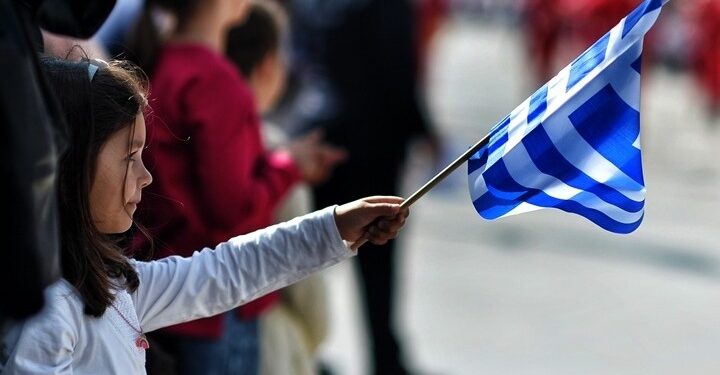
photo https://orthodoxtimes.com/thriving-greek-diaspora-in-us-canada/