Nicosia, 19.10.2026
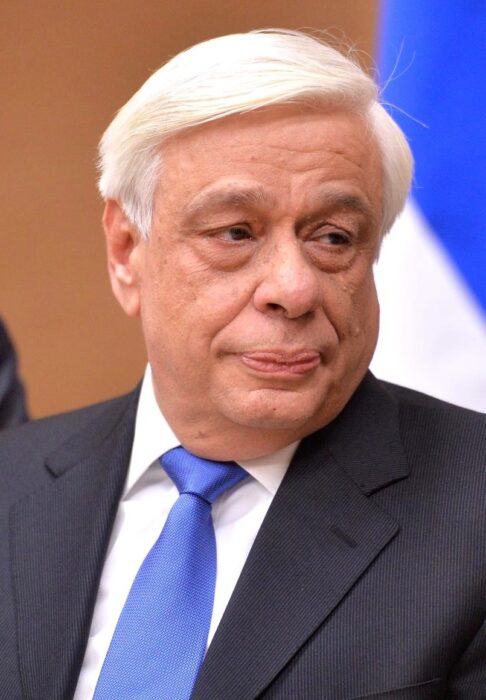
In a speech in Nicosia during the event for the 150th anniversary of the "Estia" Newspaper, the former President of the Republic, Academic and Honorary Professor of the Law School of the University of Athens, Mr. Prokopios Pavlopoulos, noted, among other things, the following:
Prologue
It is with great honor that I participate here in Nicosia, the capital of the Republic of Cyprus, in the event honoring the 150th anniversary of the Newspaper. "Focus"These feelings are justified by the fact that, as will be explained below, the Newspaper "Focus", according to the basic position it adopted during the course of the Cyprus Issue and by the passion with which it defended it, is inextricably linked to the modern History of the Martyrical Island since its foundation and beyond. While its above position was clearly unified and clearly consistent, with the main goal of the Union of Cyprus with Mother Greece. I must remind you that the aforementioned position "Home", especially after it became the property of the Cyrus Family, it was deeply inspired by two sayings: The first, true National "scream" of the Greek Cypriots par excellence during the years of the epic EOKA uprising against colonialism (1950-1959), our Great Poet George Seferis commemorates it as he photographed it on the walls of houses in Cyprus during his long stay there: "Torν HGreece we wantI a"We were eating stones"And the second, Doric and deafeningly resonant over the years, belongs to the Hero of the Cypriot Struggle for the Union Kyriakos Matsis: "Preference"ῦwhile thea raki toras a mothertheς HGreek sidea τorto purple theoras a motheras", that is, Great Britain.
I. The specificity of the relationship "Home" and the Cyrus Family with Cyprus
Η "Focus" was founded in Athens in 1876 as a literary and artistic magazine by Pavlos Diomedes, with emblematic directors shaping the intellectual orientation of its first issues, such as Georgios Drosinis and Grigorios Xenopoulos.
A. The founding of "Home»
In 1894 the "Focus» was converted into a daily newspaper. In 1898 the publication of "Home" was taken over by Adonis Kyrou with his partner Spyridon Dasios, and from 1900 onwards it came entirely under the Kyrou Family. In one way or another the "Focus" continued its publication by members of the Kyros Family until April 2015, when it joined, following the initiative of the publisher Mr. Yannis Filippakis, the "Filippakis Group" with the respected journalist Mr. Manolis Kottakis as Director. This editorial change marked the uninterrupted continuation of the journalistic course of the "Home", In addition, however, and as its acclaim proves, it also marked its impressive rebirth and flourishing within the Greek press.
- Two years after the publication of "Home", namely on the 4thη In June 1878, Cyprus was ceded, as a protectorate, to Great Britain following a relevant agreement with the Ottoman Empire. This concession raised many hopes among the inhabitants of Cyprus regarding its future Union with Greece, based on the historical experience of the previous Union of the Ionian Islands with the National Core. It is characteristic that in 1878 the "Focus" published, in a special edition, an ad hoc issue entitled "About Cyprus" for the future course of Cyprus towards the aforementioned unification direction, which was drafted and signed by the then young Spyridon Lambrou, later a prominent historian and Prime Minister of Greece.
- The relations of the Kyrou Family with Cyprus were close from the beginning, given that the progenitor of the journalistic career of Adonis Kyrou (1870-1918) was a scion of an old family from Karpasia. Adonis Kyrou attended the Pancyprian Gymnasium and worked for a short time in the Secretariat of the Archdiocese. It should be noted that after the "Focus" Cyprus and its future were included, almost by nature due to the Cypriot origins of the Kyros Family, in the subsequent history of the Newspaper as a true National Issue with an ultimate vision of the Union. After the death of Adonis Kyros, the "Focus" continued its publication with his sons Achilles and Cyrus. And since 1950, when Achilles Cyrus died, the "Focus" It was transferred to Cyrus Cyrus until 1974, that is, during the most turbulent and bloodied historical period of Cyprus in the struggle of its people to shake off colonialism.
B. The "Focus» and Cyprus
The relations of the Cyrus Family, and more precisely of Achilles and Cyrus Cyrus, with Archbishop Makarios were for years harmonious and even fraternal, as at that time they were connected by the ardent desire for Union.
- Archbishop Makarios' farewell speech to Achilleas Kyros upon his death, when the Leader of Cyprus called him, is untrue testimony "Voice of Cyprus"combining luxury accommodations with the potential for significant expansion. "Focus" supported, without conditions or preconditions, under the leadership of Cyrus Cyrus, the Struggle of the Cypriots for Union, especially after it began, on 1η April 1955, the heroic armed uprising of EOKA which lasted until 1959. The dramatic developments of that period led to the great rift between Cyrus Cyrus and Archbishop Makarios. The reason was the initial signing of the Treaty of Zurich (11.2.1959) between Greece and Turkey by the then Prime Ministers Konstantinos Karamanlis and Adnan Menderes respectively. And then - and most importantly - the signing of the Treaty of London (19.2.1959), between Archbishop Makarios as the representative of the Greek Cypriots and Fazil Küçük as the representative of the Turkish Cypriots, through which, and with the co-signing of Great Britain, the aforementioned Treaty of Zurich was ratified.
- The climate between Archbishop Makarios and Cyrus Cyrus was throughout this period literally belligerent, with sharp and often unjust attacks against Makarios. Cyrus Cyrus could never accept and understand that Archbishop Makarios, when he took the relevant decisions with great pain, was literally bound on the one hand by the treachery of Great Britain which did not intend to accept the solution of the Union of Cyprus with Greece, on the basis of the historic Referendum of 15th January 1950 which was conducted by the Ecumenical Church of Cyprus and decided on this Union with a unique percentage of 95,7%. And, on the other hand, the errors of the Greek Government, and primarily of the then Minister of Foreign Affairs of the Government of Alexandros Papagos, during the Lancaster House Conference in London between 29.8-7.9.1955, Stefanos Stefanopoulos. At that time, the Greek Minister of Foreign Affairs, artfully led by the Minister of Foreign Affairs of Great Britain in the Government of Anthony Eden Harold Macmillan, ignored the provisions of the Treaty of Lausanne of 1923 according to which Turkey had renounced all its rights in Cyprus. And the Turkish Minister of Foreign Affairs of the Adnan Menderes Government, Fatin Zorlu, also agreed to attend this Conference. Thus, the Conference became "tripartite" and the torment of Cyprus began through the unthinkable and contrary to every concept of International Law demands of Turkey against the island. The fierce attacks of "Home" against Archbishop Makarios - but also against Constantine Karamanlis - were certainly not unprecedented for the press of the time, if we go back a few years and consider the unusual attacks against Eleftherios Venizelos during the period of the Great Schism. Beyond this, one thing is a fact: The attitude of "Home" and Cyrus Cyrus was motivated only by their vision of finally achieving the Union of Cyprus with Mother Greece and did not involve anything purely personal. A vision which, as already explained, the "Focus" and the Cyrus Family served throughout time, without concessions or concessions, selflessly and with purely National criteria and motivations.
II. A fixed journalistic position of "Home»: The normative data of International Law and European Law are those which determine the minimum conditions for the just and sustainable resolution of the Cyprus Issue
What was discussed above regarding the progress indicators of the Newspaper "Focus" in what concerns the Cyprus Issue certainly belong to the past. Today, and as its entire stance after the barbaric Turkish invasion and occupation in 1974 demonstrates, the "Focus» supports, with undisputed stability and determination, our National Position regarding the minimum conditions for resolving the Cyprus Issue. A National Position - which is served exemplarily by the Government of President Mr. Nikos Christodoulides - which is condensed into the fact that secure institutional supports for the just and sustainable solution of the Cyprus Issue are, and indeed exclusively, firstly, International Law. And, secondly, European Law. With the additional note that International Law constitutes an integral part of the European Acquis since the European Union, as an entity with independent legal personality, is a full member of the International Community, starting with the UN.
A. International Law
International Law determines the minimum conditions for resolving the Cyprus Issue with a multitude of regulations.
- These regulations certainly include all kinds of regulatory Security Council Resolutions which have been, and indeed repeatedly and in various ways, condemnatory of Turkey since 1974, when the barbaric invasion of the Territory of the Republic of Cyprus took place. It is recalled that the most critical Security Council Resolutions in this regard were - and remain - the following:
a) First of all, the initial, basic Resolution of 20.7.1974, no. 353/1974, for the unequivocal condemnation of the Turkish invasion and for the appeal-decision for full respect for the Independence, Sovereignty and Territorial Integrity of the Republic of Cyprus. This Resolution was reaffirmed and supplemented in the strictest terms - mainly due to the continuation and expansion of the Turkish invasion in 1974, the demonstration of provocative intransigence on the part of Turkey and the humanitarianally deplorable situation of the refugees - with the successive Resolutions of 23.7.1974, no. 354/1974, of 1.8.1974, no. 355/1974, of 14.8.1974, no. 357/1974, of 15.8.1974, no. 358/1974, of 15.8.1974, no. 359/1974, of 16.8.1974, no. 360/1974, of 30.8.1974, no. 361/1974 and of 13.12.1974, no. 364/1974.
b) And then the, of decisive importance for the resolution of the Cyprus Issue in a manner consistent with International Law, Resolution of 12.3.1975 No. 367/1975, by which the unilateral decision of 13.2.1975, on the part of Turkey, for the creation of the internationally completely isolated pseudo-state of "Turkish Republic of Northern Cyprus". It should be noted that the above Resolution was supplemented, specifically with regard to the conditions imposed by International Law for the resolution of the Cyprus Issue, by the Resolutions of 18.11.1983, no. 541/1983, of 11.5.1984, no. 550/1984, of 12.3.1990, no. 649/1990, of 10.4.1992, no. 750/1992, of 25.11.1992, no. 789/1992 and of 29.6.1999, no. 1251/1999. Specifically, with these last Resolutions, it was accepted - and has been consistently accepted since then - that the solution of the Cyprus Issue in accordance with International Law presupposes, at a minimum, that the Republic of Cyprus must be, without other terms and conditions, an Independent State, with a single Sovereignty, a single International Personality and a single Citizenship, politically organized in the form of a Bicommunal and Bizonal Federation - therefore excluding, almost by definition, the Confederate State - while consequently rejecting, and even categorically rejecting, any prospect of partition or secession.
- In addition, for the resolution of the Cyprus Issue, the importance of the regulations of the UN Convention on the Law of the Sea (UNCLOS) is of paramount importance. Mainly, its regulations regarding stricto sensu Sovereignty and the individual Sovereign Rights of the Member States of the International Community and the UN.
a) Convention, which was drawn up in 1982 - as "Contract of Montego Bay"- and entered into force in 1994. And a Convention to which the European Union has acceded independently - that is, as a legal entity in addition to the legal entities of its Member States - since 1998. This means that this Convention has since then been an integral part of the European Acquis, which automatically binds not only the European Union but also all its Member States. It must also bind, in accordance with the Copenhagen Criteria of 1993 and the Madrid Criteria of 1995 as they are constantly updated, the candidate States for accession to the European Union, such as Turkey, in accordance with the provisions of Articles 6(1) and 49 of the Treaty on European Union (TEU).
b) Regardless of this, and according to the case law of the International Court of Justice in The Hague, the aforementioned UN Convention on the Law of the Sea also binds States that have not acceded to it - such as Turkey - because, due to the fact that in any case a sufficient number of Member States of the International Community have acceded to it, it now produces generally accepted rules of International Law, binding erga omnes. That is, even for Member States of the International Community that have not accepted it in writing. This is all the more true for Turkey since, as its contradictory and provocative foreign policy proves, it accepts the UN Convention on the Law of the Sea at will, as is evident from the signing between it and the then alleged Government of Libya of the legally completely non-existent "Turkish-Libyan memorandum", in 2019. It is noted - in order to continuously promote it internationally, which unfortunately does not happen with the required stability and clarity - that the legally completely non-existent "Turkish-Libyan memorandum» has been explicitly accepted by the European Union itself, in accordance with the clear decision of the European Council of December 2019. The "protocolization" of "memorandum" This by the UN in 2020 does not add or ensure any legal validity to it since, as the relevant practice of such protocolizations of international texts has proven, this is a purely formal procedure which is in no way related to the recognition of the normative potential of the diverse above-mentioned texts.
B. European Law
Much more important for the resolution of the Cyprus Issue, however, is the importance and influence of European Law. This is because, as already noted, the Republic of Cyprus is a full Member State of the European Union and its hard core, the Eurozone. Accordingly, there is no just and sustainable solution to the Cyprus Issue if it is not fully in accordance with the entirety of European Law, and primarily with the fundamental institutional coordinates of the European Acquis. European Law, par excellence through the Treaty on European Union (TEU), which is fundamental to the institutional existence of the European Union, sets the following conditions regarding the legal and institutional existence of a State, in order for it to be able to become, with the necessary effectiveness and duration, a Member State. That is, so that its participation in the European Union does not undermine, de jure and de facto, its institutional and political coherence and perspective, starting from the continuous and effective implementation in practice of all, without exception, the rules of the European Legal Order.
- In the light of the provisions of Articles 1-12 of the TEU, the Member State of the European Union must have a single Legal Personality internationally. This follows, for example, from the provisions of Article 5 of the TEU, regarding the division of competences between the European Union and its Member States. As well as from the provisions of Article 10(2) of the TEU, regarding the representation of the Member State in the institutions of the European Union, and in particular in the European Parliament and the European Council. Because, as is understandable, such a division of competences and such representation presuppose a Member State which is able to fully meet all its duties under European Law, primarily in the integrated and effective "absorption" of the entire European Acquis.
- From the above condition of one and only Legal Personality internationally, the condition of one and only Citizenship naturally follows. All the more so when internationally there is no example of a State with one legal personality internationally that recognizes more than one citizenship within it. The fact that the recognition of more than one citizenship opens, and indeed broadly, the way for the recognition of more than one State or even for the acceptance of a political regime of loose confederation, which, as will be explained below, cannot apply to the Republic of Cyprus under International Law, and above all under European Law, should not be underestimated.
- The Member State of the European Union must be Sovereign, as can be easily deduced in particular from the provisions of Article 4(2) of the TEU. The essential constituent elements ("essentialia negotiations") of the internal and external Sovereignty of a State - basically as the ability to independently impose its power without being limited by another's will - are commonly known based on the rules of Constitutional Law internationally. Therefore, at this point it is sufficient to refer specifically to the conditions established by the aforementioned provisions of the TEU:
a) First of all, the Member State of the European Union, in accordance with these provisions of the TEU, must be able to ensure its fundamental functions. In particular, the safeguarding of Territorial Integrity, the safeguarding of Public Order and the protection of National Security. Since in the opposite case, Sovereignty becomes, without anything else, an empty letter of content intra and extra muros. Something which makes the effective functioning of the Member State and within the European Union impossible according to European Law, and consequently subversive for the structure and functioning of the European Union itself.
b) Therefore, a State capable of exercising, in full, the rights of its Sovereignty stricto sensu under International Law as well as all its individual Sovereign Rights thereunder. This is, basically, the aforementioned Law of the Sea, in accordance with the relevant UN Convention (UNCLOS) -"Contract of Montego Bay", of 1982 - which, according to the aforementioned, has been in force since 1994 and is erga omnes.
c) In particular, among other things, the Law of the Sea determines on the one hand the institutional core of the stricto sensu Sovereignty of each Member State of the International Community, which is fully exercised beyond the Continental Territory and in the Territorial Waters or Territorial Sea - that is, in the Territorial Zone - primarily in accordance with the provisions of Articles 2 et seq. of this UN Convention. And, on the other hand, the institutional core of lato sensu Sovereignty, which includes all the individual Sovereign Rights recognized by International Law of each State. Certainly the Sovereign Rights relating to the Exclusive Economic Zone, in accordance with the provisions of articles 55 et seq. of the UN Convention on the Law of the Sea and to the Continental Shelf, in accordance with the provisions of articles 76 et seq. of the same Convention.
- The Member State of the European Union must be organized on the basis of the institutional and political coordinates of the Representative Democracy, since according to Article 10, paragraph 1 of the TEU, the entire structure and functioning of the European Union is founded on the Representative Democracy. Under these circumstances, there is no Member State of the European Union which is not based, in substance and in practice, on the entire institutional and political framework of the Representative Democracy. This consequently requires, on the part of the Member State of the European Union:
a) Full respect for the principle of the Separation of Powers and the basic institutional components of the Rule of Law, as is the case with the European Union itself, taking into account in particular the regulatory scope of Article 2 of the TEU. And with regard to the principle of the Separation of Powers, it is clarified that, among other things, it allows their intersection only to the extent provided for by the more specific individual legal rules of the democratically established Constitution. And, on the other hand, it does not tolerate any concessions, especially with regard to the operation of the sanctioning mechanism of the Judiciary, under the regime of guarantees of the personal and functional independence of the officials who staff it. As for the Rule of Law, it is obvious that its institutional arsenal certainly imposes the existence of adequate sanctioning mechanisms for any violation of the Principle of Legality by state bodies, with the Judicial Power mechanism being paramount.
b) And full respect for all, without exception, of Fundamental Human Rights, as is also the case for the European Union itself, according to the provisions of Articles 2 and 6 of the TEU. It should be noted that such a condition is all the more intertwined with Representative Democracy, as during its historical path it was consolidated, from an institutional and political point of view, as a regime guaranteeing Freedom, in all its manifestations - and primarily in the manifestation of the unhindered exercise of Fundamental Human Rights - in accordance with the equally fundamental for the modern democratically organized State Democratic Principle.
- According to the provisions of Article 4(3) of the TEU, the Member State of the European Union must be able to fulfil in full all its obligations towards the European Union. In particular, the "απορρόφηση"of the European Acquis, in terms of all its regulatory coordinates. Based on the Rule of Law under European Law, sanctions are imposed in the event of a breach of these obligations by the Member State, as defined by the provisions of Article 7 of the TEU.
- From the above, it can be concluded that the Member State of the European Union must be organized on the basis of a single, democratically legitimized, Legal Order.
a) A Legal Order headed by the National Constitution, as an emblematic guarantee of the Separation of Powers, the Rule of Law and the unhindered exercise of Fundamental Human Rights.
b) As is obvious, only under this condition of a hierarchically structured and democratically legitimized Legal Order is it possible to fully respect in practice the guarantees of effective implementation of the institutions of Representative Democracy. Furthermore, the guarantees of its harmonious coexistence with the European Legal Order and, by logical legal sequence, the guarantees of smooth and uninterrupted "absorption" from that of the European Acquis as a whole, as already clarified.
- To these conditions for resolving the Cyprus Issue, the following two must be added, which also derive directly or indirectly from International Law and European Law:
a) In the territory of the Republic of Cyprus, as a sovereign Member State of the International Community and the European Union, no guarantees of any kind from third States can be applied nor can occupation troops remain there. The example of the final unification of Germany, as the Federal Republic of Germany, in 1990 only after the withdrawal of the last Soviet soldier fully substantiates the validity of this condition, both under International Law and under European Law.
b) All the settlers established there by Turkey must gradually withdraw from the territory of the Republic of Cyprus. And the legal owners of the properties occupied by the settlers, according to the European Convention on Human Rights and the case law of the European Court of Human Rights, must return to their homes.
Epilogue
From the preceding analyses, it can be concluded that for the Governments of the Hellenic Republic and the Republic of Cyprus, achieving a solution to the Cyprus Issue is conceivable and acceptable only if it appears fair and sustainable. This further means that this solution is conceivable and acceptable only if it serves, at least in terms of its relevant basic regulatory elements, with dignity - and not superficially, under the state of unacceptable compromises or even blackmail from specific parties - International Legality and European Legality, but also the sustainability of the Republic of Cyprus as a Member State of the International Community, and especially as a full Member State of the European Union and its hard core, the Eurozone. Because the opposite leads, inversely, to dangerous paths of even more painful institutional and political weakening of the Republic of Cyprus, both within the framework of the International Community and within the framework of the European Union. This stance requires as much more diligent preparation, with the corresponding attention and foresight, as Turkey has made it - with more audacity that, unfortunately, is reinforced by the sad international, and even European in some cases, tolerance towards it - clear that as a principle of solution to the Cyprus Issue it does not accept, in any way, the elementary model of the Federal State according to International Law and European Law. And it speaks, directly, of two States. In this spirit, it is obvious that no substantive discussion on the Cyprus Issue can begin - or rather is not permissible - unless Turkey first puts aside such absurd and provocatively maximalist positions and proposals, completely contrary to International Law and especially to European Law. If the Greek and Cypriot sides make the mistake of underestimating the risk of starting a substantive dialogue on the Cyprus Issue without Turkey's substantial retreat from its extreme positions, then the "dialogue"with the Turkish side leads us to the risk of our inevitable retreat, even to a certain extent, in the face of unacceptable Turkish blackmail and the possibility of a generalized trivialization of International Law and European Law with regard to the future of the Republic of Cyprus. In addition, let us not forget that this is always Turkey's favorite tactic when it attempts to promote even its most unthinkable claims against Hellenism in general, relying with obvious international audacity on the consolidation of the fait accompli whenever it detects tendencies of hesitation, tolerance and submission. And in this regard, we must constantly keep in mind that in our relations with Turkey, even when it shows us "good intentions", the whole " is validtimeo Danaos et dona different". The same is obviously true - or should be true - for the International Community and the UN and for the European Union, given that they have experienced and suffered, in a number of cases in the distant and recent past, the submissive attitude of Turkey regarding the application of International Law and European Law. The above positions are substantiated, even more so and especially from the point of view of European Law, by the recent developments due to the military operations in the Middle East between the USA and Israel on the one hand and Iran on the other. This is evident from the fact that after the attack - in all likelihood by Hezbollah - on the territory of the Republic of Cyprus, on 1η In March of this year, the mechanism of "solidarity clause" in accordance with the provision of Article 42, paragraph 7 of the Treaty on European Union. In the context of this activation, five Member States of the European Union were mobilized, namely Greece, France, Italy, Spain and the Netherlands. During the activation of the "solidarity clause"the participating Member States of the European Union considered, and rightly so, the territorial territory of the Republic of Cyprus as unified, blatantly ignoring the, supposedly, "accomplished"of the illegal and barbaric Turkish invasion and occupation of 1974. This is therefore an initiative and action of the European Union itself which, because it was based on the single and indivisible territorial entity of the Republic of Cyprus, also creates an authentic "European precedent". Which, inversely, implies from now on that the solution of the Cyprus Issue according to European Law - but also according to International Law which, as has been clarified, is an integral part of the European Acquis - cannot, in any way, be understood on the basis of a form of "Confederation" and much more, on the basis of "two states", as Turkey seeks. Such a solution can, consequently and according to the above, be understood only on the basis of a form of modern European Federal State, in other words on the basis of a Bizonal-Bicommunal Federation."
Photo From Kremlin.ru, CC BY 4.0, https://commons.wikimedia.org/w/index.php?curid=105340525, https://el.wikipedia.org/wiki/