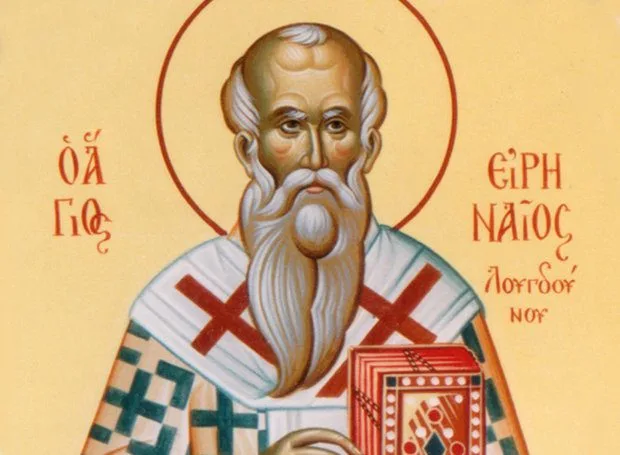
Some of the holy Fathers of our Church received his title Ecumenical Teacher, because their offering to Her was decisive for the formulation of Her teaching. Their action went beyond the narrow geographical boundaries and the era in which they lived and acted, having a catalytic effect on the formation of the universal dimension of the Church. One of these great Fathers and ecumenical teachers was also St. Irenaeus, bishop of Lougdon.
He came from its wider area Smyrna of Asia Minor. The exact time of his birth is not known. That he was a disciple of the saint Polykarpou of Smyrna (+167), presumed to have been born ca 130 by Christian parents. According to his testimony Saint Jerome he was also a student of the important Apostolic Father Papias, bishop of Hierapolis. He seems to have received a great theological and formal education. It is certain that he studied the second sophistry, as a rhetorical art. Close to great theologians and pastors he was taught and received the genuine apostolic tradition, which distinguished the bishops of Asia.
About it 160 moved to Rome, where he met Saint Justin. There the Christian Philosopher operated a theological and philosophical school. It seems that Irenaeus studied at the famous school of Justin and supplemented his theological and philosophical knowledge. This is demonstrated by the apologetic way he deals with heresies in his work, for it resembles Justin's apologetics. His stay in Rome gave him the opportunity to become acquainted with many confessors of the flourishing church there.
About it 170 left for the big city Lougdouno (Lyon) of the south of France, where he settled permanently. His transition there was not accidental, because Gaul had become a place of immigration for a large Greek-speaking Christian element of Asia Minor, due to the cruel persecutions, which were frequent in Asia Minor. According to his testimony Gregory Turonis had been sent to Lyons by the saint Polycarp of Smyrna to spiritually serve the Asia Minor refugees. This is confirmed by the information that upon his arrival, he was ordained an elder. According to another testimony, he was enthusiastically received by a group of refugees Phrygian Christians, but who were closed to his heresy Montanism. Yes, some of them "prophets" of the group, they "promised" the Second Coming of Christ, that it would take place in Lyons, where His earthly thousand-year reign would be established, as the Montanists believed. But they did not know that the orthodox Irenaeus was in Lyons, as his emissary Pope Eleftherou to fight against this heresy, which had reached alarming proportions in the region and which the Phrygian immigrants had brought from Asia Minor, its birthplace. Pope Eleftheros was looking for a radical treatment of the heresy and considered that Irenaeus was the right person.
The 177 the bishop of Lyons suffered a martyr's death Poisonous, together with many other Christians of the region, when Irenaeus was away in Rome, a guest of Pope Eleftheros, for the organization of the sect of Montanism. When he returned to Lyons, the people elected him bishop in place of Martyr Potheinus. Irenaeus began a titanic task of organizing the local church, missionary work and combating heresies. At that time it was in full swing
development of one of the most terrible persecutions against the Christians, which the emperor had proclaimed by his decree Marcus Aurelius (161-180). His philosophical status (he was a Stoic philosopher) did not prevent him from ordering one of the most murderous persecutions against unjustly persecuted Christians. Despite all the persecutions, Irenaeus carried out an admirable work. He organized a great missionary network among the Greek-speaking, Latin-speaking and Celtic inhabitants of Europe. He fought heresies, which were multiplying in the Church. His aim is the worst and most dangerous heresy: o Gnosticism. It was a religious-philosophical movement, which distorted to an absolute extent the teaching of the Church and cultivated an incredibly morbid mysticism. He is the first great ecclesiastical man and theologian, who managed to marginalize Gnosticism and annihilate it!
Irenaeus was called upon to face another great problem, which seriously afflicted the Church in the second half of 3th AD century. The dispute over the celebration of Easter, which had divided the Church. The custom had prevailed among the Christians of Asia Minor to celebrate Easter with the Jews on the 14th of the Jewish month nissan, unlike Westerners, who celebrated it on the first Sunday after the vernal equinox. Irenaeus stood aloof, admonishing the orgilus Pope of Rome Victor, who intended to create a schism in the Church. He was also called to deal with the problem of repentants, as there were extreme tendencies in the Church, for those who wanted to return to Her.
Saint Irenaeus was a great theologian of the Church, who ruled on Her highest truths. At the same time, he was also a great writer, who left a great literary work to the Church. He was a genius in the objectionable and apologetic work. His most famous writings are: "Checking and Reversing Pseudonymous Knowledge"And "Demonstration of Apostolic Preaching". He also left us many of his letters.
The 193 a new cruel persecution had broken out from him Septimius Severus (193-211). Irenaeus had been targeted by pagans for his great work. He was arrested, along with a number of other believers and he was martyred in 202. His memory is commemorated on August 23.
photo https://sansimera.gr