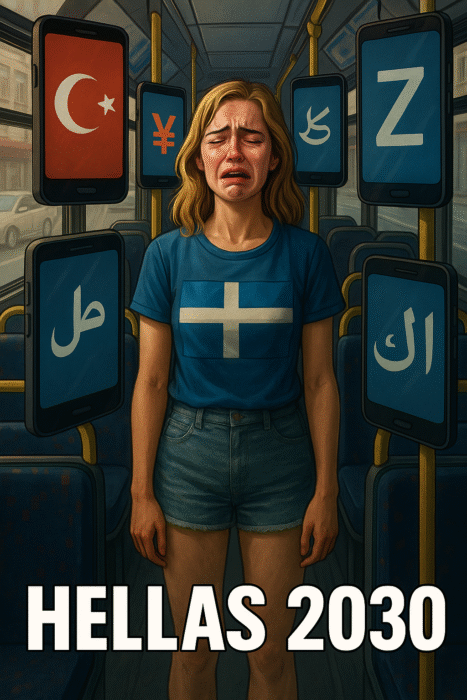
The discussion around "Islamization" of Greece and Europe is one of the most charged issues of public debate, as it meets at the intersection of politics, society, culture and geopolitics.
If one were to attempt to take a caustic position, one would say that the European Union – and with it the Greek government – have adopted a policy that oscillates between naivety and obsessive obsession. While it is clear that the mass migration flows are neither a temporary nor a temporary phenomenon, but a profound upheaval of the social fabric, European leaders continue to speak in the same tired terms of “humanism” and “tolerance”. Reality, however, does not forgive inaction.
Europe, which once defined history with its intellectual and technological superiority, now seems trapped in a peculiar nihilism: it defends neither its borders nor its values, leaving room for others to do so. Societies, immersed in artificial prosperity and political saturation, passively accept the alteration of their cultural fabric, as if it were a natural phenomenon.
The Greek case is even more bitter. The country that paid for its freedom with blood and struggle is now becoming a passage and a repository of souls, while its own government often behaves more as a subcontractor for Brussels and foreign interests than as a defender of a nation with a heavy historical heritage. Instead of a strategy, the permanent mantra of “European solidarity” prevails, which never comes into practice.
So, one could sarcastically say that Europe resembles an old man who, having lost faith in himself, uncomplainingly surrenders his house to those who knock on the door. Not because he was defeated, but because he simply had no desire to fight.
photo source greek news fl