Love and charity are synonymous with Christianity. The basis of Christian preaching is love for all people, regardless of their particularities. Nothing can stand in the way of practicing Christian love, neither the gender of the human person, nor the race, nor his social and economic status. Our Lord Jesus Christ Himself not only taught love for all, but also set as a condition the practice of love, for those who wanted and want to be His, “A new commandment I give to you, that you love one another; as I have loved you, that you also love one another. By this all will know that you are my disciples, if you have love for one another.” (John 13:34-35). He also set the example of mutual service by washing the feet of His disciples before the Last Supper, advising His disciples "If I then, the Lord and Teacher, have washed your feet, you also ought to wash one another's feet. For I have given you an example, that as I have done to you, you also should do." (John 13:13-15). In fact, this love extends even to our enemies, "Love your enemies and do good and lend to no one in despair" (Luke 16,35:XNUMX).
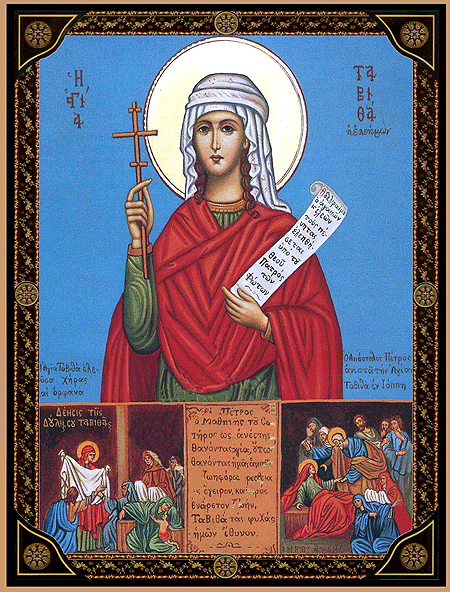
Our holy Church has put into practice the commandment of Christ's love, which has been generously offering its charity to man for two thousand years. Wonderful personalities of our Church have at times exercised love and have sealed history with their actions. One of these holy persons was the holy Tabitha, the so-called Dorcas, meaning doe, who lived in the times of the Apostles and became an example of charity and service to people in need.
The evangelist Luke speaks of Saint Tabitha in the book of "Acts of the Apostles": «She was full of good works and alms she did.” (Acts 9:36). She lived in the city of Joppa in Palestine and practiced the profession of a weaver. She had become a Christian and lived the Christian faith in her daily life. Her heart overflowed with sincere love for her suffering and poor fellow citizens. That is why she sewed clothes day and night, which she sold and gave the money to those in need. At the same time, she was surrounded by other Christians in the city, where she organized an amazing charitable activity. A multitude of hungry people, widows and orphans were recipients of the love and charity of Saint Tabitha. However, God provided for her to undergo a harsh trial, so that His name would be glorified and the saint would become known. She suddenly fell ill and died.
In those days the apostle Peter was touring that region. He was teaching in the neighboring city of Lydda when he was informed of the tragic event by two envoys of the believers from Joppa. Peter immediately ran to Joppa, where everything was ready for the funeral of Tabitha. He found a large crowd inside and outside her house, mourning the loss of the noble daughter. Those who had benefited from her were weeping inconsolably, because they had lost their support.
As soon as the chief apostle arrived, he asked to see the dead woman in the upper room. He begged to be left alone with the honest body of Tabitha, knelt down and prayed fervently. Then he cried out loudly: "Tabitha, arise", and oh, the miracle, the spirit returned to the body of the dead woman and stood up! The miraculous event not only filled the crowd present with joy, but spread throughout the
Palestine. This resulted in the glorification of God's name and the conversion of many Jews and pagans to Christianity.
Saint Tabitha then lived many years of a holy life, continuing her charitable work, and died at an advanced age. Our Church ranked her among Her saints, honoring her memory on October 25th.
It is necessary to keep in mind the timeless charitable work of our Church, which stems from our faith that in the face of every needy person, Christ is depicted and according to His own assurance, «"Truly I tell you, inasmuch as you did it to one of the least of these my brothers, you did it to me." (Matthew 25:40). It is also necessary to point out that charity is an exclusive privilege of Christianity, because the concept of charity was unknown in the pre-Christian world! There is no evidence of an organized network of charity and charitable institutions! From the coffers of the incredible wealth of the "saints" of pagan religions, such as those of Delphi, never was the slightest amount allocated for the relief of human suffering! There is no evidence of such a thing! On the contrary, Julian the Transgressor in the 4ο AD century, wanting to resurrect idolatry, he asked the pagan priests to imitate the Christians in the practice of charity, because it was non-existent among them!
Our ecclesiastical history has to show us an immense charitable work over the centuries. Thousands of imitators of Saint Tabitha have selflessly offered their selfless services and goods to the suffering and needy, especially in times of hardship. But even today, in our time, when our people are being tested by the unprecedented economic crisis, which was created by human greed, our Church, with the thousands of imitators of Saint Tabitha, volunteers of love, feeds and cares alone, a multitude of our fellow human beings, whom both the official State and the various other “humanitarian” institutions have abandoned!
photo HOLY CHURCH OF THE PANTOCRATOR OF MELISSOCHORI
https://www.impantokratoros.gr/371B33B7.el.aspx