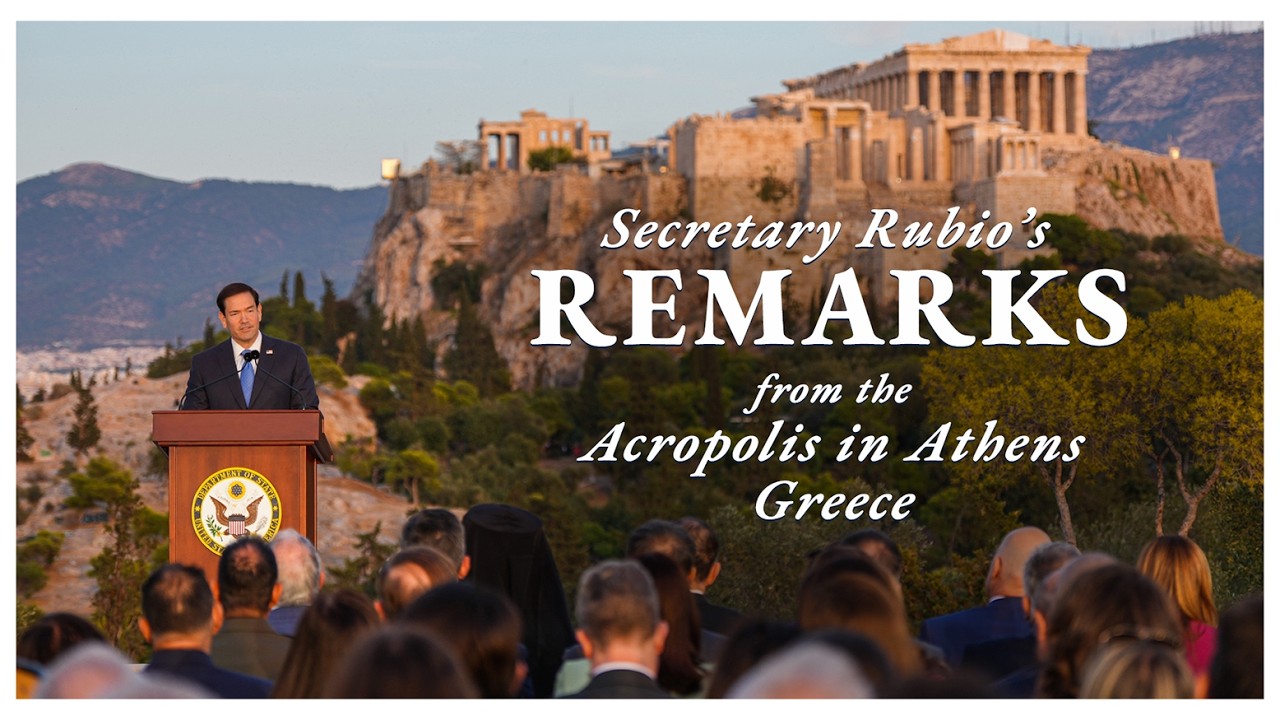
United States Secretary of State Marco Rubio spoke on Wednesday, October 7, 2026, at the Pnyx, with the Acropolis in the background, as part of his visit to Athens.
This is a speech that is already being hotly debated, in Greece and internationally. From ancient Athens and the Parthenon to the Founding Fathers of the United States, Daniel Webster and the Revolution of 1821, the US Secretary of State spoke about the West's debt to Greece, but also about the Trump administration's policy, power, defense and the future of the US-Europe alliance.
Because most media outlets only published excerpts, Greek News & Radio FL quotes the speech below in its entirety, as we translated it from the official text published by the U.S. Embassy in Greece. We did not cut or add anything. We even kept the repetitions and pauses of the spoken word, so that the reader has before him Rubio's words exactly as they were spoken.
The speech
SECRETARY RUBIO: There are great ruins all over the world. In many cases, they are places where history seems to have run its course: remnants of distant civilizations that have long since passed beyond living memory.
But the Acropolis is different.
For thousands of years, the civilization that built what stands behind me has captured the imagination of the Western world. Generations of our statesmen, artists, and philosophers have turned their gaze to it – they have looked at it with admiration and they have looked at it with awe.
Time has a tendency to dull the senses: great victories and devastating defeats seem to shrink into something like a footnote in a textbook, another event that our children memorize and forget. But the ancient Greeks seem to exert an almost mystical power over our memory. They beckon us to return to them, again and again.
In 480 B.C., the armies of Xerxes arrived in this city and set its sanctuaries ablaze. Most Athenians had already evacuated the city by ship to a nearby island. But there were a handful who refused to abandon their homes. So they entrenched themselves in the rocky citadel of the Acropolis to fight a magnificent last stand, rolling huge stones from the cliffs onto the Persian invaders and holding off the greatest empire of the time for days. They were eventually defeated. The Persians plundered the temples, burned the sanctuaries, and razed the Acropolis, but when the Athenians returned, they collected the shattered remains of the old Acropolis and buried them on the hill where it had stood. And decades later, under Pericles, they erected the Parthenon.
For 25 centuries since then, the Parthenon has stood. Empires have risen and fallen under its shadow. And the descendants of the people who built it – the sons of Athens and Rome – carried their civilization with them to the ends of the Earth.
Two and a half centuries after the founding of the American republic, on the other side of the world from where I stand now – I stand here today as Secretary of State of that republic, and the great-grandson of settlers who arrived in the New World from Spain – I stand here to bear witness to a debt that no passage of time, no distance in space can ever erase.
The history of America, the history of my country, is full of the fingerprints of antiquity. Greece is literally etched into the architecture of our government: in the towering columns, the domes, and the monuments throughout our capital. The city where our Constitution was born – Philadelphia – is itself a Greek name.
The people who founded my country were fascinated by the legacy we received from yours. They were extremely well-read in history—they were keenly aware of their unique place in it—but no other era of the past held their attention or their imagination as much as that of antiquity. Many people are surprised to learn that the author most often quoted in the Federalist Papers was not some Enlightenment philosopher or political theorist. No, the author most often quoted in the Federalist Papers was Plutarch, the Greek biographer of the great men of Greece and Rome.
Much has been written and said about the influence of ancient Greece on the ideas of the American Founding Fathers—and, by extension, on all the Western philosophers and statesmen who came before them. Most of us know the basic story. Athens gave us democracy. Plato and Aristotle gave us Western philosophy. Our ideas about law, virtue, citizenship, and democratic government were shaped in the Greek city-states. Even much of our political vocabulary—words like democracy, tyranny, the very word “politics”—found its roots here.
All of this is true. But what we owe to this place – as Americans, and as people of the West – is actually much, much deeper. These institutions and these ideas – these institutions and these ideas were the outward expression of more fundamental traits that we see in the ancient Greeks – traits that cannot be reduced to any particular political system or theory.
Here, in Athens, we found the first full realization of all the essential characteristics that would come to define the West: fierce individuality and relentless ambition; bold exploration and inventiveness; a thirst for discovery, for adventure, for risk and glory. An insatiable curiosity about the world and the principles by which it operates, a hunger to know the mysteries of nature and to grasp the secrets of the universe. An impatience with the idea of the impossible, a discomfort with every border and limit, an attempt to peer into the depths of the unknown.
These were not simply the formulas or teachings of a particular philosophical school. They were the characteristic of a people – expressed in their traditions, in their stories, in their imagination; in the qualities they demanded of their citizens; in what they lived for and fought for and died for.
Knowing them means knowing ourselves.
What flourished here, in this place, was the Western desire to reveal all that ignorance, darkness, and distance had kept hidden from the human mind. The Greeks did not simply shape history; the Greeks gave us history itself. Much of – much of what we know about many ancient civilizations comes almost entirely from the records of Greek explorers and historians, explorers and historians who did not simply record the stories of their own people, but went out to observe and record the epics of foreign peoples and cultures throughout the world.
Where others looked inward, the Greeks were the first to turn their attention outward, to pursue the thrill and glory of seeing all that was strange and new. It was this trait – it was this trait that would drive the West to create and build things that others could not, setting us apart from so many other civilizations where stability and survival were the highest goals of life.
But it is not just the ambition to explore the unknown that we inherit from the Greeks; it is the belief that the unknown can be known. The certainty that the world can be mapped and measured and captured and understood – and that there is a logical order to the universe, governed by certain fundamental laws, laws that humans can observe and the mind can come to understand.
This was the foundation of the Western mind: our mathematics, our science, our medicine. Our philosophy, our ethics, and our religion. It paved the way for the gospel of Jesus Christ to find fertile ground in Europe and flourish in the empire of Christendom. It was the foundation of the wealth of Christian theology – Augustine and Aquinas and the whole tradition of natural law.
He gave birth to a civilization characterized not only by a common culture, it was characterized by a common anthropology – a common understanding of man and his place in the universe. His descendants would share not only the idea of a natural order, but also a distinct conception of virtue; of destiny and fate; of truth, goodness and beauty; of a code that defines how people should live; of objective measures and ideals to strive for.
For the ancient Greeks, the pursuit of excellence was the very principle of human existence. They organized the whole of public life around struggle, ambition, competition: in philosophy and poetry, in sculpture and drama, in sports and art, in war and politics. The classical Greek city was an arena where great men tested and proved themselves, where they honed their abilities through constant struggle – to be the best, the strongest, the most beautiful, striving to come a little closer and a little closer to perfection.
I know that to modern ears, what I have just described, this way of life, may sound strange; it may even sound cruel. The ideal of many ideologies of our time has become, frankly, a world of absolute security, without risk or failure, without either the glory of victory or the shame of defeat. Too often in our day, we build downwards. We plan our measures to ensure that no one loses; we are more concerned with the comfort of the worst than with the possibilities of the best. We hold the most extraordinary things among us hostage to the average, the ordinary, the mediocre.
The people who built the Parthenon were building upwards. They believed that the highest and noblest ambition in life was to surpass everyone else, to strive to be the best at everything. The ancient Greek city-states were full of them. They were full of intense passion and rivalry and factions and conflict. But out of this constant struggle for distinction – out of it came the great flowering of art and philosophy and political and intellectual energy that would transform a group of Mediterranean cities into the birthplace of the greatest civilization in the world.
Anger, as the ancient Greeks called it – the fire of passion, strength, courage, pride – is the heart of great civilization. And without it? Without it, nations lose their will to fight, their will to struggle, their will to survive.
Today, a very large part of the West has forgotten this trait. Over time, we in the West came to be ashamed of the very things that made us exceptional. We felt embarrassed that our achievements set us apart from the rest of the world. Our prosperity somehow became a source of guilt. We no longer believed that we deserved and had earned our greatness.
The word "nationalism" became a dirty word. And so we tore down our monuments; we condemned our own history. And in too many places, we taught our children to be ashamed of the countries they would inherit. Along the way, we opened our borders and moved our industry overseas, and we let our armed forces wither and decline.
And with each passing year, it seemed we were ceding more and more of our sovereignty, handing over our decisions to global bureaucracies far beyond our control.
But others were more than willing to fill the void we left—the void left by our weakness. And as the West’s self-confidence faltered, its rivals and competitors only grew more assertive, building their own wealth and power in our place.
And now, today, we stand at a crossroads. For the next decade and the decisions we make will write the history of the next century. The course we take will determine whether the West will maintain its place at the top of the world or whether it will resign itself to a future of atrophy and servitude and decline. Either we choose to act now or we will lose the choice to act altogether.
Under President Trump, the United States has made its choice. We choose to pursue national power without apology: to take back control of our critical supply chains, to reindustrialize our economy, to rebuild our defenses, to strive for dominance in the technologies and industries of the future.
We choose to reach out to new frontiers: to advanced manufacturing and superintelligence; to drones, weapons, and warfare; to microchips, minerals, cyberspace, and every other realm of human possibility. To unleash our energy, to rebuild our factories, to return our astronauts to the Moon, and to usher in a new era of space exploration.
For all their lofty ideals, the ancient Greeks were not naive. They understood that nations have interests. They understood that the exercise of politics requires prudence and diplomacy, but they also understood that it requires the ability to use force when prudence and diplomacy fail. They understood that power requires not only having the means to defend yourself, it requires the credibility of being willing to use them.
This is the classic understanding of politics and policymaking that the Trump Administration hopes to reclaim – reclaim not just for our country, but for our entire culture.
We believe that Europe can awaken from its long slumber and rekindle the fire that was lit here millennia ago.
There are already signs.
Across this continent, we are witnessing what we hope is the beginning of a generational change: a surge in defense spending, a slew of new partnerships and programs, expanded manufacturing and production, following on from the historic defense commitments made last year in The Hague.
Greece is at the center of this change. The people of this nation have proven once again that they are an irreplaceable friend to both Europe and the United States, in everything from energy to immigration to defense, where Greece has been a model ally.
And it is our sincerest hope that the whole of Europe will follow your example.
While passions may, at times, have tested the bonds of affection between the United States and Europe, they must not be allowed to fray. Together, we must strengthen an alliance capable of confronting the threats of our time.
And we can. Because we don’t believe that transatlantic friendship should be a zero-sum game. Quite the opposite: our vision is of an alliance that is greater than the sum of its parts. It’s a vision that we saw in action just last month, in an unprecedented new agreement between the United States, Denmark, and Greenland – an agreement that will reshape the Arctic and strengthen the security of the entire NATO. All three partners in this agreement have come out winners. All of Europe – and NATO and the United States – have come out safer, stronger, and more protected because of it.
We want to win together. We must win together.
It has become fashionable today to believe that an enlightened foreign policy means prioritizing the international community over your own people. And I think here, too, we have a lot to learn from the people of ancient Greece, because they knew that there was nothing selfish or wrong with being devoted to your nation, nor anything selfish or wrong with fighting to defend its interests above all else.
They believed – strongly – in the ideal of the great man: the exceptional individual who earns immortality through his own actions. But they believed that glory and fame, those things, were earned through struggle, sacrifice, and great achievements for something greater than oneself. The recurring hero of the ancient Greek world was the man who was willing to pay any price for a cause worthy of his devotion.
We see this in Socrates, who refused to abandon the search for truth even at the cost of his life. We see it in the legendary resistance of the 300 Spartans – surrounded and hopelessly outnumbered by the vast armies of Persia – who refused the chance to save themselves, choosing to fight to the last man rather than abandon their position or abandon their duty. And we see it in the epic myth of Achilles, who is given the choice to return home and live a long and peaceful life – but chooses instead to stay in Troy and perish in pursuit of eternal glory.
These – these are the traits that would shape the Western moral imagination. From the Christian martyr who refused to betray his faith to the patriot who gave his life for his country; from St. Thomas More to the Battle of the Alamo, running through the immortal closing words of the United States Declaration of Independence which say: “We mutually pledge ourselves to one another with our Lives, our Estates, and our sacred Honor.”
From the Greeks the West inherited a sense of duty – an unwavering devotion to your code, to your cause, to your country. Our heroes, the heroes of the West, are those who choose to remain true to their duty precisely when it is most difficult and painful to do so: the man who is bound by his word, the soldier who does not abandon his post, the captain, the proverbial captain, who sinks with his ship.
This is completely different from what we see, even now, for example from fanatics like the radical mullahs of Iran, whose cult of death proclaims child suicide bombers as national heroes, and presents martyrdom as an end in itself.
Our heroes – our heroes may be willing to die for their cause; but our heroes do not worship death. It is precisely because we value life that we come to recognize heroism in those who would rather sacrifice it than betray their principles. We take the Western concept of these things – heroism, honor, duty – for granted. We assume that they are somehow universal to all people, in all times and places. They are not. They are the product of a unique character, a unique character that emerged here and shaped the entire history of the civilization that followed. A civilization that we must fight to defend today with the same passion that our ancestors showed.
The men who built the Parthenon were succeeded by the architects of European Christendom, who raised the cathedrals of Milan, Cologne, and Florence. The quest for perfection of the human form that had driven the ancient Greek sculptors found new expression in Michelangelo. The Greek philosophers' quest for the structure of the universe was inherited by Copernicus, and then by Galileo, then by Kepler, and then by Newton.
It was the hunger for new knowledge that gave birth to Magellan's first expedition around the world, Columbus' discovery of America, and finally Apollo 11's journey to the Moon. And the traits that led Alexander to conquer the entire known world reappeared in Caesar, then in Charlemagne, and then in Cortes.
And in America, that same tradition reinvented itself anew. An open and wild land became the site of a great renaissance of Western imagination and ambition. The Greek yearning for new horizons became the American frontier spirit. The civilization of Athens and Rome transformed a fledgling coastal democracy into a continental empire.
The greatest Americans of every generation bore the unmistakable characteristics of their ancestors – born in Athens, shaped by Rome, baptized into Christianity, hardened in the furnace of medieval Europe, endowed with the English genius for freedom, and then transported across the Atlantic to be reborn on the shores of a new world.
Together, we must now rediscover that spirit. We are at a turning point – a turning point not only in the history of my nation, but a turning point in our entire civilization.
The threats we face today are as real as they were on the dramatic stage of antiquity.
National interests did not disappear in the face of international institutions. The war was not lost simply because we preferred peace. Other states continued to arm themselves, to seek influence, to compete for territory, and technology, and resources, and markets, and energy, and power.
And now, there is war again. There is new competition between great powers again. There is vulnerability again, aggression, terrorism, a whole universe of new threats and attacks.
And so we must rebuild our institutions and our alliances to confront these threats together – understanding that the purpose of these things is not to abolish the sovereignty of the nations that compose them; it is to defend it. And that nations do not need to abandon their separate identities to recognize their common interests.
We have built a model of this with our partners here in Greece. In our defense partnerships, in energy and technology, in our shared ambition to protect Europe's borders from the threats of mass migration.
Our friendship dates back to the earliest years of my nation. When Greece rose up in 1821 to regain its independence after centuries of Ottoman rule, Americans recognized something familiar in that struggle. Three years later, the great American statesman Daniel Webster delivered a famous speech to Congress, helping to place the struggle of the Greek Revolution before the representatives of the young American republic.
And he began by drawing their attention to everything that surrounded them. This is what he said in his speech; he said: “This free form of government, this popular assembly… this practice of free confrontation, and public debate, the contest of mind with mind… even the edifice in which we meet, these harmonious columns, this ornate architecture, all remind us that Greece existed, and that we, like the rest of humanity, are in a great measure indebted to it.”
Those words are as true today as they were when he spoke them. And all of us – not just Americans, but Europeans and our friends throughout the West – must relearn the lessons our ancestors learned from this place and its history.
The history of Greece – the history of Greece does not just offer us a glimpse – it does not offer us a glimpse into our institutions in their earliest forms. The history of Greece shows us a picture of ourselves.
It shows us that ours is the legacy of great heroes, and that we should be proud – that we should be deeply proud – of where we come from. We should admire what our ancestors carved from this land. The story of our civilization is the greatest story that man has ever known. And it began here, with the first men and women of the West. From them – from them – we can rediscover the virtues, the courage and the strength to face the dangers that face us in our time.
Thank you.
(Applause.)
Translation: Greek News & Radio FL, from the official text of the speech published by the US Embassy in Greece. See the original in English: Secretary of State Marco Rubio Remarks at Pnyx.